

Plastic injection moulding solutions: voestalpine injection mould insert
Increase the value of your plastic products and optimise productivity
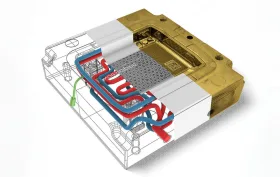
Unoptimised thermal management of the insert can lead not only to dimensional deviations but also to visible lines around functional features and openings. This often results in a higher reject rate as well as a longer cycle time due to process-related adjustments. The application of variotherm temperature control concepts offers the advantage of more precise control of the cooling process in the mould, thereby influencing shrinkage and surface quality. However, with a conventional arrangement of drilled cooling channels, this change in temperature control concept usually leads to a longer cycle time due to the additional heating phase.
 |
|
Integrating textures into the surface of a plastic part is another way to increase product value. Premium surface patterns can be used to specifically tailor both the look and feel. Here, variotherm temperature control enables targeted local adjustment of the cavity temperature for improved injection moulding or shaping of various surface structures and textures. This is particularly the case when the actual texture is overlaid with microstructures to incorporate invisible but readable information into the plastic product. A high level of precision is required to make this information readable, and this can be influenced by precise thermal management.
Plastics with fillers and additives can cause wear on the microstructure, so it needs to be protected. PVD coatings are ideal for this purpose.
voestalpine injection mould inserts
voestalpine High Performance Metals (HPM) presents a solution for plastic injection moulding, and the example of the voestalpine injection mould insert illustrates the complete value chain of manufacturing activities – from concept to final product.
 |
|
| Figure 1: voestalpine injection mould insert for a plastic cap (left) and the finished plastic part with a hologram effect and DigiMarc (digital watermark) hidden in the background texture (right) |
Applying an optimised procedure made it possible to completely eliminate flow lines on the plastic part and reduce cycle time by 18 %*. These improvements in the injection moulding process and part quality were made possible by variotherm temperature control of conformal cooling channels produced using additive manufacturing (3D printing). New design features, such as DigiMarc and a hologram, were achieved through texturing. The combination with a PVD coating ensured protection against wear and thus a long service life.
* Compared with the original conventionally manufactured insert.
Complete elimination of surface defects:
 |
 |
| Figure 2: Conventional temperature control (visible flow lines) |
Figure 3: AM – variotherm temperature control (no visible flow lines) |
 |
|
| Figure 4: Comparison of cycle times for a mould with conventional temperature control and a mould with AM – variotherm temperature control |
What exactly makes voestalpine injection mould inserts so unique?
To produce high-quality and technically complex parts, the required conditions must be met, and this is achieved through the precise coordination of every manufacturing process in the value chain. The quality of the individual process steps (such as additive manufacturing, texturing, surface treatment, etc.) and their seamless interaction are equally important. The injection mould insert for a plastic cap from voestalpine demonstrates the potential that can be achieved by combining state-of-the-art methods, from design and simulation through to manufacturing technologies and materials.
From optimised thermal management and sensor-based process monitoring to eliminate defects such as flow lines and increase productivity, through to unique wear-resistant surface texturing to integrate an invisible watermark (DigiMarc) – many of the insert's features and benefits are listed below.
The value chain for voestalpine injection mould inserts
The diagram below shows the entire value chain, starting with the selection of the right powder for additive manufacturing and ending with the final PVD coating. Improvements in the injection moulding process and in the quality of the plastic part are achieved through the interaction of the processes and the precise coordination of the individual steps.
 |
|
| Figure 5: Complete solutions within a single value chain for voestalpine injection mould inserts |
|
Depending on the design requirement, all individual process steps are available to create a voestalpine insert. Whether voestalpine HPM customers need just one process (such as a PVD coating) or the entire value chain for a customised solution, they have access to all technologies from a single trusted source.
A comprehensive presentation of all the processes listed in the value chain can be found on our website voestalpine HPM Slovakia here.
The manufacturing process for this insert can be summarised as follows:
1. Premium powders, additive manufacturing, heat treatment, machining and polishing
 |
|
| Figure 6: Mould insert printed on a 3D printer |
Using premium AM powder from the BÖHLER / Uddeholm brands and optimised process parameters, the insert was additively manufactured according to the design requirements (including the integration of conformal cooling channels) to achieve the highest possible part quality. Subsequent processing continued with optimal heat treatment in a vacuum hardening furnace. After heat treatment, the surface was machined to the required shape. Subsequent polishing, carried out by our experts from voestalpine eifeler Group, achieved a high-gloss surface finish. The basis for achieving a high gloss is the combination of powders and optimised AM process parameters.
2. Variotherm Temperature Control and Sensor Integration
 |
 |
| Figure 7: Conventional arrangement | Figure 8: Conformal arrangement |
The integrated conformal cooling channels follow the complex contours of the cavity walls, providing much more uniform heat removal compared with conventionally drilled cooling channels. A homogeneous temperature distribution in the cavity eliminates hot spots, minimises thermal stress and thus enables excellent part quality (elimination of flow lines) and shorter cycle times.
The conformal cooling arrangement in the insert was optimised for variotherm temperature control – with an enlarged heating area and minimised distances between the cooling channels and the cavity walls. By enabling rapid heating of the cavity walls, flow lines were eliminated from the surface of the injection-moulded part, and fine surface textures (such as a hologram) could be reproduced consistently.
Using patented voestalpine HPM technology, two thermocouples were integrated into the insert, enabling real-time monitoring, as shown below, to ensure part quality and allow optimal switching between heating and cooling.
3. Temperature Control and Sensor Monitoring
 |
 |
| Figure 9: Two thermocouples integrated into the mould insert | Figure 10: Conventional vs. variotherm temperature control |
The conformal cooling channel configuration in the cavity insert enables variotherm temperature control (70/140 °C). The increased temperature at the flow front in the variotherm process eliminates flow lines.
Despite variotherm process control, the cycle time can be reduced by 18 % compared with the conventional process (conventionally manufactured insert).
The two thermocouples integrated into the demonstration insert are shown in green in the figure above. One sensor measures the mould wall temperature in the flow-line areas; the other sensor measures the hologram structure area. These precisely positioned sensors enable real-time measurement of the heating and cooling phases, allowing the injection moulding process to be optimised to eliminate defects and reduce cycle time. The patented sensor integration process allows thermocouples to be positioned close to the cavity wall without adversely affecting the cooling channel design.
4. Texturing and PVD Coating
 |
|
| Figure 11: Mould with a background texture and an integrated digital watermark (left) and a hologram effect engraved on the mould surface using femtosecond laser technology (right) |
Thanks to the expertise of voestalpine Eschmann Textures the insert was processed using femtosecond laser technology to create a visually appealing background surface texture into which a digital mark is integrated. The digital watermark can be used to integrate invisible information into the surface of plastic products.
DigiMarc has versatile applications, ranging from integrating recycling information directly into the surface of a part to protection against counterfeiting. In this case, DigiMarc was used as a link to a website where the customer can find further information about the project.
Femtosecond laser technology also enables the engraving of extremely precise fine structures into the mould surface, such as the hologram effect (shown in the figure above), which highlights the logo: voestalpine – one step ahead.
These fine surface structures utilise the phenomenon of diffraction, in which light waves incident on the structures are scattered rather than reflected in only one direction. Depending on the position of the observer and the light source, the light is refracted into different spectral colours.
The polymer used – PC/ABS with flame-retardant and UV-protection additives – requires the fine structure to be protected against wear. The precision of the hologram can only be maintained throughout the tool's service life through the precise interaction of the coating and texture, combined with conformal cooling temperature control and sensor-based process monitoring. The voestalpine coating TiN-ultrafine provides high wear protection and high surface quality, while the CHROME-X coating allows the gloss level and the highest surface quality of the plastic part to be maintained.
This hologram effect can be moulded onto the surface of the part using the injection moulding process. In addition to countless creative optical applications, the hologram effect can also be used for security purposes.
Are You Ready to Increase Efficiency and Add Value to Your Injection-Moulded Products?
The Voestalpine insert for plastic injection moulds demonstrates a complete solution within a single value chain – from concept to finished product. Our solution not only enables improvements to the injection moulding process through features such as conformal AM cooling design and variotherm temperature control, but also allows value to be added to products through technologies such as texturing and PVD coating (DigiMarc and the hologram effect).
If you would like further information, contact us.
-

voestalpine High Performance Metals Slovakia, s.r.o.
Market leader for special steels, tool steels and other value-added services such as heat treatment and PVD coating.


Trends in plastic injection moulding: venting structures
7.2.2025 In plastic injection moulding, most of the venting takes place through the parting planes. However, conventional venting solutions are often not sufficient, resulting in low injection efficiency and part quality problems.
Most read in the last 7 days
-
Polymer prices - october price increases partly successful, with minor corrections expected in the week ahead
-
Long-lasting solution: Radiation-crosslinked PE-Xc pipes for drinking water supply
-
Polymer prices – the increase in olefin monomer contract prices in October was in line with expectations
-
Polymer prices - Year-End Polymer Price Scenarios
-
Plastica-expo 26





Most read in the last 7 days
-
Polymer prices - october price increases partly successful, with minor corrections expected in the week ahead
-
Long-lasting solution: Radiation-crosslinked PE-Xc pipes for drinking water supply
-
Polymer prices – the increase in olefin monomer contract prices in October was in line with expectations
-
Polymer prices - Year-End Polymer Price Scenarios
-
Plastica-expo 26