


Ing. Lubomír Zeman: Melt flow index and its use in thermoplastic injection moulding technology - theory and practice part 5
The concept of degradation can also be linked to the concept of stabilisation. For example, a quality auditor may ask whether long-term storage of polymer materials can lead to a deterioration in their properties as a result of ageing. One possible answer to such a question is a reference to the work by Shenoy, A.V, Saini, D.R.: Melt Flow Index: More Than Just A Quality Control Rheological Parameter, Advances in Polymer Technology, 10/2017. The authors found that mechanical properties such as tensile strength at yield, tensile strength and elongation at break, as well as dielectric and electrical properties, changed very little during 13 years of storage of unstabilised and stabilised LDPE (low-density polyethylene). The most pronounced change during this period was in the MFI value. Figure 19 shows that, for the unstabilised material (LDPE – I), the change in MFI is more or less linear up to a storage time of approximately 17 years. For the stabilised material (lDPE – II), only a slight decrease in MFI is observed over the 17-year period. The changes in MFI values can be attributed to oxidation and crosslinking.
 |
|
| Fig. No. 19 : Dependence of the change in MFI on storage time ( years ) for LDPE |
The previous paragraph mentions the concept of crosslinking. This term refers to the interconnection of polymer chains to form a three-dimensional network. In general, crosslinking reduces the solubility of polymers (in solvents they only swell, increasing their volume), and they lose their meltability and thermoplasticity. Conversely, their dimensional stability at elevated temperatures increases, and in some cases their resistance to chemicals also improves. The denser the polymer network, the more difficult it is for low-molecular-weight substances to penetrate it, and the lower its tendency to swell and absorb moisture.
Crosslinking reactions can also be assessed by the change in MFI, as shown in Figure 20.
 |
|
| Fig. No. 20 : Dependence of the change in MFI on crosslinking temperature and time for PPS |
A characteristic property of almost all thermoplastics is their greater or lesser ability to absorb low-molecular-weight substances from their surrounding environment or release them into that environment. This applies particularly to moisture, or more specifically to the water content of the granules or within the moulded part.
To illustrate the statement above, I will give several examples of the equilibrium moisture content by volume as a percentage, i.e. the moisture saturation state at a temperature of 25 °C and a relative humidity of 50 %, for selected thermoplastics – PP, PE, PS < 0,10 %, PC 0,15 %, PC/ABS, PET 0,20 %, PBT 0,25 %, ABS 0,45 %, PMMA 0,60 %, PA 66 2,50 % to 3,50 %, PA 6 2,8 % to 3,6 %.
The absorption of water directly from a liquid is called water absorption, while uptake in the form of vapour, for example from the air, is called moisture absorption; we usually speak of the moisture absorption of plastics. Moisture absorption is a reversible process, meaning that granules or moulded parts made from hygroscopic thermoplastics absorb moisture in a humid environment and, conversely, dry out in a dry environment. This is a diffusion process in which water molecules spontaneously move from an area of higher concentration – the surrounding environment – to an area of lower concentration – the granules or moulded part – and vice versa.
 |
|
The moisture content of granules before processing is a very serious issue in the injection moulding of thermoplastics. Even a very small water content usually causes both a deterioration in the mechanical properties of moulded parts and, in particular, surface defects – silver streaking, uneven gloss, matting, local changes in colour shade and marks left by escaping steam. Wet material can rapidly degrade in the plasticising barrel of the injection moulding machine – hydrolytic degradation – and bubbles may appear, especially in moulded parts with thicker walls. It must also be borne in mind that the volume and weight of moulded parts change with their moisture content, adversely affecting their shape and dimensional accuracy and the stability of their dimensions and shape (moisture absorption is a reversible process).
A polymer melt with a moisture content higher than the limit permitted by the pellet manufacturer also has greater flowability, a higher MFI value and a lower viscosity, which can lead to flash at the parting lines of the injection mould. The reason for this is that the viscosity of polymers is a function of the polymer's relative molecular mass. As the relative molecular mass decreases due to the low-molecular-weight liquid, water, hydrolytic degradation of the polymer occurs, and thus, as the chains become shorter, the polymer's viscosity decreases and the melt flow index values increase. We will illustrate this using the example of a highly hygroscopic material, the polyester PET, in Figure 21. At a lower moisture content, one material reaches an equilibrium melt flow index level below 0.035 % (blue curve), while the other still shows a slight change at a lower moisture content and reaches equilibrium below 0.02 % moisture. In general, the MVR value as a function of moisture increases with increasing moisture content.
 |
|
| Fig. 21 : Typical dependence of melt volume-flow rate on moisture content as a percentage for two types of PET |
I have already mentioned biodegradability, and in connection with the pressure to use injection moulding materials with this property, it must be stated that, in addition to their positive properties, these materials also have a number of shortcomings, one of which is hydrolytic degradation. The technical literature provides the following values for PHB (polyhydroxybutyrate, from renewable sources, biodegradable) - before hydrolysis, the melt volume-flow rate was (21.0 +/- 2.2) cm3/10 minutes under the test conditions, and after hydrolysis had ended, following 60 hours of exposure to water, the MFI value was (229 +/- 9) cm3/10 minutes under the same conditions. The MVR value increased more than 10-fold during hydrolytic degradation, indicating a significant reduction in molecular mass.
Naturally, the change in melt flow index due to moisture also applies to composite materials, as shown in Figure 22, which illustrates the change in melt mass-flow rate MFR as a function of hydrolysis time for different melt temperatures at 95% relative humidity, for the material PBT GF 30.
 |
|
| Fig. 22 : Change in melt mass-flow rate MFR as a function of hydrolysis time ( h ) for different melt temperatures at 95 % relative humidity, material PBT GF 30 |
|
Moisture contained in the pellets or in a moulded part made from a hygroscopic material results in a reduction in both physical and mechanical properties. One result of this negative effect can be seen in Figure 23 a, b, which shows tensile stress as a function of strain for test specimens made from PA66 (Ultramid A3K). Figure 23a relates to dried material – 80 °C/10 hours, while Figure 23b shows the curves for pellets that have absorbed moisture. The material datasheet for this polyamide provides information on both flowability and moisture absorption – typical melt volume-flow rate according to ISO 1133 = 120 cm3/10 minutes (275 °C/5 kg), viscosity number (0.5 % in 96 % H2SO4) according to ISO 307, 1157, 1628 = 150 cm3/g, water absorption according to ISO 62 = 8% to 9%, moisture absorption at 23 °C and 50% relative humidity, according to ISO 62 = 2.5% to 3.1%.
 |
|
| Fig. 23 a,b : Tensile stress as a function of strain at different temperatures, PA 66 – a) dried , b) moisture-conditioned |
The graphs show a clear decrease in the tensile stress of the moisture-conditioned polymer material at the relevant measurement temperature. For example, the tensile stress of the dried material measured at a temperature of 23°C and an elongation of 4% reaches 85 MPa, whereas the tensile stress of the moisture-conditioned material, measured under the same conditions, is practically half that value, 40 MPa, meaning that the material has lost strength and stiffness but gained toughness. This phenomenon can be used with certain types of PA mouldings where toughness of the features is required during, for example, assembly, and stiffness after assembly. In such a case, conditioning can be used, whereby the moulding is exposed to water for a certain period, gains toughness (elongation, notched impact strength) and is subsequently dried. The increase in elongation at break and notched impact strength is shown in Table 3.
 |
|
| Table No. 3 : Increase in toughness after conditioning of polyamides |
Ultramid A3K, PA66 is a highly hygroscopic material; with such materials, it is sometimes impossible, even after prolonged drying, to achieve the residual moisture levels specified for processing, as shown in Figure 24.
 |
|
| Fig. No. 24 : Effect of drying time on the melt flow index of PA 66 Ultramid A3K |
For such materials, which also include PC, for example, it is essential not only to dry them thoroughly before processing but also to prevent the dried material from coming into contact with an environment with higher relative humidity, to avoid further moisture absorption. This applies, for example, to cases where the injection moulding process is interrupted for an extended period for some reason and the injection moulding machine is not equipped with a drying hopper or is not supplied with granules centrally, or where the entire volume of purchased, pre-dried material is not processed.
A range of dryers is available on the market for drying hygroscopic granules:
- dryers with natural circulation of heated air
- dryers with forced circulation of heated air
- dryers with forced circulation of heated air
- vacuum dryers
- compressed-air dryers
Of the dryers listed, only the last three are suitable for thorough and economical drying.
Residual moisture content is a very important parameter when processing hygroscopic thermoplastics – slightly hygroscopic: equilibrium water content ranges from 0.1% to 0.5%, for example HI-PS, SAN, ABS, PET, PBT, PC; moderately hygroscopic: from 0.6% to 2.0%, for example POM, PMMA, PA+SV, plasticised PVC, PA 11, PA12; highly hygroscopic: greater than 2%, for example CA, CAB, CAP, PA 6, PA 66, PA 610, PA 46 – and, as already mentioned, before a particular material is actually processed, it must be prepared and dried to below the permissible residual moisture level, which should be measured to enable prompt adjustments to the injection moulding process itself as well as the drying process.
Methods for determining the water content of a polymer are specified in the standards ČSN EN ISO 15512 (Plastics - Determination of water content) and ČSN EN ISO 960 (Plastics - Polyamides - Determination of water content). These standards specify methods for determining the water content of plastics in granular form or as finished products, each intended for different levels of water content determination:
- extraction with anhydrous methanol – residual moisture content of 0.1% and above - an extraction method based on the use of anhydrous methanol and subsequent titration of the water using the Karl-Fischer method
- evaporation of water - 0.01% and above – the method is based on the principle of evaporating water using heated dry air or nitrogen, followed by determination of the collected water by Karl-Fischer titration
- manometric method - 0.01% and above - the principle of the method is a chemical reaction of the water contained in the polymer with a chemical reagent, calcium hydride CaH2 - the Aquatrac instrument from the German company Brabender
- method based on the thermogravimetric principle – this instrument operates on the thermogravimetric principle, whereby, at the start of the measurement, the moisture analyser determines the mass of the sample (the minimum sample mass is 10 g), which is then rapidly heated by a built-in halogen heating module, causing moisture to evaporate from the polymer sample. During drying, the instrument continuously determines the mass of the sample (the current moisture loss is shown on the instrument's display), and once drying is complete, the final residual moisture content is displayed.
Conclusion
As already stated - the melt flow index is defined in terms of how it is measured - as the mass or volume of the material being evaluated that flows through a die of defined shape and dimensions over a period of 10 minutes, under a given load and at a temperature relevant to the granules being evaluated.
MFI is not suitable for describing the behaviour of polymer melts, but it is a relatively simple processing test, which we recognise is carried out at substantially lower shear rates than those achieved in the actual injection moulding process when filling mould cavities with polymer melt, yet it is suitable, for example, for use in:
- comparing materials with one another in terms of their flowability
- assessing the quality of a delivered batch of granules
- assessing the quality of the production process
- designing the gating system of injection moulds
- designing the geometry of the moulding
- recognising certain limitations in the application of plastics
- etc.
End of the fifth and final part.
You can find the first part here.
You can find the second part here.
You can find the third part here.
You can find the fourth part here.
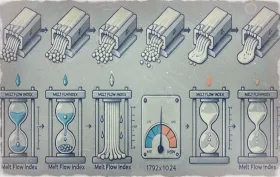
Illustrative photo: AI
-

Jiří Češka, Nástrojárna Příbram
Production of injection molds, cutting and stamping tools, CNC machining, electric discharge machining, laser welding.

Suppliers on this topic
-
Plasted spol.s r.o.
Plastic processing, production of plastic products, production of plastic windows, plastic window profiles, plastic… -

KOH-I-NOOR MACHINERY a.s.
Development and production of tools, injection molds, blow molds, plastic injection, blow molding machines for… -

Mateja Plasty, s.r.o.
Processing of thermoplastics and thermosetting plastics using injection molding, extrusion and blow molding. -

Elektroplast výrobné družstvo Prešov
Production of plastic products, injection, vacuuming of plastics, plastic technical moldings, household goods. -

Extruindustrie CR s.r.o.
Extrusion of plastics, production of plastic profiles, plastic profiles, boards, rods and others, plastic and rubber… -

JASPLASTIK-SK spol. s r.o.
Plastic components for the automotive, electronic and industrial markets, plastic molding, assembly, painting, PVD…


ALLROUNDER e TREND: ARBURG Sets a new standard in electric injection moulding machines
21.9.2026 Rising energy costs, pressure to improve production efficiency and a shortage of skilled workers are changing how plastics processors assess new investments. ARBURG is responding to these trends with the launch of its new ALLROUNDER e TREND series...


Most read in the last 7 days
-
Polymer prices - october price increases partly successful, with minor corrections expected in the week ahead
-
Long-lasting solution: Radiation-crosslinked PE-Xc pipes for drinking water supply
-
Polymer prices – the increase in olefin monomer contract prices in October was in line with expectations
-
Polymer prices - Year-End Polymer Price Scenarios
-
Plastica-expo 26





Most read in the last 7 days
-
Polymer prices - october price increases partly successful, with minor corrections expected in the week ahead
-
Long-lasting solution: Radiation-crosslinked PE-Xc pipes for drinking water supply
-
Polymer prices – the increase in olefin monomer contract prices in October was in line with expectations
-
Polymer prices - Year-End Polymer Price Scenarios
-
Plastica-expo 26