

Trends in plastic injection moulding: venting structures
What are the main venting problems in plastic injection moulding?
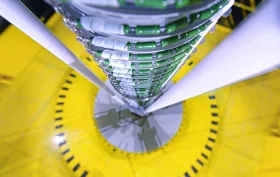
At the start of the injection phase, the mould cavity is filled with air. During plastic injection, the air is displaced by the melt towards the end of the filling path. Vents are needed to prevent air from remaining trapped inside. Several defects can arise as a result of inadequate venting.
An air pocket at the end of the filling path can prevent the mould cavity from being completely filled with melt. This results in an incomplete part, known as a “short shot”. If an air pocket is trapped between two melt streams, the mechanical properties of the resulting weld line can be significantly reduced.
Trapped air can overheat due to high injection pressures and high injection speeds (> 1 000 °C). This can cause the plastic melt to burn, leaving a black burn mark on the part. The mixture of trapped air and combustion gases can also burn. It can damage not only the plastic material, but the overheated air can also burn the mould steel. Depending on the compound being injected, the gases generated during combustion can be aggressive and cause erosion and corrosion of the tool steel.
 |
|
| Figure 1: Examples of problems with conventional venting solutions |
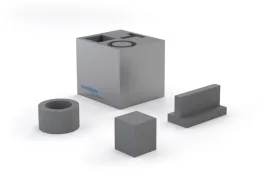
Traditionally, the venting system is created through gaps between mould components. The main venting point is the mould parting plane, where air can escape through channels created by the mould manufacturer. However, venting is also achieved at the parting planes between mould cavity inserts and through the clearance between ejector pins and cavity inserts.
Standard components with active and passive venting are also available. Sintered porous plugs are an example of passive venting, but they have limitations, whether in manufacturing (complexity of the part geometry, etc.) or in the performance characteristics of sintered porous materials. The performance issues are:
-
Low hardness,
-
Non-uniform porous morphology,
-
Corrosion (material that is not corrosion-resistant).
voestalpine HPM offers a better solution
If you are looking to solve venting problems, voestalpine HPM offers a better solution. Additively manufactured venting inserts are designed to overcome venting problems inside the cavity and provide excellent performance.
 |
|
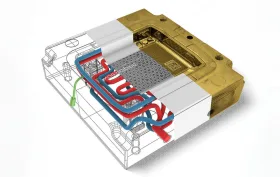
| Figure 2: voestalpine Venting Structures – illustration of the main function |
Our additive manufacturing approach enables venting at the end of the filling path independently of the parting plane or ejector position. The venting structure can be integrated directly into the insert.
What are the main advantages of voestalpine venting structures?
Venting structures offer the following significant advantages over conventional solutions:
-
Increased gas flow
-
Reduced scrap rate / Defect prevention
-
Reduced injection pressure / Energy savings
-
Increased corrosion resistance
-
Higher hardness leads to better wear resistance
-
Longer service life
-
Easy maintenance
They are custom-made from premium BÖHLER/ Uddeholm materials for the specific plastic injection moulding operation, in three different densities: low, medium and high.
Customised solutions include:
-
Design optimised to meet requirements
-
Powder optimised for the specific application
-
Optimised printing with the highest possible quality, reliability and efficiency
-

voestalpine High Performance Metals Slovakia, s.r.o.
Market leader for special steels, tool steels and other value-added services such as heat treatment and PVD coating.


DESMA Elastomertechnik's global mold and cold runner production achieves record sales in 2024
27.1.2025 Klöckner DESMA Elastomertechnik GmbH, headquartered in Fridingen an der Donau, has been developing molding processes for sophisticated rubber and silicone articles of various sizes for almost six decades. One of DESMA's key competencies is that it...
Most read in the last 7 days
-
Polymer prices - october price increases partly successful, with minor corrections expected in the week ahead
-
Long-lasting solution: Radiation-crosslinked PE-Xc pipes for drinking water supply
-
Polymer prices – the increase in olefin monomer contract prices in October was in line with expectations
-
Polymer prices - Year-End Polymer Price Scenarios
-
Plastica-expo 26






Most read in the last 7 days
-
Polymer prices - october price increases partly successful, with minor corrections expected in the week ahead
-
Long-lasting solution: Radiation-crosslinked PE-Xc pipes for drinking water supply
-
Polymer prices – the increase in olefin monomer contract prices in October was in line with expectations
-
Polymer prices - Year-End Polymer Price Scenarios
-
Plastica-expo 26