


Nordson EFD: Why Size Matters in Fluid-Based Assembly Applications
Dispensing requires the delicate balance of fluid properties and operational output
Choosing the right dispensing technology requires striking a delicate balance between a fluid’s physical properties and the demands of a manufacturer’s operational output, such as throughput and precision requirements. Optimizing this pairing prevents costly material waste, process interruption and downtime. Automated dispense systems also bridge the gap between fluid properties and production demands by eliminating operator variability and delivering the exact fluid shot size at the same location, time after time, to radically increase efficiencies.
Size is fundamental, not optional
In assembly production, size matters. Finding the right size fluid dispensing components is not optional. It is fundamental. To place an accurate bead of fluid, size selection is critical for single-use plastic components like dispense tips used with hand-held dispensers or the most sophisticated automation systems. Serving as the “point-of-dispense,” dispense tips also come in a multitude of styles, lengths, and outer/inner diameters.
|
|
|
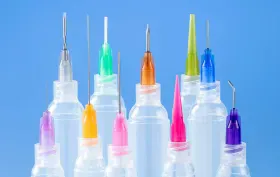
Nordson EFD’s engineered dispensing tip styles range from 14 ga to 37 ga to accommodate a wide range of assembly fluids with unique viscosities. |

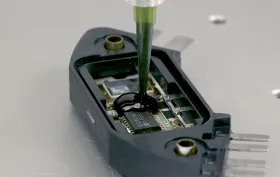
Tips are instrumental in controlling how a fluid leaves a syringe barrel or valve as it is deposited onto a substrate. The miniaturization of products, especially in the medical and electronics space, has created demand for even smaller, more precise tips to dispense without overflow in hard-to-reach areas.
A customer’s unique assembly application always drives the sizing requirements. If the manufacturer is assembling thousands of parts a day versus a few hundred, a cartridge may be another option for the dispensing system. Formulators of fluids like epoxies and adhesives typically package this material in either a syringe barrel or cartridge when working with a single or pre-mixed fluid. Syringe barrel volumes range from 3cc to 70cc and cartridges vary from 2.5 fl oz to 32 fl oz. The upper volume range in syringe barrels, such as the popular 70cc size, provides the flexibility needed to add more fluid capacity to each cycle, which translates to less downtime as the fluid body is switched out less frequently.
|
|
|
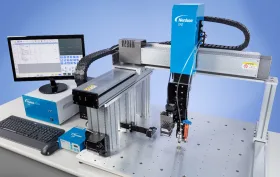
The vision-guided GV Series gantry robot can work as a standalone dispensing system or for fully automated, conveyer-fed assembly production. The configuration includes an engineered needle valve and tip for precision fluid dispensing in an electronics application. |

For smaller batch dispensing, syringe barrels may be the better fit. A general rule of thumb is to dispense fluid containers from full-to-empty in any given shift, achieving maximum value-dispensing to the very last deposit. This practice reduces fluid waste and saves money on syringe barrel or cartridge usage.
Keeping assembly operations top of mind
The sizing principles outlined for fluid dispense applications shine a light on the path toward constructing highly engineered parts and products with confidence and quality. The surge in demand for next generation products − sensors, semiconductors, smart medical devices and fiber optics − has manufacturers rethinking their production models.
|
|
| The vision-guided GV Series gantry robot can work as a standalone dispensing system or for fully automated, conveyer-fed assembly production. The configuration includes an engineered needle valve and tip for precision fluid dispensing in an electronics application. |

The competitive reality for OEMs and contract manufacturers lies in prioritizing assembly processes much earlier in the product development cycle to streamline time to market. Getting ahead of the process control curve simply saves time and money in the long run.
-

Nordson EFD
Precision liquid dosing devices, EFD dosing devices, liquid dispensers, dosing tips, liquid reservoirs, static mixers and cartridges, valve dosing…
Suppliers on this topic
-

Flumasys s.r.o.
Authorized distributor of Nordson, manufacturer of dosing systems, technologies for regeneration of industrial… -

ZP Polymers, s.r.o.
Injection molds, compression molds, dosing systems, epoxy resins, sealing and insulating materials, insulation… -

1.PLASTCOMPANY, spol. s r.o.
Horizontal and vertical injection molding machines, extruders and extrusion lines, extrusion tools, material conveyors… -

DRÄGER CZ s.r.o.
Machines for plastics processing, Blow molding machines, extrusion lines, regranulation extrusion lines, thermoforming…


Dispensing tips for industrial applications from Flumasys – dispense with precision
14.10.2026 Inconsistent dispensing, adhesive dripping, or a clogged tip can disrupt work and increase material consumption. Choosing the right dispensing tip can be the first step towards solving these problems. Find out what to consider when selecting a tip...
Most read in the last 7 days
-
Polymer prices - october price increases partly successful, with minor corrections expected in the week ahead
-
Polymer prices – the increase in olefin monomer contract prices in October was in line with expectations
-
Plastica-expo 26
-
Long-lasting solution: Radiation-crosslinked PE-Xc pipes for drinking water supply
-
Polymer prices - Year-End Polymer Price Scenarios







Most read in the last 7 days
-
Polymer prices - october price increases partly successful, with minor corrections expected in the week ahead
-
Polymer prices – the increase in olefin monomer contract prices in October was in line with expectations
-
Plastica-expo 26
-
Long-lasting solution: Radiation-crosslinked PE-Xc pipes for drinking water supply
-
Polymer prices - Year-End Polymer Price Scenarios