


Stepanek3D: Additional processing of 3D printing products
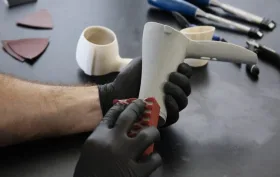
The final product may still require additional finishing and processing after printing to achieve the desired quality and functionality.
Why is post-processing important?
Although 3D printing offers many advantages, including speed, flexibility and the ability to create complex geometries, the print result is not always flawless. Several factors can affect print quality, including the material used, print settings and model design. Although modern printers can achieve high precision, imperfections may occur, such as visible layers, hatching, build plate texture, lower detail resolution and so on. Post-processing makes it possible to eliminate or improve these shortcomings and enhance the quality and aesthetics of the final product.
Methods for post-processing 3D prints:
1) Surface finishing
Surface finishing is one of the most common methods of post-processing 3D-printed products. Fine sanding and polishing can significantly improve the aesthetics and surface roughness of printed parts. Using various abrasive materials and techniques, it is possible to achieve a professional appearance regardless of the material used. Putty or spray filler is usually used as a base for further sanding and painting. However, this is a time-consuming process that also requires manual skill and various tools.
 |
|
| Surface finishing of 3D-printed products |
2) Painting and lacquering
Painting and lacquering are not merely aesthetic treatments; they can also protect the product from damage and improve its overall durability. Different types of paints and lacquers can be used to achieve a wide range of appearances and surface finishes.
 |
|
| Painting and lacquering of 3D-printed products |
3) Chemical treatments
Some materials, such as ABS, can be chemically treated with acetone to obtain a smoother surface. This process, known as acetone smoothing, dissolves the surface layers of the material, creating a smoother, glossy surface.
 |
|
| Chemical treatments of 3D-printed products |
4) Electroplating
Metallisation and electroplating methods can be used to give printed parts a metallic appearance. These processes deposit a thin layer of metal onto the surface of printed parts, achieving a metallic appearance. Copper or nickel, or alternatively chromium, is usually used. More information can be found on our subpage.
 |
|
| Electroplating of 3D-printed products |
5) Mechanical machining
In addition to surface finishing, mechanical machining can also be carried out, such as CNC machining of prints or machine grinding, drilling and so on. These operations are mainly used to improve the precision of critical areas of a part or to enhance its aesthetics. More information can be found here.
 |
|
| Mechanical machining of 3D-printed products |
6) Installing threaded inserts
Whether metric, pipe or other types of threads available in the form of threaded inserts, we can integrate them into our plastic products by heat insertion.
 |
|
| Installing threaded inserts |
Post-processing 3D-printed products is a step towards achieving optimal results. Using these methods and techniques, printed parts can be transformed into professional, functional products that meet even demanding standards.
Whether the aim is aesthetic enhancement or improved functionality, post-processing is the key to success in the world of 3D printing. When selecting a post-processing method, it is important to consider the specific requirements and properties of the product to achieve the optimal result. Ultimately, post-processing is not just a necessity but also an opportunity to further refine and personalise the final product. If you need advice or would like us to carry out post-processing of your prints, please feel free to contact us.
By following these key maintenance principles, you can ensure that your FDM 3D printer operates at maximum performance and achieves a long service life, resulting in a stable and reliable production process.
Instructions and recommendations for specific machines are usually provided directly in the manuals or on the manufacturers' websites. If you need help with servicing or maintaining your 3D printer, you can contact us.
-

3D Tlač - Stepanek3D
3D scanning, 3D printing, editing of 3D models, plastic atypes, custom production, small series production, production of plastic prototypes.


Trends in plastic injection moulding: venting structures
7.2.2025 In plastic injection moulding, most of the venting takes place through the parting planes. However, conventional venting solutions are often not sufficient, resulting in low injection efficiency and part quality problems.
Most read in the last 7 days
-
Polymer prices - october price increases partly successful, with minor corrections expected in the week ahead
-
Long-lasting solution: Radiation-crosslinked PE-Xc pipes for drinking water supply
-
Polymer prices – the increase in olefin monomer contract prices in October was in line with expectations
-
Polymer prices - Year-End Polymer Price Scenarios
-
Plastica-expo 26




Most read in the last 7 days
-
Polymer prices - october price increases partly successful, with minor corrections expected in the week ahead
-
Long-lasting solution: Radiation-crosslinked PE-Xc pipes for drinking water supply
-
Polymer prices – the increase in olefin monomer contract prices in October was in line with expectations
-
Polymer prices - Year-End Polymer Price Scenarios
-
Plastica-expo 26