


Stepanek3D: Using generative design for conventional technologies
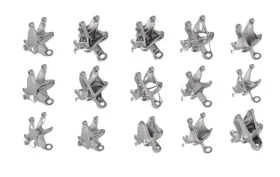
A brief overview of applications for conventional technologies
Generative design in Fusion 360 enables design with the following manufacturing technologies in mind:
a) CNC machining (CNC Machining)
-
CNC machining is one of the most widely used conventional manufacturing technologies in combination with generative design. The resulting designs are optimised for efficient machining and minimise material use, leading to cost and time savings.
-
Suitable for manufacturing parts from both metals and plastics.
b) Casting / injection moulding of parts (Casting)
-
Generative design can create designs optimised for casting, which is ideal for high-volume production of metal or plastic parts. The software designs complex shapes.
-
This technology is suitable for products that have complex geometries and require series production.
c) Sheet metal parts (Sheet Metal)
-
Fusion 360 includes generative solutions for manufacturing sheet metal parts, optimising designs for processes such as bending, laser cutting and welding. The software can create designs that are suitable for straightforward manufacturing using available sheet metal technologies.
 |
|
| Fusion 360 generative design |
Generative design inputs and outputs
Inputs:
-
Loading criteria: Physical forces and loads to which the product will be subjected.
-
Material properties: Material selection is important for strength and weight optimisation. Custom material profiles can also be created.
-
Manufacturing constraints: Such as the available axes for CNC machining, sheet thickness, or the minimum and maximum dimensions of the part.
-
Spatial constraints: Defining the volume or region within which the part must be manufactured.
Outputs:
-
Optimised designs: Fusion 360 offers multiple solutions optimised for various parameters (e.g. weight, strength, manufacturing costs, etc.).
-
3D models: The outputs are 3D models in various formats that can be used directly in the manufacturing process (e.g. formats for CNC machining).
-
Simulations and analyses: Before manufacturing, strength and mechanical analyses can be performed to verify the calculation against the design objectives and the selected factor of safety.
Benefits of using generative design for conventional technologies
-
Material savings: Generative design optimises the amount of material used, saving costs and reducing product weight.
-
Shorter development cycle: The automated design process saves the time needed to create complex designs.
-
Design innovation: Enables the creation of shapes and geometries that could not be designed efficiently using traditional methods.
-
Integration with manufacturing technologies: Fusion 360 provides outputs ready for direct manufacturing on CNC machines, for sheet metal parts, or for additive technologies.
 |
 |
| Benefits of using Fusion 360 generative design for conventional technologies | |
Generative design in Autodesk Fusion 360 offers extensive possibilities for optimising designs that can be manufactured using traditional technologies, such as CNC machining, casting or sheet metal fabrication. The calculation allows us to design the ideal geometry on the first attempt (traditional engineering design methods are usually less efficient and involve trial and error), taking the calculation objectives into account.
At STEPANEK3D, we can help with implementing the entire design process, from defining boundary conditions through running the calculation to selecting suitable solutions and subsequent work with the calculated models, such as verification through analyses, parametric remodelling and preparation of technical documentation. You can find more about model optimisation here.
-

3D Tlač - Stepanek3D
3D scanning, 3D printing, editing of 3D models, plastic atypes, custom production, small series production, production of plastic prototypes.

Suppliers on this topic
-

Schier Technik Slovakia s.r.o.
Autorizovaný predajca 3D CAD systém SolidWorks a CAM systém SolidCAM, inžinierske a projekčné služby CAD/CAM, 3D… -

OSMOS s.r.o.
ERP software, 3D design of plastic products, simulation of plastic injection, plastic press, plastic injection… -

SMARTPLAST s.r.o.
Analysis of plastic injection, technological design of plastic parts, simulation of plastic injection, Moldflow… -

Kasko spol. s r.o.
Development and injection of plastic moldings, construction, production of molds and tools, plastic press, plastic… -

Esox-plast s.r.o.
Design and production of plastic moulds, injection moulding -

Injection and tooling Engineering, s.r.o.
Technical partner for the development of injection-moulded parts, injection moulds and processes – from part design to…


AI in maintenance: How to turn data and human expertise into practical support for manufacturing
2.11.2026 Predictive maintenance, access to know-how, and faster troubleshooting. The panel discussion showed that the real value of artificial intelligence in industrial maintenance lies not only in predicting failures, but also in how companies work with...
Most read in the last 7 days
-
Polymer prices - october price increases partly successful, with minor corrections expected in the week ahead
-
Polymer prices - Year-End Polymer Price Scenarios
-
Long-lasting solution: Radiation-crosslinked PE-Xc pipes for drinking water supply
-
Polymer prices – the increase in olefin monomer contract prices in October was in line with expectations
-
Plastica-expo 26




Most read in the last 7 days
-
Polymer prices - october price increases partly successful, with minor corrections expected in the week ahead
-
Polymer prices - Year-End Polymer Price Scenarios
-
Long-lasting solution: Radiation-crosslinked PE-Xc pipes for drinking water supply
-
Polymer prices – the increase in olefin monomer contract prices in October was in line with expectations
-
Plastica-expo 26