


Ing. Lubomír Zeman – Renowned author in the plastics industry publishes his fourth technical book Vstřikování plastů 3
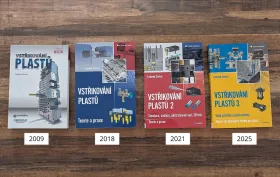
Thermoplastic injection moulding technology, in all its variants, plays a fundamental and indispensable role among plastics processing technologies.
The operating principle of plastics injection moulding technology is essentially simple. The required quantity of the material being processed, in the form of a polymer melt, is injected by a screw or plunger from the plasticising chamber of the injection moulding machine into the closed cavity of the injection mould. Subsequently, as heat is removed, the melt solidifies and the moulding is ejected from the mould cavity and removed for any further processing.
Compared with other plastics processing methods, the advantages of thermoplastic injection moulding technology include:
- a significant reduction in production cycle time
- the ability to produce integrated components with a wide variety of shapes
- the ability to produce mouldings with reproducible properties, including shapes and dimensional tolerances, as well as a very good surface finish
- design flexibility that allows a reduction in surface finishing and assembly operations
The main disadvantages of thermoplastic injection moulding include:
- relatively high investment costs, particularly for injection moulds
- relatively long lead times for manufacturing injection moulds
- a more complex technological process which, due to the greater number of production factors involved, creates greater processing challenges
- higher qualification requirements for process engineers, setters, production operators, quality personnel, etc.
The author's earlier books on Plastics Injection Moulding, published in 2009 – 238 pages, 2018 – 455 pages and 2021 – 447 pages, covered thermoplastic injection moulding technology in its full breadth: plastics for injection moulding technology, moulding shrinkage, prerequisites for injection moulding parts of defined quality, setting up and optimising the injection moulding process, production of initial mouldings, drying of granules, venting of injection mould cavities, design for manufacturability of thermoplastic mouldings, measurement of mouldings, methods for testing and evaluating mouldings, Rapid Prototyping methods, injection mould design, mould temperature control, mould manufacture, mould maintenance and repairs, injection moulding of composite materials, emission and odour behaviour of thermoplastics, colour and gloss measurement, thermal analyses, plastics processing technologies, injection moulding methods, simulation software, 3D printing, moulding defects and their elimination.
This book (224 pages) seeks to help improve the qualifications of everyone involved in the production of thermoplastic mouldings. It provides a comprehensive summary and, from the entire spectrum of knowledge about thermoplastic injection moulding presented in the author's previous publications, briefly highlights the fundamentals, particularly – basic requirements for plastics suitable for injection moulding, characteristic temperatures of polymers, rheology of polymer melts, physical processes occurring in polymers during injection moulding, phases of the injection moulding process, the procedure for producing initial mouldings, optimisation of the injection moulding process, evaluation of moulding quality, troubleshooting in thermoplastic injection moulding.
The largest part of the book is devoted to the last-mentioned chapter – troubleshooting in thermoplastic injection moulding. In this chapter, three groups – mouldings produced by standard injection moulding, structural foam mouldings, and mouldings produced by multi-component injection moulding of thermoplastic elastomers TPE – cover 28, 11 and 17 defects respectively, the vast majority illustrated with photographs. The sections defect / cause of the defect / elimination of the defect outline possible approaches to eliminating each defect, allowing individual personnel to develop their own approach. The approach is further divided into defects caused by the injection moulding material M, injection moulding process parameters T, the injection moulding machine and its peripheral equipment S, P, the injection mould F and the moulding design V.
In conclusion – much has changed during the author's 49 years in the field of plastics injection moulding, but the principles of thermoplastic injection moulding technology described in this book have held true, hold true today and will continue to hold true, and therefore they need to be understood, which this book can help achieve.
Suppliers on this topic
-

Injection and tooling Engineering, s.r.o.
Technical partner for the development of injection-moulded parts, injection moulds and processes – from part design to… -

ISPE TECHNOLOGIES SE
High-quality series injection molds from China. More than 600 molds delivered. Exceptionally thorough and fast DFM and… -

Schier Technik Slovakia s.r.o.
Autorizovaný predajca 3D CAD systém SolidWorks a CAM systém SolidCAM, inžinierske a projekčné služby CAD/CAM, 3D… -

3M TRADE - PLASTIC PARTS s. r. o
Plastic molding, plastic injection, injection molds, molds, industrial robots, manipulators, grippers, EOAT components. -

IPA Slovakia, s.r.o.
Consulting for plastic and rubber production, accredited education in the field of plastics, training of operation and… -

PM AUTOMATION CZ s.r.o.
Complete solutions for industrial automation, robotics and machine vision. We support you every step of the way, from…




Modernisation of Industrial Machinery by Symtex Brno: How to Extend Equipment Life and Improve Production Efficiency
26.10.2026 In the plastics processing and recycling industries, production equipment is often expected to operate reliably for many years. However, as machinery ages, its performance, availability of spare parts and compatibility with modern control systems...
Most read in the last 7 days
-
Polymer prices - october price increases partly successful, with minor corrections expected in the week ahead
-
Long-lasting solution: Radiation-crosslinked PE-Xc pipes for drinking water supply
-
Polymer prices – the increase in olefin monomer contract prices in October was in line with expectations
-
Polymer prices - Year-End Polymer Price Scenarios
-
Plastica-expo 26




Most read in the last 7 days
-
Polymer prices - october price increases partly successful, with minor corrections expected in the week ahead
-
Long-lasting solution: Radiation-crosslinked PE-Xc pipes for drinking water supply
-
Polymer prices – the increase in olefin monomer contract prices in October was in line with expectations
-
Polymer prices - Year-End Polymer Price Scenarios
-
Plastica-expo 26