


History of the Czechoslovak plastics industry in interviews of witnesses (VII./VII.)
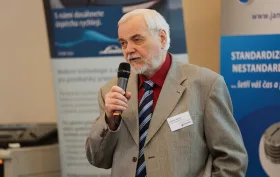
Let me start with the usual question. How did you get into plastics? Most of the veterans interviewed previously say it was more by chance.
More or less by chance, too. I graduated from the Faculty of Mechanical Engineering at ČVUT in Prague. After defending my thesis on extending the service life of metal forging dies, I went to ask at SVUM (the State Research Institute for Materials) whether they had a vacancy. There was no vacancy in the metallic materials department, but there was one in Počernice in the plastics injection moulding department. All I knew about plastics was that they were synthetic materials :-) That was in 1976.
The department was headed by Emil Neuhassel. Thermosets were becoming less attractive from an environmental perspective, and our research projects focused mainly on thermoplastics. In addition to applied research, we carried out basic research into plastics injection moulding; the academic council of the Academy of Sciences approved our projects.
 |
|
| Lubomír Zeman |
At first I worked on an old Engel machine. I am actually self-taught; I had to get hands-on experience with everything and study it all myself. My publishing and lecturing activities began in 1979; I wrote articles, for example, for the specialist journal Plasty a kaučuk. Thanks to basic research, I came into contact with some very interesting people; for example, I worked with Professor Wichterle on improving the production technology of the “contact lens machine”.
This year, the Uniplast association is celebrating 60 years since its foundation. You were not actually on the committee, but you actively participated in its activities. Uniplast operated nationwide, with its main focus on Moravia. What was the situation in the Czech part of the republic?
You could say there were two research centres here: in Prague, the State Research Institute for Materials, which dealt with discontinuous processes, namely injection moulding, and the Zlín region, which dealt with continuous processes, extrusion and blow moulding. And that gave rise to this kind of division, with Uniplast spanning both sides.
Until 1990, Emil Neuhassel and I ran training courses through the Scientific and Technical Society in Dobřichovice and Čelákovice. Uniplast operated in parallel with us. They gave talks at our conferences, and we gave talks at theirs – Jirka Gabriel, Láďa Bobčík, Ondra Kebrle. The Houses of Technology handled the organisation of conferences and seminars for us. As conference participants, we helped one another and pooled our experience. At all those meetings, apart from alcohol :-) it was about knowledge; each of us had a piece of it.
All the veterans speak of an unusual level of sharing technical information, which was a necessity in the socialist era.
I remember that when I first got to the K trade fair in Düsseldorf, I brought back 40 kg of paper brochures, because for us that was the only source from which we could learn about new developments.
Yes, we had access to Kunststoffe, Modern Plastics and one other foreign journal that the research institute received. Other companies, however, did not have access to these journals. So we made that information available to them.
Did you take part in similar lecturing activities in Slovakia?
As far as I remember, no similar conferences were held in Slovakia at all. Slovaks came to us in large numbers, from all those places such as Poprad, Snina, Košice and Nitra. They also came here to give talks. We wanted to do it for them too, because the pond was not all that big. We worked with universities in Bratislava and Košice, with Professor Almáši and with Associate Professor Horvát from VUNAR – the Tool Research Institute – who later became head of a department in Trnava. From a plastics industry perspective, things only really got going in Slovakia after the revolution, when foreign capital came in.
After 1989, everything took a different direction. Industry gained investors. What happened to the lecturing activities?
The hunger for information in the early nineties was still enormous. The Scientific and Technical Society broke up, many Houses of Technology ceased to exist, and even Uniplast was doing practically nothing. In 1992, I left SVUM, and Emil and I founded Plastform servis, which continued the previous training activities. I also began visiting companies and providing training for them. I have prepared around 55 topics – each with 80–200 slides.
„Céesky“ are still a household name among plastics professionals. Both in a positive sense – a simple machine, and in a negative sense – less stable and precise production. Were you involved in developing these machines as a researcher?
From 1980 until the revolution, I worked as an expert reviewer at Vihorlat Snina, where machines for low-pressure aluminium die casting were originally manufactured. Transferring the production of injection moulding machines for plastics processing from TOS Rakovník was a disaster. At that time, TOS manufactured machinery to a very high standard. Engel even sourced toggle clamping units from TOS; they were fast and reliable. Then the state-owned enterprise Vihorlat Snina took over the development, and only a few people at Vihorlat knew what it was all about, while the rest learned as they went along.
Unfortunately, they kept copying the original TOS system and did not make much progress in development. Even the control system newly developed at the time reflected the limitations of the era; its components were not of good quality, so it never worked.
Those who remember that period also recalled the production technologies of the time and their availability. What machines did you use?
Large foreign companies had no access to socialist Czechoslovakia, so they set up offices in Vienna and usually hired one or two Czechs there. They sold these products to domestic enterprises – provided, of course, that the Czechoslovak enterprises obtained what was known as a foreign currency allocation pledge. Representatives of Western companies then naturally also brought information and documentation into Czechoslovakia.
 |
|
| Launch of the Book Plastic Injection Moulding |
The foreign trade enterprise Incheba in Bratislava was the only organisation authorised to purchase injection moulding machines for the whole of Czechoslovakia. All negotiations with Engel, Arburg, Krauss Maffei, Feromatik, etc. had to take place in Bratislava. We needed a machine for testing and modelling injection moulding. In the end, we bought one from Battenfeld. Among other things, we developed a patented process monitoring system, which Engel later purchased and offered in its expert “control” package.
Injection mould manufacturing is a major topic today. In the Czech and Slovak Republics, there are many toolmakers whose very survival is now under threat. You have always been in contact with toolmakers. How did this sector develop?
When we began developing and manufacturing injection moulds in Czechoslovakia, we were reinventing the wheel, as access to information was sporadic. We carried out various processing trials to find out how each parameter affected the properties. At that time, moulds were not designed the way they are today. Everything was assembled from separate parts. Everything was milled and turned to create interlocking joints; it was expensive and time-consuming. But it had one huge advantage: if something broke, you discarded that part and made a new one. Spark erosion and electrical discharge machining came much later.
All those toolmaking and injection moulding shops emerged after 1990, building on what had already been established here. Some split off from Tesla enterprises, others from the much-ridiculed ancillary production operations of collective farms. People knew how to work with plastics. The Germans came here for the cheap labour. They knew that the design expertise was here, and even though we had no five-axis milling machines or state-of-the-art equipment, we made high-quality moulds. Unfortunately, we often undercut one another on price. Constant price pressure and the export of our know-how eventually caused us to lose our competitiveness.
You have written an extensive publication on plastics processing by injection moulding, a three-volume book. Simply reading and understanding it is demanding in itself; the breadth of its content is enormous. It is certainly a summary of your entire lifetime of practical experience.
Each volume took three years of work – Saturdays, Sundays, nights. Because I gave lectures, I had feedback on what interested people. I used to do basic research, so writing a scientific paper would not have been a problem, but nobody would have read it. So I wrote a book based on practical experience, including explanations of foreign words and technical terms, so that everyone could find their way around it and new terminology could become established. For many new technologies, we have no uniform terminology; each manufacturer uses a different technical term, and some names just never seem to become established. As I still visit those factories today, we first have to establish a common language so that we can understand one another. From what I can see, the book continues to sell; I am glad there is interest in it.
 |
|
| Three Volumes of Plastic Injection Moulding |
|
Within Europe, we are still seen as countries with strong plastics industries. This stems from our history in mechanical engineering. Although there are “only” 15 million of us in Czechia and Slovakia, our plastics industry potential is comparable to, or even greater than, that of large countries. There have always been, and still are, intelligent, skilled and hardworking people here who can take it further. Your generation, who witnessed that history, is gradually departing, yet remains willing to pass on experience and share it. I would like to thank you, Mr Zeman, and everyone else for the interviews and, above all, for the work you have done for us.
The first part of the interview with Jaroslav Novák and Associate Professor Miloslav Maňas can be found here.
The second part of the interview with Jaroslav Novák and Associate Professor Miloslav Maňas can be found here.
The third part of the interview with Zdeněk Řehulka can be found here.
The fourth part of the interview about ARBURG can be found here.
The fifth part of the interview with Jiří Gabriel can be found here.
The sixth part of the interview with Ondřej Kebrl can be found here.
-

ARBURG spol. s.r.o.
Injection molding machines, injection molding machines, two-component injection moulding, accessories for plastics, production automation, conveyors…

Suppliers on this topic
-

Plasted spol.s r.o.
Plastic processing, production of plastic products, production of plastic windows, plastic window profiles, plastic… -

KOH-I-NOOR MACHINERY a.s.
Development and production of tools, injection molds, blow molds, plastic injection, blow molding machines for… -

Mateja Plasty, s.r.o.
Processing of thermoplastics and thermosetting plastics using injection molding, extrusion and blow molding. -

Elektroplast výrobné družstvo Prešov
Production of plastic products, injection, vacuuming of plastics, plastic technical moldings, household goods. -

Extruindustrie CR s.r.o.
Extrusion of plastics, production of plastic profiles, plastic profiles, boards, rods and others, plastic and rubber… -

JASPLASTIK-SK spol. s r.o.
Plastic components for the automotive, electronic and industrial markets, plastic molding, assembly, painting, PVD…




ALLROUNDER e TREND: ARBURG Sets a new standard in electric injection moulding machines
21.9.2026 Rising energy costs, pressure to improve production efficiency and a shortage of skilled workers are changing how plastics processors assess new investments. ARBURG is responding to these trends with the launch of its new ALLROUNDER e TREND series...
Most read in the last 7 days
-
Polymer prices - october price increases partly successful, with minor corrections expected in the week ahead
-
Polymer prices - Year-End Polymer Price Scenarios
-
Long-lasting solution: Radiation-crosslinked PE-Xc pipes for drinking water supply
-
Polymer prices – the increase in olefin monomer contract prices in October was in line with expectations
-
Plastica-expo 26




Most read in the last 7 days
-
Polymer prices - october price increases partly successful, with minor corrections expected in the week ahead
-
Polymer prices - Year-End Polymer Price Scenarios
-
Long-lasting solution: Radiation-crosslinked PE-Xc pipes for drinking water supply
-
Polymer prices – the increase in olefin monomer contract prices in October was in line with expectations
-
Plastica-expo 26