

Everything you need to know when choosing materials for 3D printing: advice and recommendations by cotu s.r.o.
In its early days, stereolithography was inaccessible to ordinary users. Expensive 3D printers and materials were the main obstacles, while the material was also brittle and prone to rapid ageing, making it suitable only for prototyping.
Recently, however, these obstacles have begun to be overcome. Thanks to inexpensive LCD designs, stereolithography printers have become more widely available to the general public. Nevertheless, preparing 3D printing data can sometimes remain problematic. However, if the part is correctly oriented, the result is worth it.
Of course, the key question remains: Is it possible to produce functional plastic parts using stereolithography? This article will reveal some of the issues involved in selecting a suitable material and hopefully shed a little light on their considerable potential for our future.
Current Developments in Photopolymers
Thanks to modern organic chemistry, materials for stereolithography have improved significantly in recent years. The initial materials were brittle, but the latest generations are considerably more durable and fully replace thermoplastics.
The first generation, which we began using in 2014, was based on monomers from fossil sources. These monomers were toxic and hazardous both in their uncured form and after curing. Sticky surfaces and allergic reactions were common problems. We therefore recommend always reviewing the Hazard statements section and paying attention to the safety pictograms in the document called the MSDS — the safety data sheet. Many manufacturers still produce these toxic materials today, although they are well aware of their shortcomings. These materials are often inexpensive and readily available on the market. Their liquid consistency makes printing easy, but unfortunately they have significant shortcomings. They are brittle and deform relatively quickly, which limits their use to prototyping.
The second generation of materials, based on renewable sources, appeared in 2018. These materials, composed of larger "components" (oligomers), are more viscous and require heating to make them printable. Their significantly longer-lasting durability and UV stability have enabled their use in series production as well. Their durability is comparable to that of acrylic glass; they do not break even when dropped from two metres. Materials were developed with properties resembling those of ABS, PP and the first generation of flexible rubbers.
In 2021, a series of patents was granted, leading to the development of the third generation of "monomer free" materials. These materials, based on oligomers and macromers, are natural, highly biocompatible and exhibit high durability. Printing with these materials on lower-end 3D printers can be challenging, but is achievable with a little effort. In a professional environment, higher-end DLP printers equipped with heating and sensors that monitor the thickness of each layer provide more reliable results. These materials are exceptionally durable and can withstand drops from more than four metres. The result is mechanically durable materials similar to POM, Nylon, PA12, PEEK and functional abrasion-resistant rubbers.
| price vs. generation |
Industrial Applications and the Question of Durability
While most SLA materials degrade rapidly and their properties change, the highest-quality materials retain their mechanical properties for 5 years or more. Materials with various properties are available, including tough, rigid, super-hard, flexible rubber-like, transparent and highly heat-resistant materials, as well as composites. Modern materials often resemble conventional plastics such as ABS, PP, POM, Nylon, PA12, PEEK and can achieve durability similar to that of thermoplastics.
| breakability - impact strength vs. generation |
Some materials contain additives such as ceramics, mineral or carbon fibres, or graphene. There are also special ranges, such as self-extinguishing (UL94 V0), electrically conductive or ESD materials, and anything that ready-made materials do not offer can be formulated to order.
Another major topic is post-processing, which has a fundamental influence on the mechanical durability of parts. Proper cleaning is key to ensuring the toughness and resistance to breakage of materials. It is essential to follow the recommended procedures set out in the product data sheet or in the IFU (instructions for use) document, where manufacturers describe suitable methods for cleaning and curing printed parts. For example, simply allowing parts to air out for one hour after cleaning can increase durability by up to 30%.
Durability is also affected by the design of the part itself. DLP and LCD stereolithography prints internal corners as sharp as they are defined in the design. These sharp corners can be weak points, so it is advisable to round them to prevent cracking.
This topic is extensive and cannot be covered in full within this article. We will therefore be happy to share further experience and insights with you in future publications.
What to Look for in a Material Data Sheet
For most materials, you would search in vain for a material data sheet. However, some material brands recognise that entering industrial production requires certain guarantees. They therefore offer materials with comprehensive material data sheets. These contain not only basic mechanical properties but also important information on intended use, resistance, operating temperature, water absorption, biocompatibility and electrical properties.
One of the most important factors for users is the change in mechanical properties over time. Some material data sheets therefore include tests of ageing caused by heat and weathering (sunlight, temperature fluctuations and humidity), as well as the material's behaviour in chemical environments.
An Open Approach to Materials
Many 3D printer manufacturers have realised that it is better to focus entirely on improving their equipment than to try to be material manufacturers as well. They have therefore opened up their systems and enabled their customers to benefit from industrial materials from other brands.
The company BASF offers materials with moderate resistance that are easy to print even on lower-end LCD printers and achieve good resolution. Although inexpensive, they have higher toxicity.
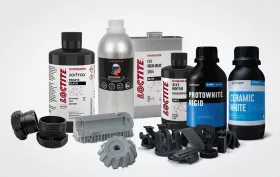
The brand Loctite produces safer materials that are more expensive, but the result is always worth it. These materials print better at higher temperatures and with higher light output, which are primarily offered by DLP printers. With a little effort, however, they also work on lower-end LCD printers.
Materials from Evonik print very well on all types of printers, are highly resistant and require additional thermal curing.
The brand Liqcreate offers more expensive but environmentally friendly materials with moderate resistance that can also be printed on lower-end LCD printers.
Core Alpha is the most resistant material, but it requires a demanding 3D printing process and special equipment for thermal curing under vacuum. This material is not easy to use in production.
Conclusion
Materials for stereolithography have been experiencing a renaissance in recent years and offer a range of advantages. Compared with other technologies, they offer a much more diverse portfolio of materials that are described in detail and allow individual adaptation to our needs.
Although these materials are more expensive, the technology is compact, has low energy requirements and is highly productive. Investment in a reliable, high-performance, higher-end 3D printer does not exceed one million Czech crowns. These printers have a service life of approximately a decade and require minimal servicing. Gradual automation is taking place, surface finishing of printed parts is being simplified, and parts are being optimised not only through weight reduction.
In many cases, it is therefore sensible to consider, or begin adopting, the replacement of conventional manufacturing methods with this technology. When implementing it in practice, it is important to work with a supplier who has manufacturing experience and can guide you through this field without wasting time or money.
Do you want to bring your idea to life? Contact us for professional advice on SLA 3D printing. We will recommend the most suitable material, take care of the complete production of your product, or supply and help you integrate a manufacturing process, including the technology.
Find out more about our 3D printing services, explore the consultancy services we offer, or simply arrange a meeting.
Suppliers on this topic
-

SORTEC EUROPE, s. r. o.
Supply of robotic systems for large-format pellet 3D printing, custom 3D printing of parts up to 3 m, mould… -

FilamentyBrno.cz
Custom 3D printing, filaments and 3D printer servicing. Prototypes, jigs and small series for companies in Brno. -

ADATEX, s.r.o.
3D printing, 3D printers, 3D scanners, 3D scanning and inspection, 3D digitization, 3D measurement, 3D model, 3D… -

OSMOS s.r.o.
ERP software, 3D design of plastic products, simulation of plastic injection, plastic press, plastic injection… -

Ing. Peter Náhori - Tlač v 3D
Services in the field of 3D printing and 3D modeling, sales of 3D printers, 3D scanners, 3D pens, 3D printing strings… -

3D Tlač - Stepanek3D
3D scanning, 3D printing, editing of 3D models, plastic atypes, custom production, small series production, production…


INOFEST 2026: A car manufacturer and a vineyard face the same challenges. Nitra made that clear
5.10.2026 On 29 September, the Creative Centre of the Slovak University of Agriculture in Nitra hosted the seventh edition of the INOFEST innovation festival. The event brought together 164 participants and featured 28 speakers, 53 companies, and 16...
Most read in the last 7 days
-
Polymer prices - october price increases partly successful, with minor corrections expected in the week ahead
-
Long-lasting solution: Radiation-crosslinked PE-Xc pipes for drinking water supply
-
Polymer prices – the increase in olefin monomer contract prices in October was in line with expectations
-
Polymer prices - Year-End Polymer Price Scenarios
-
Plastica-expo 26





Most read in the last 7 days
-
Polymer prices - october price increases partly successful, with minor corrections expected in the week ahead
-
Long-lasting solution: Radiation-crosslinked PE-Xc pipes for drinking water supply
-
Polymer prices – the increase in olefin monomer contract prices in October was in line with expectations
-
Polymer prices - Year-End Polymer Price Scenarios
-
Plastica-expo 26