





cotu s.r.o.: Efficient production planning using detailed resin 3D printing
How to Accelerate Development, Reduce Costs and Improve Quality
Efficient production planning today means not only managing processes correctly, but above all the ability to respond quickly to changes.
Development teams and production departments are therefore increasingly using high-detail resin 3D printing, which has become a key tool for linking design, testing and small-batch production.
Proper implementation of 3D printing in the production process makes it possible to:
- shorten the development cycle by tens of percent,
- reduce prototyping and tooling costs,
- accelerate product time to market,
- and at the same time improve the accuracy and repeatability of results.
1. Plan from the Design Stage, Not Just from Production
One of the most common mistakes in production planning is to start using 3D printing only at the part production stage, rather than incorporating it into the design phase of development.
- This means missing the opportunity to test designs at full scale and verify product functionality, ease of assembly or ergonomics.
- A properly configured process accounts for 3D printing as early as the CAD model design stage – parts are optimised for 3D printing, and their subsequent processing is faster and less expensive.
Practical experience and industrial studies show that incorporating 3D printing at the design stage can shorten the development cycle by as much as 30–50 %.
You can find more about designing parts for SLA printing in the Services section.
2. Choose the Right Technology and Material for the Intended Purpose
Not every 3D printing technology is suitable for every type of part.
Key questions every manufacturer should ask:
- What resolution and accuracy do I need?
- Does the part need to be optically clear, mechanically strong or resistant to chemicals and temperature?
- Will the part be polished, painted or machined?
Resin 3D printing excels where high accuracy, detail and surface quality are required.
The wide range of resins available can meet a variety of needs:
- Mechanically, chemically and thermally resistant plastics – suitable for engineering parts that must withstand loads or demanding conditions over the long term,
- Rigid or highly elastic materials – used, for example, to manufacture seals, soles or medical devices where either strength or high elasticity is required,
- Self-extinguishing and antistatic resins – used in electronics, the railway industry or aviation to meet safety standards and provide protection against electrostatic discharge,
- Melt-out wax for lost-wax metal casting – enables the rapid production of precision castings with minimal need for subsequent machining,
- Medical and biocompatible materials – with the highest level of biocompatibility and a wide range of applications, for example in dentistry and implantology.
3. From Prototype to Production: 3D Printing as a Fully Fledged Production Step
Many companies view 3D printing primarily as a prototyping tool. In practice, however, it can play a much more significant role – becoming a fully fledged production step that complements or completely replaces traditional technologies.
High-detail resin 3D printing now enables:
- the production of precise functional parts,
- engineering components with demanding requirements for detail and dimensional accuracy,
- assembly and auxiliary fixtures,
- housings, holders, mounts and small structural assemblies for various devices,
- small-batch and custom production without the need for moulds,
- rapid modifications and variants without investment in moulds and vacuum casting.
The advantage is the ability to move very quickly from prototype to actual production, significantly reducing product time to market.
The ability to link development, testing and production itself is precisely one of the areas in which cotu has a substantial lead.
Interested in a specific practical example?
In the Dronetag case study, we explain how detailed resin 3D printing can accelerate product development, simplify design and enable small-batch production of final parts. The article also shows how the right choice of material and design modifications helped meet demanding requirements for appearance, precision and functionality.
4. Efficient capacity planning: in-house 3D printing vs. outsourcing
When planning production, the decision whether to use in-house 3D printing capacity or work with an external partner has a major impact.
In-house production is worthwhile where 3D printing is part of day-to-day operations – typically in laboratories, design studios or development departments.
Material subscription helps keep production running without delays while reducing the administrative and logistical burden. An ideal solution for companies that want to plan efficiently and manufacture without worries.
At cotu, we offer both options – from consulting, product development and sales of professional technologies and materials to custom 3D printing and small-batch production.
Take a look at the Series production service.
5. Post-processing and quality – an often underestimated stage
Proper production planning does not end with printing the model.
The quality of the resulting part is also significantly influenced by post-processing – processes such as:
- washing and curing, which directly affect the mechanical strength of the part,
- polishing and surface finishing to achieve the desired appearance,
- checking dimensions and tolerances.
Modern SLA printers today ensure better surface quality thanks to pressure sensors during 3D printing itself, reducing the need for subsequent finishing operations.
Unlike technologies such as FDM and SLS, post-processing in SLA 3D printing is often as much as 8x faster and simpler. Nevertheless, it forms an important part of the process and must be taken into account when planning production.
It is therefore advisable to include post-processing when preparing the job – for example, by estimating curing, surface finishing or assembly operation times in advance. At cotu, we actively help companies with this: we can estimate these costs, train staff and set up processes to make them predictable in terms of time and reproducible.
6. Measurable results: how 3D printing changes production planning
Companies that integrate detailed resin 3D printing into their production plan achieve tangible results:
- a 40 % shorter development cycle,
- cost savings of up to 60 %,
- higher part quality and repeatability,
- faster testing of new variants and models.
By incorporating 3D printing into planning, you gain a predictive process – production steps can be simulated, time and costs estimated, and changes addressed quickly without relying on external suppliers.
7. How to get started: from analysis to implementation
Successful implementation of 3D printing is not about a single machine – it is about the entire system.
At cotu, we combine technology, materials and know-how into solutions that work over the long term. We help companies and development teams:
- identify suitable areas for the use of 3D printing,
- choose the right combination of technologies and materials,
- optimise product development and accelerate the transition to production,
- ensure training, servicing and quality control.
Want to make planning and product development more efficient?
We will be happy to discuss your specific needs with you and propose the optimal solution. We help companies turn ideas into reality – from design to the final product.
Suppliers on this topic
-

3D Tlač - Stepanek3D
3D scanning, 3D printing, editing of 3D models, plastic atypes, custom production, small series production, production… -

LukMatic s.r.o.
LukMatic is a modern Czech company that has been providing professional services in the field of additive… -

ADATEX, s.r.o.
3D printing, 3D printers, 3D scanners, 3D scanning and inspection, 3D digitization, 3D measurement, 3D model, 3D… -

Veeser Plastic Slovakia k.s.
Plastic production for the automotive industry; plastic injection molding, plastic molding, plastic molding shop… -

SORTEC EUROPE, s. r. o.
Supply of robotic systems for large-format pellet 3D printing, custom 3D printing of parts up to 3 m, mould… -

FilamentyBrno.cz
Custom 3D printing, filaments and 3D printer servicing. Prototypes, jigs and small series for companies in Brno.




Modernisation of Industrial Machinery by Symtex Brno: How to Extend Equipment Life and Improve Production Efficiency
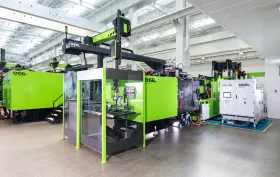
26.10.2026 In the plastics processing and recycling industries, production equipment is often expected to operate reliably for many years. However, as machinery ages, its performance, availability of spare parts and compatibility with modern control systems...



Most read in the last 7 days
-
Polymer prices - october price increases partly successful, with minor corrections expected in the week ahead
-
Long-lasting solution: Radiation-crosslinked PE-Xc pipes for drinking water supply
-
Polymer prices – the increase in olefin monomer contract prices in October was in line with expectations
-
Polymer prices - Year-End Polymer Price Scenarios
-
Plastica-expo 26





Most read in the last 7 days
-
Polymer prices - october price increases partly successful, with minor corrections expected in the week ahead
-
Long-lasting solution: Radiation-crosslinked PE-Xc pipes for drinking water supply
-
Polymer prices – the increase in olefin monomer contract prices in October was in line with expectations
-
Polymer prices - Year-End Polymer Price Scenarios
-
Plastica-expo 26