

Development of the Vividi device: custom production of enclosures for smart electronics by cotu s.r.o.
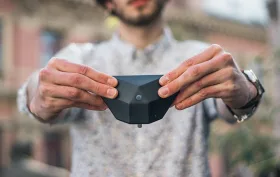
The company Iterait a.s. focuses on developing advanced AI solutions in computer vision that help companies streamline operations, reduce costs and automate routine tasks in retail, healthcare or transport. The company cotu® was approached by Iterait a.s. to design and manufacture an enclosure for a device used to analyse customer behaviour in stores, combining advanced electronics with a discreet, functional and reliable design.
The collaboration resulted in two generations of the Vividi device. Each brought new challenges and, above all, demonstrated how important it is to combine design, engineering and manufacturing know-how into a single compact unit.
The aim of this case study is to present how cotu® approaches technically demanding projects throughout their entire development. The process includes design and engineering, the development of a functional prototype and subsequent production, with an emphasis on the use of modern technologies that enable high precision, time efficiency and manufacturing flexibility.
How cotu® Decided to Tackle This Challenge
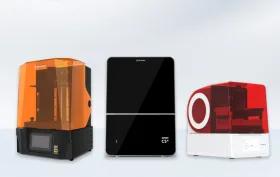
Technology used: Asiga Pro 4K
Material used: Asiga PlasGRAY, polyurethane vacuum casting
1st Generation Vividi: From Idea to Implementation
The aim of the first generation of Vividi was to create a device that would be unobtrusive, easy to install and sufficiently durable for everyday operation in public spaces. The cotu® development team thoroughly assessed the technical and aesthetic requirements, from the mounting method and electronics layout to a clean, minimalist appearance.
Design and Prototyping
Several design concepts were developed based on these requirements. The designs incorporated different mounting methods, types of ventilation openings and enclosure shapes. Following consultations with the client and the design engineer, the selected designs were converted into an initial 3D model. The proportions were then verified using a physical 3D-printed mock-up.
Technical Solution and Production Preparation
Once the mock-up was approved, work continued with detailed 3D modelling in Rhinoceros 3D software, including structural features modelled in SolidWorks. Optimisation for subsequent production also took place at this stage. Parting planes were adjusted, walls were thickened and internal transitions were optimised.
Production and Finishing
The final master model was printed on an Asiga PRO 4K 3D printer, whose precision simplified subsequent surface finishing and helped shorten the time between the design and the first product. Silicone moulds were then produced, and within two days the first casting was ready for dimensional and visual quality inspection. This step was followed by small-batch production of 100 units.
Thanks to the speed and flexibility of 3D printing, the entire process from design to completion of the 100-unit batch took just 2 months.
2nd Generation Vividi: More Compact, More Durable and More Technically Demanding
The second generation of Vividi represented a significant step forward in both engineering and technology. The new brief included requirements for smaller dimensions, greater durability, watertightness (IP68), better heat dissipation, an integrated logo and an optical light guide for LED indication.
Design and Electronics Reorganisation
In this case, the task was no longer just to improve the design, but to fundamentally change the internal layout and the choice of materials. A designer from cotu® prepared three visual directions, with the final version integrating the triangle motif from the logo directly into the body of the enclosure. At the same time, cotu® also considered optimising the electronics layout. This optimisation made it possible to significantly reduce the size of the device without negatively affecting its functionality.
Material Selection and Optimisation of the Structural Design
During the development phase, it was essential to verify the suitability of the materials used in terms of mechanical stability and temperature resistance. Various combinations of aluminium-filled plastic were tested. Ultimately, casting the rear section in aluminium and manufacturing the front section from plastic proved to be the most suitable solution. This combination provided the required rigidity and thermal stability. The first units produced revealed deviations in the tolerances of the aluminium castings, which required design modifications to the front component. Thanks to vacuum casting, the change was implemented in just a few days and without high costs.
Watertightness
The client's requirements also included a high level of watertightness. The cotu® team therefore conducted a series of tests to assess different sealing options. After several unsuccessful cycles, a specialist Czech facility was approached and supplied a custom-made seal. This made it possible to ensure the declared ingress protection rating without the need for further design modifications.
Controlled Small-Batch Production
Once the prototype had been approved, master models with the final surface finish were produced. Manufacturing continued using vacuum casting, which enabled reliable and rapid small-batch production. Thanks to an efficient workflow, the cotu® team was able to produce up to 100 enclosures per week.
Today, this project would be carried out using direct 3D printing and the durable, non-hazardous material Loctite IND405, whose mechanical properties are similar to those of PA12 used in SLS/MJF technologies. By eliminating vacuum casting and using 3D technology, the entire process could be shortened by as much as 1–2 weeks, not only thanks to the additive technology itself, but also to lower staffing requirements. The result would also be a lower price, making the entire process more cost-effective.
Summary and Benefits
The collaboration between Iterait and cotu® demonstrates how additive manufacturing, specialist expertise and rapid iteration can take a complex product from an idea to real-world operation within a few weeks. cotu® acted as a technical partner that not only designed and manufactured a functional solution, but also actively contributed to optimising the entire product.
Have an Idea of Your Own? cotu® Will Help You Bring It to Life.
Are you looking for a partner to help you design a functional and aesthetically pleasing solution, create prototypes and validate them in practice, or arrange small-batch production without unnecessary costs? cotu® will help you turn your vision into reality. Quickly, with quality and a professional approach.
Suppliers on this topic
-

LukMatic s.r.o.
LukMatic is a modern Czech company that has been providing professional services in the field of additive… -

3D Tlač - Stepanek3D
3D scanning, 3D printing, editing of 3D models, plastic atypes, custom production, small series production, production… -

FilamentyBrno.cz
Custom 3D printing, filaments and 3D printer servicing. Prototypes, jigs and small series for companies in Brno. -

ADATEX, s.r.o.
3D printing, 3D printers, 3D scanners, 3D scanning and inspection, 3D digitization, 3D measurement, 3D model, 3D… -

OSMOS s.r.o.
ERP software, 3D design of plastic products, simulation of plastic injection, plastic press, plastic injection… -

Veeser Plastic Slovakia k.s.
Plastic production for the automotive industry; plastic injection molding, plastic molding, plastic molding shop…


INOFEST 2026: A car manufacturer and a vineyard face the same challenges. Nitra made that clear
5.10.2026 On 29 September, the Creative Centre of the Slovak University of Agriculture in Nitra hosted the seventh edition of the INOFEST innovation festival. The event brought together 164 participants and featured 28 speakers, 53 companies, and 16...

Most read in the last 7 days
-
Polymer prices - october price increases partly successful, with minor corrections expected in the week ahead
-
Long-lasting solution: Radiation-crosslinked PE-Xc pipes for drinking water supply
-
Polymer prices – the increase in olefin monomer contract prices in October was in line with expectations
-
Polymer prices - Year-End Polymer Price Scenarios
-
Plastica-expo 26




Most read in the last 7 days
-
Polymer prices - october price increases partly successful, with minor corrections expected in the week ahead
-
Long-lasting solution: Radiation-crosslinked PE-Xc pipes for drinking water supply
-
Polymer prices – the increase in olefin monomer contract prices in October was in line with expectations
-
Polymer prices - Year-End Polymer Price Scenarios
-
Plastica-expo 26