


Introducing the Special Automation Design Department of Wittmann Battenfeld CZ spol. s.r.o.
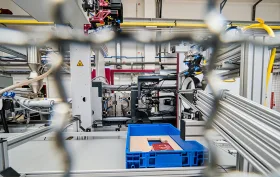
Industrial Automation and Equipment Design
We have been designing and developing special automated solutions for our customers since 2012. We have a stable and experienced team that includes our own 3D designers, electrical designers, assembly technicians, service technicians and other staff providing back-office support. The design department uses premises covering approximately 550 m2, including office and production space. Modern 3D software is used to design and develop the equipment we supply and to create the manufacturing documentation itself. Our own 3D printers enable us to manufacture certain components that can be adapted to specific requirements. We also have machine tools and tools available for the complete preparation of aluminium frames and structures. Over the course of our existence, we have built a network of proven and reliable suppliers of components used to manufacture automated workcells and other special-purpose machines.
Automation for Plastics Companies – Czech Republic, Slovakia and Abroad
Our main customers are companies in the plastics industry operating primarily in the Czech and Slovak markets, such as WITTE Nejdek, spol. s.r.o., WITTE ACCESS TECHNOLOGY s.r.o., Erwin Quarder CZ s.r.o., ROBERT BOSCH spol. s.r.o., Gerresheimer Horsovsky Tyn spol. s.r.o., but in cooperation with our colleagues from the Wittmann Battenfeld GmbH production plant, we have also implemented some projects abroad. Over the course of our existence, we have successfully completed numerous projects.
We can offer our customers:
- grippers ranging from simple to highly sophisticated, which can then enable, for example, picking and loading inserts, handling parts during multi-component injection moulding …
- degating stations
- equipment for preparing inserts, such as vibratory feeders, step feeders, rotary and sliding tables
- stations with vision inspection
- laser marking of parts
- conveyor lines allowing parts to be stacked in KLT boxes and the boxes to be handled (conveyors, lifts, gravity conveyors, tilting stations), making it possible to prepare empty boxes and remove full boxes from a single operator station
- various transfer and cooling stations, also with interchangeable fixtures
- complete automated workcells
- other special-purpose equipment
… including their installation and commissioning, warranty and post-warranty service
|
Fig. 1. Vision inspection of a finished part using 5 cameras, including evaluation, as part of a complete automated workcell |
Fig. 2. Picking and preparing contacts for loading into the mould |
Customised Complete Automated Workcells
Complete automated workcells very often pay off where there are large production runs requiring various types of inspection with the highest level of repeatability. A good example of the use of an automated workcell is the production of parts with various types of metal inserts (threaded inserts, contacts, bushings), where the workcell operator only replenishes the supply of inserts and removes finished parts from the conveyor belt / or filled KLT boxes containing finished parts. Such an automated workcell may then consist of a vibratory feeder with a sorting unit for preparing inserts, a robot equipped with a suitable gripper for handling finished parts and runners removed from the injection moulding machine's mould and for picking and subsequently loading inserts, and a conveyor system for handling KLT boxes, which may also include magazines containing interlayers for placement between individual layers of finished parts. The workcell can also be equipped with a wide variety of inspection stations. These may range from basic checks for the presence of inserts in finished parts to short-shot detection, inspection of specific critical points on the finished part, and so on. Of course, the workcell can also readily be supplemented with a station for laser marking of parts, including evaluation of the laser marking. Various types of automatic inspection then enable customers to save considerable costs on operating the workcell thanks to the stability of the production process and the elimination of human error, as NOK parts are rejected directly during the manufacturing process. This then helps reduce the costs of handling potential complaints from the end customer (sorting OK / NOK parts).
|
Fig.3 Vibratory insert feeder, including preparation of inserts for picking by a gripper, as part of a complete automated workcell |
For complete automated workcells, and not only these, we always strive to meet customers' requirements and propose the optimal solution.
As this is not series-produced equipment, it is always necessary to focus from the outset on the brief itself and the specific requirements that the equipment / automated workcell should meet. For this, it is absolutely essential to have the appropriate data with which we can then work further.
|
Fig.4 Simple gripper manufactured using 3D printing, horizontal and rotary servo axes for transferring parts between individual stations |
Depending on the type of equipment, it is always advantageous to have sample parts (both OK and NOK) available, for example to verify that parts can be picked without problems, to test a suitable vision system, laser marking, and so on. The more data and information are known at the very beginning, the better. Even small details can influence the final solution.
| Fig. 5. A live demonstration of an automated workcell for producing a snack box with laser marking of parts, vision inspection and a conveyor system for handling boxes, which we prepared for our customers on the occasion of the “20 YEARS with You” event. |
If you are interested, we would be delighted if you contacted us with your requirements.
-

Wittmann Battenfeld CZ spol. s r.o.
Injection molding machines, linear robots and manipulators, tempering devices, systems for drying and conveying granulate, dispensers, grinders… -

Wittmann Battenfeld SK spol. s r.o.
Wittmann peripherals, plastics processing machines, spare parts for WITTMANN BATTENFELD peripherals, injection molding machines, injection molding…


Suppliers on this topic
-

Dopak sp. Z o. o.
Dopak is one of the leading suppliers for the plastics processing and recycling industry in Central Europe. -

Vibrofeed - MTR s. r. o.
Design and manufacture of high quality vibratory feeding and sorting systems used for process automation in various… -

A.M. spol. s r.o.
Technology consulting, design and sale of machines and peripheral equipment for the plastics operations, dispensers… -

1.PLASTCOMPANY, spol. s r.o.
Horizontal and vertical injection molding machines, extruders and extrusion lines, extrusion tools, material conveyors… -

LUGER spol. s.r.o.
Peripheral equipment for the plastics industry, tempering equipment, plastic crushers, plastic conveyors, metal part… -

MARTING, s.r.o.
We are manufacturer and supplier of equipment for mechanization, automation and quality control for plastic operations.



DESMA Open House 2026: Innovation, Practical Application, and International Exchange
28.10.2026 Under the motto “Built right. Runs right.”, DESMA opened the doors of its main plant in Fridingen on October 1, 2026, and welcomed over 280 visitors from around the world to a thoroughly successful Open House.
Most read in the last 7 days
-
Polymer prices - october price increases partly successful, with minor corrections expected in the week ahead
-
Polymer prices - Year-End Polymer Price Scenarios
-
Long-lasting solution: Radiation-crosslinked PE-Xc pipes for drinking water supply
-
Polymer prices – the increase in olefin monomer contract prices in October was in line with expectations
-
Plastica-expo 26





Most read in the last 7 days
-
Polymer prices - october price increases partly successful, with minor corrections expected in the week ahead
-
Polymer prices - Year-End Polymer Price Scenarios
-
Long-lasting solution: Radiation-crosslinked PE-Xc pipes for drinking water supply
-
Polymer prices – the increase in olefin monomer contract prices in October was in line with expectations
-
Plastica-expo 26