


Vinyl Floor Maintenance: Is Polishing Really Necessary?
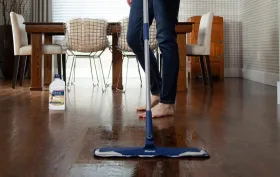
This is precisely why the question of whether additional polishes or protective films are needed at all for modern vinyl floors is being raised increasingly often.
Modern factory-finished vinyl floors
Today's vinyl floors are equipped with a protective polyurethane layer that provides:
- resistance to common chemicals,
- easy cleaning,
- protection against stains,
- greater abrasion resistance,
- long-term colour stability.
This means that the floor itself does not require additional wax or polymer layers, as was the case with older types of PVC flooring.
The problem with polishes
Many polishes work by forming a thin film on the floor surface. While this film may temporarily increase gloss or conceal minor scratches, it also gradually wears away.
And this is precisely where the problem arises:
- the polish dissolves over time during routine washing,
- residues enter wastewater,
- the floor may develop patchy areas or an uneven appearance over time,
- incorrect layering can reduce the floor's slip resistance.
With modern PU/PUR surfaces, this is therefore often not about protecting the floor itself, but merely about maintaining an additionally applied film.
Fewer chemicals, simpler maintenance
The trend in floor maintenance today is shifting towards:
- a lower chemical burden,
- simple cleaning,
- minimising waxes and polymers,
- using pH-neutral cleaning agents.
For routine maintenance of vinyl floors, manufacturers particularly recommend:
- regular vacuuming,
- a microfibre mop,
- cleaning with a slightly damp mop,
- cleaners specifically designed for vinyl floors.
Sustainability plays an increasingly important role
At a time when both industry and households are seeking to reduce their environmental impact, it is important to consider even the seemingly small details of everyday maintenance.
If a floor has high-quality factory-applied protection, minimalist maintenance can be not only more economical but also more environmentally friendly. Fewer additional layers mean:
- fewer chemicals indoors,
- fewer residues in wastewater,
- simpler long-term floor care.
When using conventional polishes, however, it is necessary to bear in mind that they often contain so-called micropastes – fine particles that create the visual effect of gloss and conceal minor damage. These microsubstances are gradually released during cleaning, settle in the surface structure or enter wastewater. The result may be not only an uneven floor appearance over time, but also an unnecessary burden on the maintenance process and the environment.
| Floors in healthcare: This is the condition of floors treated only with wax polishes, which dissolve rapidly when exposed to disinfectants. |
Modern vinyl floors thus demonstrate that proper maintenance today does not have to mean more products, but rather a smarter and gentler approach.
At the same time, however, in environments subject to extreme demands – such as healthcare facilities, hospitals or laboratories – professional floor treatment can offer significant benefits. Bona Pure coating creates a highly durable polyurethane protective layer designed for heavily used commercial premises, significantly increasing the floor's resistance to wear and commonly used disinfectants. Bona Pure HD , Facility management
A surface treated in this way has lower porosity, which contributes to better hygiene, easier cleaning and reduced dirt accumulation. In practical terms, this means not only greater resistance during daily cleaning, but also a significant extension of the floor's service life and a reduced need for extensive refurbishment.
| Floor treated with Bona Pure. |
Refurbishment instead of replacing the floor covering
Damaged or worn vinyl floors do not need to be replaced. Modern refurbishment restores their appearance, extends their service life and also reduces material consumption, downtime and environmental impact.
90 % CO₂ savings
Refurbishment generates only 1.14 kg CO₂/m² compared with 11.42 kg CO₂/m² for a new floor – the carbon footprint is thus more than 10× lower.
90 % energy savings
Refurbishment uses the existing floor, so energy consumption drops from 200 MJ/m² to just 20 MJ/m².
It is precisely this longer service life and reduced need for chemical treatments that align with the principles of environmental sustainability – fewer materials consumed, less waste and more efficient building operation.
Suppliers on this topic
-

Fatra, a.s.
Processing of PVC, PE, PP and PET, FATRAFOL waterproofing foils, PVC flooring, PVC granulate, regranulate… -

INOVATIVA s.r.o.
Innovative solutions for workplace safety and comfort in industrial facilities, logistics centers, warehouses, and… -

TOMIRTECH, s.r.o.
Technical plastic parts, plastic moldings, rubber seals, plastic pipes, tubes, hoses, pipes, rubber bumpers, rubber… -

CleanAnt s.r.o.
Industrial cleaning and specialized cleaning of facilities, equipment and production lines, including high-level… -

Zenit SK, s.r.o.
Sales of polycarbonate boards and plexiglass, hollow polycarbonates, hollow core boards, panels, boards, rods…


-
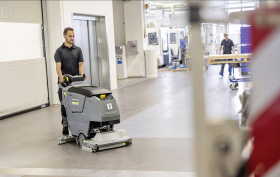
FLOOR-STANDING MACHINES: An efficient choice for the plastics industry
The plastics industry is one of the most dynamic and demanding sectors. Fast-paced production, the processing of polymer granules, and the presence of fine... -
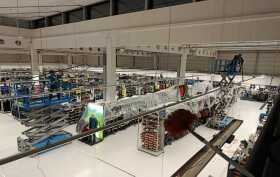
CleanAnt s.r.o.: High-level dust removal in production halls as an important element of safety, technology reliability, and worker health protection
In industrial production facilities, dust is generated as a natural byproduct of various technological processes. In the plastics industry, this includes fine...
Most read in the last 7 days
-
Polymer prices – the increase in olefin monomer contract prices in October was in line with expectations
-
Polymer prices - monomer-linked price increases based on early September levels
-
Polymer prices - october price increases partly successful, with minor corrections expected in the week ahead
-
Plastica-expo 26
-
Internationale Zuliefererbörse (IZB) 2026





Most read in the last 7 days
-
Polymer prices – the increase in olefin monomer contract prices in October was in line with expectations
-
Polymer prices - monomer-linked price increases based on early September levels
-
Polymer prices - october price increases partly successful, with minor corrections expected in the week ahead
-
Plastica-expo 26
-
Internationale Zuliefererbörse (IZB) 2026