


Messer Technogas s.r.o.: Cryogenic Grinding in the Plastics Industry
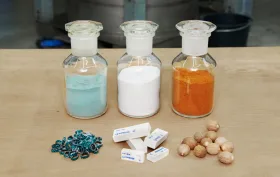
Another group consists of spices, seeds, food additives and pharmaceuticals. When grinding them, the most common difficulties arise from the temperature increase that occurs during grinding. This leads to a loss of aroma and flavour in spices such as pepper, nutmeg, ginger, cardamom or cloves. It can also cause materials to agglomerate and clog the mill. Last but not least, it is often necessary to address the risk of oxidation and the danger of explosion of the powdered product.
Advantages of Cryogenic Grinding
These problems can easily be avoided if grinding takes place at low temperatures. Liquid nitrogen (–196 °C) is used to cool the material to a temperature at which it becomes brittle. It is then immediately fed into the mill. We use SBR/NR rubber as an example to demonstrate the advantages of cryogenic grinding over grinding under normal conditions. After cooling to approximately –100 °C, the SBR/NR is fed into an impact mill (e.g. a pin mill). The mill's capacity increases by up to three times with no change in electrical power input. At the same time, significantly greater grinding fineness and a very narrow particle size distribution are achieved. The graph in Figure 1 shows the particle size distribution of SBR/NR. The curves clearly show a comparison of the results: the D50 value for grinding at ambient temperature is approximately 480 µm, while for grinding after cooling with nitrogen, the value is D50 = 180 µm. The specific consumption of liquid nitrogen depends on the type of material and the required temperature; in this case, it is approximately 1 kg per 1 kg of powdered product.
| Particle size distribution of SBR/NR |
In addition to a significant increase in mill throughput and improved powdered product characteristics, low temperatures offer further advantages. They prevent the melting and agglomeration of material, which are common during grinding without cryogenic cooling and lead to frequent cleaning and a shorter equipment service life. Some materials cannot be ground into the required powder form at all without cooling. Another advantage is the creation of an inert atmosphere through the evaporation of liquid nitrogen, which prevents oxidation of the ground material and the formation of explosive mixtures of fine particles.
Cryogenic Grinding for the Separation of Composite Materials
Using standard grinding techniques, it is very difficult to separate the individual components of composite materials, such as fibre-reinforced thermoplastics (coverings, hoses, various reinforced rubber products, etc.) or metal-plated plastic parts (sanitary products, automotive parts, etc.), see Figure 2. The application of cryogenic temperatures makes this possible due to the different coefficients of thermal expansion and the different brittleness of the individual materials, with the different types of material becoming detached during crushing or grinding itself. In the next step, the individual components are separated and can thus be reused – recycled.
| Difficult separation of the individual components of composite materials | ||
Technical Solution
The material is fed into an insulated screw conveyor, where it is cooled by spraying liquid nitrogen along the entire length of the conveyor to achieve the required material temperature, after which it is fed into the mill. The amount of liquid nitrogen is controlled based on the temperature in the mill. A process diagram is shown in Figure 3.
| Diagram of the cryogenic grinding process |
Alternatively, nitrogen can be fed directly into the mill without pre-cooling the material. This option is used to suppress heating, which helps ensure the stability of the grinding process and improve product quality. Since the material is not cooled throughout, this approach does not lead to a significant increase in mill throughput as in the case where the material is pre-cooled.
Equipment for Pilot-Scale Tests
Messer has a test laboratory for carrying out pilot-scale cryogenic grinding tests using customer samples. For this purpose, a counter-rotating pin mill with a throughput of 5 to 200 kg/h (depending on the type and quality of the material) is installed there. The particle sizes achieved range from 20 to 800 µm. The mill is equipped with cryogenic equipment similar to that used in industrial operation. A cutting mill equipped with cryogenic cooling is also available and is used when a larger product particle size is required. The equipment is fitted with measuring instruments that allow all important parameters, such as mill throughput, electrical energy consumption and liquid nitrogen consumption, to be evaluated during the test. After the particle size distribution has been measured, the processed material samples are sent back to the customer. Based on discussions with the customer, operating and investment costs are estimated for the implementation of permanent operation. It is often possible to use the existing mill after certain modifications, so it is not always necessary to buy a new one. This option can be assessed by carrying out a cryogenic grinding trial directly at the customer's premises using their equipment, for which we provide and install cryogenic equipment consisting of an insulated screw conveyor, valves, a nitrogen dosing control unit, hose connections and a mobile liquid nitrogen storage tank.
Conclusion
Cryogenic grinding is a technology with great potential. With growing requirements for the quality of powdered products and increasing pressure for material recycling and safety, it is attracting ever more attention from many companies operating in the plastics, recycling, chemical and food industries. Messer has many years of practical experience and numerous references, providing the assurance of a reliable partner. We would be pleased to discuss with you all aspects of cryogenic technologies and the associated supplies of liquid nitrogen or other industrial gases.
Dipl.-Ing. Oliver Dietrich
Messer SE & Co. KGaA
Ing. David Bek, Ph.D.
Messer Technogas s.r.o.
David.Bek@messergroup.com
+420 602 760 022
Suppliers on this topic
-

Maloun s.r.o.
Collection and sorting of plastic waste, crushing, production of regranulates, compaund, testing and sale of primary… -

Remarkplast compounding a.s.
Plastic compounds, plastic compounding, regranulate, plastic regranulation, construction plastics - production and… -

Import Export Hurt Spedycja J.J. Sp. z o.o.
Collection and purchase of waste plastics, plastic waste, purchase, sale, recycling of plastics in the form of… -
SRNOPLAST K96 s.r.o.
Purchase and crushing of plastic materials, custom crushing of plastics, regranulate, regranulation, recycling of… -

SOLLAU CZ s. r. o.
Purchase and sale of plastic crumbs and regranulates, magnets and magnetic separators, metal part separators… -

geba Kunststoffcompounds GmbH
Masterbatches for plastics, plastic regranulate, ABS regranulate, ABS plastic regranulate, PC, PC/ABS, PA6, PA66, TPU…


BASF expands the Ultradur® portfolio with new grades based on post-consumer recycled PET
9.10.2026 BASF is expanding its portfolio of engineering plastics with new Ultradur® grades designed to help automotive manufacturers and suppliers increase the recycled content of their products while meeting demanding technical requirements. The new...



Most read in the last 7 days
-
Polymer prices - october price increases partly successful, with minor corrections expected in the week ahead
-
Polymer prices – the increase in olefin monomer contract prices in October was in line with expectations
-
Plastica-expo 26
-
Polymer prices - monomer-linked price increases based on early September levels
-
Internationale Zuliefererbörse (IZB) 2026





Most read in the last 7 days
-
Polymer prices - october price increases partly successful, with minor corrections expected in the week ahead
-
Polymer prices – the increase in olefin monomer contract prices in October was in line with expectations
-
Plastica-expo 26
-
Polymer prices - monomer-linked price increases based on early September levels
-
Internationale Zuliefererbörse (IZB) 2026