

NEWMATEC 2026: In a time of geopolitical uncertainty, Europe’s automotive industry must remain flexible, realistic and competitive.
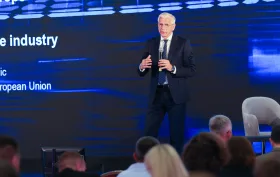
The event, organised annually by the Automotive Industry Association of the Slovak Republic (ZAP), took place on 26–27 May 2026 at the Partizán hotel in Tále.
In his address, Alexander Matušek pointed out that the automotive sector faces several simultaneous challenges – from geopolitical tensions and growing competition from Chinese manufacturers to regulatory pressure and a weakened business environment. Car sales in the European market have fallen by 2.5 to 3 million vehicles compared with the pre-pandemic period, while competition for customers is intensifying significantly.
Solutions at European level must be based on a realistic assessment of the current situation; the automotive industry is calling for simpler and more flexible regulations, requiring a pragmatic transformation and stronger competitiveness.
During discussions on the future of the automotive industry, representatives of industry, government and the expert community agreed that Europe is at a critical crossroads. Czech MEP Ondřej Krutílek summarised the current geopolitical situation and its impact, identifying the current threats: Europe has entered an era of deglobalisation and growing geopolitical rivalry that is fundamentally changing the way international trade and industrial supply chains operate.
In his address, he also noted that Europe still has strong industrial know-how, high-quality research and technological potential. He identified initiatives aimed at supporting competitiveness, industry and innovation, including the Clean Industrial Deal, the Automotive omnibus and measures to simplify rules for companies and start-ups, as positive signals.
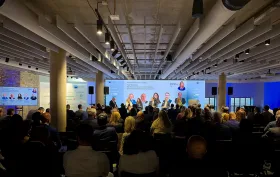
His address was followed by a panel discussion on the competitiveness of the European automotive industry. The European perspective was represented by Juraj Nociar, Slovakia's Ambassador to the European Union; State Secretary at the Ministry of Economy of the Slovak Republic Vladimír Šimoňák presented the Slovak government's positions, while business was represented by ZAP SR President Alexander Matušek
and Tatrabanka economic analyst Juraj Valachy.
| Vladimír Šimoňák, State Secretary at the Ministry of Economy of the Slovak Republic |
The need for a realistic and technology-neutral transformation was a prominent theme in the debate. Although no one questions the EU's goal of climate neutrality by 2050 or the development of electromobility, several speakers pointed out that the pace and approach to regulation must reflect the actual capabilities of industry, the market and customers. Particular criticism focused on the fact that Europe had set ambitious regulatory targets without adequately securing production capacity, battery technologies and support for demand for electric vehicles.
ZAP SR President Alexander Matušek once again highlighted the problems facing Slovakia: a high tax and social contribution burden, the transaction tax and the outflow of talent from Slovakia. He stressed that without support for growth, innovation and a skilled workforce, it would not be possible to maintain the long-term competitiveness of Slovak industry. The participants in the discussion agreed that creating a single capital market is also an essential prerequisite for European competitiveness.
| Ivan Hodáč, moderator, founder of Aspen Institute Central Europe and former Secretary General of ACEA |
The panel discussion involving representatives of OEMs and Tier 1 suppliers focused on finding responses to global changes in the automotive industry. Carmakers were represented by Wolfram Kirchert, from Volkswagen Slovakia, and Juraj Sabo from Volvo Car Košice, while suppliers were represented by Kai Lücke from ZF Friedrichshafen and Miroslav Janota from Schaeffler. The panellists agreed that the era of a single global product for all markets is coming to an end. In their view, carmakers now need to adapt products to individual regions and build local production and supply chains.
A major topic of discussion was the “Made in Europe” strategy and the question of how the automotive industry should respond to increasingly aggressive competition from China. Although the individual participants' views differed, they agreed that Europe needs to create fair conditions for manufacturers and support local production, innovation and development. However, a strong warning was also voiced: if “Made in Europe” is implemented in an overly protectionist or costly manner, it could reduce the competitiveness of European cars and increase pressure on prices. A balance is therefore being sought between protecting European industry and maintaining an open market, so that excessive regulation or rigid rules do not weaken European industry.
China is no longer merely the largest market; it is becoming a technological leader.
The question of Europe's competitiveness relative to China and the United States was also a prominent theme throughout the conference. Maria Grazia Davino, BYD's Regional Director for several European markets, pointed out in her address that Chinese manufacturers are now setting the pace of technological development and that, in her view, Europe must respond with greater openness to change, increased competitiveness and a more pragmatic approach.
| Maria Grazia Davino, Regional Director of BYD Europe |
She presented BYD as a global technology company with more than a million employees and a strong research and development base. She emphasised that the company is vertically integrated – from battery production to logistics – enabling it to respond more quickly to the needs of the market and customers.
The presentation by Martin Koers, a professor at Shenzhen Technology University in China, provided a detailed comparison of the German and Chinese automotive industries and highlighted a fundamental shift in the global balance of power in the automotive sector. According to Koers, the traditional pillars of the German automotive industry's success were strong brands, technological innovation and open global markets. Today, however, the sector faces several simultaneous pressures for transformation – decarbonisation, digitalisation, geopolitical changes and the emergence of disruptive brands from China.
The changing nature of the car was another prominent topic. According to Koers, the car in China is becoming a “smartphone on wheels”, with software, digital services and the speed of innovation becoming decisive factors. The presentation also addressed differences in working culture and approaches to performance. Koers highlighted the fast pace of work and competitive environment in China, which, in his view, contribute significantly to the speed of innovation and Chinese companies' ability to respond to the market.
The closing presentation by Petr Knap, a senior adviser at EY, focused on how to respond to new challenges in the automotive sector and introduced several recommendations. Among the most important are a stronger customer focus and the use of existing sales channels as a competitive advantage, stronger cooperation between European and Chinese manufacturers, cost control and a significant acceleration of innovation and product development.
Photo Gallery


Suppliers on this topic
-

Bonafa projekt s.r.o.
Protection of interiors against overheating and glare, external shading of rooflights with screen fabrics, rooflight… -

OSMOS s.r.o.
ERP software, 3D design of plastic products, simulation of plastic injection, plastic press, plastic injection… -

Slovensko-nemecká obchodná a priemyselná komora
Support of trade and economic relations between Germany and Slovakia, consultancy for plastic and rubber production… -

Röchling Industrial Tábor s. r. o.
Plastic semi-finished products, extruded and molded sheets, rods, profiles and welding wires for 3 divisions… -

3M TRADE - PLASTIC PARTS s. r. o
Plastic molding, plastic injection, injection molds, molds, industrial robots, manipulators, grippers, EOAT components. -

IPA Slovakia, s.r.o.
Consulting for plastic and rubber production, accredited education in the field of plastics, training of operation and…


AI in maintenance: How to turn data and human expertise into practical support for manufacturing
2.11.2026 Predictive maintenance, access to know-how, and faster troubleshooting. The panel discussion showed that the real value of artificial intelligence in industrial maintenance lies not only in predicting failures, but also in how companies work with...
Most read in the last 7 days
-
FORT-PLASTY: Over 30 years of experience in manufacturing plastic ventilation systems and custom-made products
-
Polymer prices - Year-End Polymer Price Scenarios
-
Polymer prices - october price increases partly successful, with minor corrections expected in the week ahead
-
Polymer prices – the increase in olefin monomer contract prices in October was in line with expectations
-
Long-lasting solution: Radiation-crosslinked PE-Xc pipes for drinking water supply




Most read in the last 7 days
-
FORT-PLASTY: Over 30 years of experience in manufacturing plastic ventilation systems and custom-made products
-
Polymer prices - Year-End Polymer Price Scenarios
-
Polymer prices - october price increases partly successful, with minor corrections expected in the week ahead
-
Polymer prices – the increase in olefin monomer contract prices in October was in line with expectations
-
Long-lasting solution: Radiation-crosslinked PE-Xc pipes for drinking water supply