

EU declaration of conformity under the PPWR: How can packaging compliance with legislation be demonstrated?
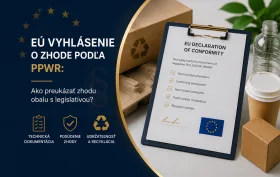
This is a document resulting from the conformity assessment process by which the manufacturer declares that the packaging meets all applicable PPWR requirements. For such a declaration to be issued, it must be supported by complete technical documentation to the extent specified by this regulation.
The scope of the supporting documents required and the practical implementation of the new obligations are raising many questions among packaging manufacturers. One of the most common is which documents will need to be prepared and whether the new requirements also apply to packaging that has already been placed on the market for several years.
What Is an EU Declaration of Conformity?
Under the PPWR, before placing packaging on the market, the manufacturer is required to carry out a conformity assessment, prepare technical documentation and subsequently issue an EU declaration of conformity. This is an official declaration by the manufacturer stating that the packaging meets the requirements of Regulation (EU) No 2025/40 on packaging and packaging waste, and assuming responsibility for its conformity with this legislation.
The declaration itself cannot be viewed as an isolated document. Its content must be supported by technical documentation demonstrating the data, tests and expert assessments on which the manufacturer based its conclusion that the packaging meets the requirements of the regulation.
The Packaging Manufacturer Is Responsible for the Content of the EU Declaration
By signing the EU declaration of conformity, the manufacturer confirms that the packaging meets all applicable PPWR requirements. The declaration is issued under the sole responsibility of the manufacturer and constitutes its official confirmation that the packaging complies with the relevant Union harmonisation legislation. To support this declaration, the manufacturer must have prepared technical documentation that makes it possible to demonstrate compliance with the PPWR requirements.
The regulation also stipulates that the EU declaration of conformity must be drawn up in accordance with the model set out in Annex VIII. This means that the manufacturer must be able to demonstrate not only what it declares, but also the supporting documents on which it based its declaration.
The Declaration Alone Is Not Enough
One of the most common mistakes is the assumption that a declaration from the material supplier or a simple internal confirmation is sufficient to draw up an EU declaration of conformity. In fact, the EU declaration is the final document in the entire conformity assessment process. Its credibility depends on the quality of the technical documentation available to the packaging manufacturer.
Technical documentation should be prepared during the design and development of the packaging and continuously supplemented during its manufacture. Its purpose is to enable surveillance authorities and business partners to verify that the manufacturer has sufficient evidence of the packaging's conformity.
What Supporting Documents Will the Manufacturer Need?
The scope of the technical documentation depends on the type of packaging, the materials used and the intended use. The most important supporting documents include:
- a general description of the packaging and its intended use (information on material composition, manufacturing drawings, documentation from raw material suppliers),
- descriptions and explanations necessary to understand the design and functioning of the packaging,
- harmonised standards, common specifications and other relevant technical specifications for measurement or calculation purposes;
- a description of the solutions adopted to meet the PPWR requirements where harmonised standards or common specifications are not applied,
- a qualitative description of how the conformity assessment was carried out,
- test reports.
Depending on the type of packaging, the technical documentation may also include additional supporting documentation needed to demonstrate compliance with specific PPWR requirements or other applicable legislation. This may include, for example, documentation demonstrating the recycled content of plastic packaging or supporting documents relating to materials and articles intended to come into contact with food.
It is the quality of these supporting documents that determines whether the EU declaration of conformity can be credibly drawn up and, if necessary, defended before surveillance authorities or business partners.
How Is Conformity Assessed Under the PPWR?
The PPWR does not require packaging conformity to be assessed by a notified body. The manufacturer carries out internal production control, which constitutes the conformity assessment procedure under Module A set out in Annex II to Decision No 768/2008/EC. As part of this procedure, the manufacturer is required to take all measures necessary to ensure that the manufacturing process and its monitoring guarantee that the manufactured packaging complies with the technical documentation. The packaging manufacturer also arranges the assessment of the packaging's conformity with the requirements of the regulation itself. It must prepare technical documentation, gather all relevant supporting documents and draw up an EU declaration of conformity on that basis.
Packaging intended for food contact requires special attention
If packaging is intended for food contact, demonstrating compliance with the requirements of the PPWR alone is not sufficient. The manufacturer must also ensure compliance with legislation governing materials and articles intended to come into contact with food. Depending on the type of material, this may include, for example, safety data sheets for input raw materials, declarations of compliance from suppliers, and, above all, the results of migration tests on the packaging. When assessing packaging conformity, it is therefore necessary to take into account both the requirements of the PPWR and legislation governing materials intended for food contact. If such packaging contains recycled plastic, the manufacturer must also demonstrate compliance with the requirements of specific legislation governing the use of recycled plastic materials and articles in contact with food.
In practice, this part of the documentation is among the most demanding. The manufacturer must obtain supporting documents from material suppliers, the results of the necessary tests and their expert assessment so that the packaging's compliance with the requirements of legislation governing materials intended for food contact can be clearly demonstrated. SK PRODUKT CERT s.r.o. carries out expert testing and provides accredited certification of packaging intended for food contact.
Demonstrating the recycled content of plastic packaging
The PPWR gradually introduces minimum recycled content levels in plastic packaging. Although labelling the recycled content on packaging is apparently not expected to be mandatory, manufacturers will have to be able to demonstrate compliance with the recycled content targets under the PPWR. For this, they will need objective evidence of the origin of the recycled material, its traceability and documentation throughout the supply chain.
Technical documentation is not a one-off task
The manufacturer's obligations do not end with the preparation of technical documentation. The documentation must reflect the current state of the product throughout the period in which it is placed on the market. Any significant change in the materials used, suppliers, packaging design or manufacturing process may affect compliance with the requirements of the PPWR. In such cases, it is necessary to check whether the existing documentation remains up to date and to amend it if necessary.
The same obligation also applies to the EU declaration of conformity, which must correspond to the current state of the technical documentation and the product. In practice, companies are advised to introduce an internal system for regularly reviewing documentation and assessing changes that may affect packaging conformity.
Must manufacturers also prepare an EU declaration of conformity for packaging placed on the market before the PPWR applies?
Articles 15, 38 and 39 of the PPWR require the manufacturer to carry out a conformity assessment, prepare technical documentation and draw up an EU declaration of conformity before placing packaging on the market. However, the Regulation does not explicitly address the situation where, after 12 August 2026, a manufacturer continues to produce the same type of packaging that was first placed on the market before that date.
Recital 14 states that packaging placed on the Union market before the date on which the relevant requirements begin to apply and held in distributors' stocks does not have to comply retrospectively with the new sustainability and labelling requirements. This provision primarily addresses the transitional period and prevents the need to retrospectively modify or withdraw from stock packaging that has already been placed on the market.
What do we recommend to packaging manufacturers?
If a manufacturer plans to continue producing and supplying packaging after 12 August 2026, now is the right time to prepare technical documentation and an EU declaration of conformity in accordance with the requirements of the PPWR. The manufacturer will thus be able to demonstrate that the packaging meets the current requirements of the Regulation and will also be ready to respond to the requirements of business partners. Such an approach is not only a matter of legislation, but also of business practice.
Customer requirements are already coming in
In the course of our work, we increasingly encounter customers requesting an EU declaration of conformity under the PPWR from packaging manufacturers, even though the Regulation will only begin to apply on 12 August 2026. We have seen a similar development in the past with materials intended for contact with food, when customers began requesting the relevant documentation during the transitional period before the new legislation began to apply. It can therefore be expected that the EU declaration of conformity under the PPWR will become (and should become) a standard part of the documentation that packaging manufacturers provide to their customers.
SK PRODUKT CERT s.r.o. provides manufacturers with expert services in accredited certification of materials and packaging for food contact as well as verification of recycled content, thereby supporting their readiness for the new PPWR requirements.
-

SK PRODUKT CERT s.r.o.
Accredited certification body, certification of plastic products and plastics intended for contact with drinking water, certification of plastic…

Suppliers on this topic
-

INSTITUT PRO TESTOVÁNÍ A CERTIFIKACI, a. s. (ITC)
Evaluation of quality and safety of products, certification of plastic products, accredited testing laboratories… -

Volkswagen Slovakia, a. s.
Materials laboratory of Volkswagen Slovakia with modern technological equipment, materials testing and trials… -

Strojírenský zkušební ústav, s.p. (SZÚ)
Comprehensive services in testing, inspection, certification, and training for manufacturing and supplier companies. -

3DTEC s.r.o.
Accredited testing services for various industries, 3D measurement, 3D scanning, programming for 3D measurements. -

Ekotoxikologické Centrum Bratislava s.r.o.
Consulting and advisory services, compliance with product legislative requirements, chemical legislation REACH, CLP. -

TECHLER INDUSTRY spol. s r.o.
Supplier of products for industry, manufacturing and service, such as oil separators (skimmers), lubrication…


MSV 2026 brought together industrial innovation, experts and young talent – Photo Gallery, Part 2: Halls A, B and F
23.10.2026 This year’s MSV offered not only industrial technologies but also a rich programme of expert events and networking, featuring around 100 conferences and discussions. Key topics included digitalisation, artificial intelligence, robotics, technical...



Most read in the last 7 days






Most read in the last 7 days