


Game changer in vocational education: Electromobility is changing schools and industry
Industry is changing faster than the education system. Automation, digitalisation and electromobility are already changing manufacturing, servicing and the requirements for technical occupations. Companies therefore need not just graduates with vocational certificates or school-leaving qualifications, but people who can learn, understand connections and work with new technologies.
This was precisely the focus of the CEOVP – Changing the Game conference, which brought together schools, companies, the public sector and young people. For industry professionals, the most interesting question was how to prepare future technicians for manufacturing that already looks different from just a few years ago.
Electromobility Is Not Just About What Drives on the Roads
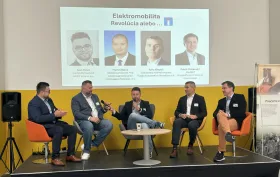
One of the main items on the programme was the panel “Electromobility – Revolution or Dead End?”, moderated by Michal Chabada. Industry experts also joined the discussion, including Patrik Križanský from SEVA, Martin Balco from Volkswagen Slovakia, Ivan Hílek from HÍLEK a spol. and Juraj Klepáčk from Hedin Automotive Slovakia.
The panel highlighted an important point: electromobility is not just about what drives on the roads today. Above all, it is about what is changing in factories.
From a maintenance perspective, an electric vehicle is simpler than a vehicle with an internal combustion engine. It has fewer mechanical parts, and many routine servicing tasks are no longer required. In practice, the main tasks that remain are checking the brake fluid, windscreen wipers and basic operating components.
However, this does not mean that electromobility is simple. Complexity is shifting towards battery systems, electronics, software, safety, thermal management and manufacturing itself.
The Change in Automotive Also Affects Plastics Processors
For car manufacturers, this is not just about replacing the engine. Electromobility is changing the entire supply chain. It affects component manufacturers, toolmakers, automation, electrical engineering, logistics and plastics processors.
| Lucia Lednárová Dítětová |
Electric vehicles bring new requirements for lightweight structures, battery system housings, insulating components, connectors, technical mouldings and materials capable of meeting demanding safety, thermal and quality requirements.
For the plastics industry, electromobility is therefore a much broader topic than the sale of electric cars. It is about materials, component design, plastics processing and suppliers' ability to respond to new automotive requirements.
Schools and Companies Must Build Closer Links
If manufacturing is changing, the way people are trained must change too. Dual education is particularly meaningful when students see technology not only in a textbook, but also in a real company environment.
This is where Centres of Excellence in Vocational Education and Training – CEOVP have an important role to play. Their aim is to strengthen digital skills and critical thinking, and better prepare students for professional practice.
| From the left: Mgr. Klaudius Šilhár, PhD., Mgr. Bibiana Lazarová, Mgr. Mariana Mlčúchová, Mgr. Vladimír Pálfi, moderator Mgr. Monika Kubincová |
What will be decisive, however, is whether more real company assignments, industry mentors and technologies that young people will also encounter when they enter employment can be incorporated into education.
Generation Z Needs Purpose, Not Platitudes
The programme also included a discussion on Generation Z, led by Ing. Milan Ráchela, head of the private automotive secondary vocational school of Duálna akadémia. An important message was that young people are not a problem, but an opportunity.
They communicate differently, have different expectations and often ask more questions about the purpose of their work. For companies, this can be challenging, but also useful. If they want to attract young people to technical fields, they must show them real technology, career prospects and concrete employment opportunities.
Simply saying that “technology has a future” is no longer enough. Young people need to see where they can progress and why their work matters.
Conclusion
The CEOVP – Changing the Game conference showed that vocational education is not just a matter for schools. It is also a matter for companies, manufacturing and the future competitiveness of industry.
Electromobility, digitalisation and automation are already changing the requirements for people working in manufacturing. If schools and companies are to respond, they must work together in a much more practical way than they have so far.
For industrial companies, including plastics processors, the message is clear: buying new technologies is not enough. They need people who understand them.
Suppliers on this topic
-

SOVA Digital a.s.
Complex solutions for digitization and optimization of production processes, Industry 4.0, industrial automation… -

OSMOS s.r.o.
ERP software, 3D design of plastic products, simulation of plastic injection, plastic press, plastic injection… -

MEPAC SK, s.r.o.
Maintenance of injection molds, tool repair, lapping, grinding, polishing, laser welding, surfacing, engraving, tool… -

KUBOUŠEK s.r.o.
Measuring instruments, injection molding machines, tempering equipment, belt conveyors, cooling systems, mills and…Lidická 1937
České Budějovice
-

Flumasys s.r.o.
Authorized distributor of Nordson, manufacturer of dosing systems, technologies for regeneration of industrial… -

A.M. spol. s r.o.
Technology consulting, design and sale of machines and peripheral equipment for the plastics operations, dispensers…




DESMA Open House 2026: Innovation, Practical Application, and International Exchange
28.10.2026 Under the motto “Built right. Runs right.”, DESMA opened the doors of its main plant in Fridingen on October 1, 2026, and welcomed over 280 visitors from around the world to a thoroughly successful Open House.
Most read in the last 7 days
-
Polymer prices - october price increases partly successful, with minor corrections expected in the week ahead
-
Polymer prices – the increase in olefin monomer contract prices in October was in line with expectations
-
Polymer prices - monomer-linked price increases based on early September levels
-
Plastica-expo 26
-
Internationale Zuliefererbörse (IZB) 2026




Most read in the last 7 days
-
Polymer prices - october price increases partly successful, with minor corrections expected in the week ahead
-
Polymer prices – the increase in olefin monomer contract prices in October was in line with expectations
-
Polymer prices - monomer-linked price increases based on early September levels
-
Plastica-expo 26
-
Internationale Zuliefererbörse (IZB) 2026