




Laser Technologies in Plastics Processing: When to Choose Decoating, Etching, Cleaning, or Cutting for an Efficient and Modern Production Environment

Laser Decoating: Selective Removal of Coated or Functional Layers
Laser decoating enables the selective removal of painted or metallized layers without affecting the underlying plastic substrate. In the automotive industry, it is primarily used for creating backlit graphics (day & night design), symbols, text, or decorative structures.
The process offers resolution in the range of tens of micrometers and high repeatability, which is essential for serial production. The non-contact principle also eliminates mechanical stress on the part and reduces the need for masking.
In addition to automotive interior and exterior components, this technology is also widely applied in consumer electronics, home appliances, HMI panels, and lighting technology, where precise graphics and a stable visual effect are required.
Get inspired by a real-world laser decoating implementation.
Laser Etching: Processing Multi-Layer Plastic Structures
Laser etching allows for deeper intervention in multi-layer painted or functional structures. It is used where the goal is not only to remove a layer, but also to modify the surface properties – for example, to change transparency, surface texture, or locally influence conductivity.
The precision of the defined processing area is in the range of hundredths of a millimeter. This technology is particularly suitable for combinations of multiple material layers, where mechanical processing would pose a risk of delamination or damage to the substrate.
It also finds applications in electronics, functional films, sensor elements, and decorative multi-layer plastic systems, where precise control of the processing depth is essential.
Laser Cleaning and Surface Pre-Treatment of Plastics
Laser cleaning represents a non-contact alternative to chemical and mechanical pre-treatment methods for plastics. It enables the removal of release agents, production residues, or fine surface contaminants without affecting the underlying material.
When process parameters are properly set, no thermal or mechanical damage occurs. The process is homogeneous and highly repeatable, making it easy to integrate into automated production lines. Where automation is not possible or practical, a mobile version of the SPYRE laser cleaning system can be used.
In addition to surface preparation prior to bonding, painting, or welding, laser cleaning is also applied in mold refurbishment, tool cleaning, and the maintenance of precision plastic components.
Read the interview: how LASCAM used laser cleaning on a VVER reactor.
Contact Cutting and Trimming of Painted Plastic Parts
Laser cutting of plastics offers an alternative to milling or mechanical trimming, particularly for finished painted visible components. The non-contact process minimizes the risk of burrs, paint cracking, and part deformation.
The technology ensures stable shape reproducibility and can be integrated directly into the production line. This is especially crucial for large-format or geometrically complex parts.
Applications extend beyond the automotive industry to packaging systems, technical plastic housings, medical plastics, and structural polymer components.
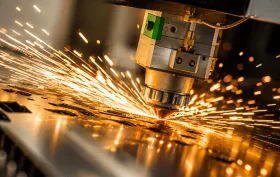
Take a look at a large-format laser cutting example.
Laser as a Stable Component of Serial Production
Today, laser applications are no longer just a design tool, but a fully-fledged manufacturing technology. The key lies in the correct assessment of the material composition, the type of layer involved, and the requirements for the final function or appearance.
When properly integrated into the process, laser technology offers high repeatability, precise control of the intervention area, and long-term parameter stability, all of which are critical factors in serial production.
From the perspective of plastics processing, it is therefore not about replacing one method with another, but about selecting the technology that best meets the specific production requirements.
-

LASCAM systems s.r.o.
Laser components, machine knives, blades, cutting tools, industrial robots, manipulators, laser technologies, plastic welders, automatic welding...




Branson to showcase welding technologies at MSV 2026
10.9.2026 At MSV Brno 2026 (Hall G1, Stand 55), Branson will showcase advanced welding and joining technologies that enhance manufacturing flexibility, quality, and connectivity.