


BOLE: Premiere of the MG 300 Thixomolding Injection Molding Machine at PLASTPOL
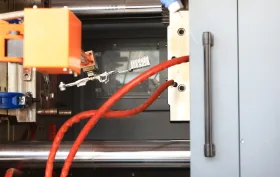
BOLE Unveiled Thixomolding Technology Developed in Cooperation with Research Institutions
Thixomolding technology, which BOLE is developing in cooperation with scientific research institutions, represents an advanced method of processing magnesium alloys in a semi-solid state. This process is increasingly regarded as one of the most promising technologies for the automotive industry, consumer electronics and the production of lightweight structural components.
Magnesium Injection Moulding – Metal Processed Like Plastic
Thixomolding technology can be described as a combination of die casting and plastics injection moulding technology. Unlike conventional casting processes, the material is not processed in a fully molten state. Magnesium alloy chips are fed into the machine barrel, where they are transformed into a semi-solid state and then injected into the mould at high speed.
A key element of the process is the material's thixotropic behaviour – under shear stress, the alloy flows like a liquid while retaining the properties of a semi-solid material. A specially designed plasticising system makes it possible to achieve a fine-grained globular microstructure with a high degree of uniformity.
BOLE began developing Thixomolding technology in 2019 through a joint research and development programme with Shanghai Jiao Tong University under the leadership of Professor Xiaoqin Zeng.
BOLE MG 300 – European Premiere at PLASTPOL
The highlight of BOLE's presentation at PLASTPOL was the premiere of the new MG 300 injection moulding machine with a clamping force of 300 tonnes, designed specifically for processing magnesium alloys in a semi-solid state.
The new platform is engineered to ensure high process dynamics and stable production parameters. The machine design includes:
- a high-rigidity clamping unit,
- a low-inertia injection system,
- fast-response servo valves,
- a mechanical-hydraulic braking system for high-speed injection.
The technology enables extremely high injection speeds without compromising process precision or control over the material's microstructure.
According to BOLE, the solution has been developed to produce thin-walled, high-strength components for:
- electromobility,
- consumer electronics,
- the aerospace industry,
- drones and lightweight engineering applications.
An Alternative to Conventional Magnesium Die Casting
One of the greatest advantages of Thixomolding technology is its ability to eliminate many of the problems associated with traditional magnesium die casting.
The process does not require a separate melting furnace or protective gases such as SF₆, which face increasingly stringent environmental restrictions in the European Union. The technology also reduces the risk of fire and, compared with conventional casting processes, can reduce energy consumption by as much as 50 to 60 %.
Other advantages include:
- lower porosity,
- a more homogeneous microstructure,
- higher mechanical strength,
- better fatigue resistance,
- longer mould service life,
- lower material losses.
According to data presented by BOLE, component strength can increase by approximately 10 %, while elongation can improve by up to 50 % compared with traditional casting technologies.
Lightweight Structures and New Design Possibilities
BOLE emphasises that the development of Thixomolding technology is a direct response to the growing importance of lightweight materials and component weight reduction in modern industry.
The company has already presented a wide range of applications for magnesium processed in a semi-solid state, including:
- laptop housings,
- consumer electronics components,
- structural components for the automotive industry,
- components for UAVs,
- and even the world's first automotive wheel rim made from magnesium processed in a semi-solid state.
Industry experts anticipate that this technology could play a significant role in the future development of electromobility and advanced lightweight structures.
BOLE at PLASTPOL
During PLASTPOL, visitors to the BOLE stand had the opportunity to learn more about the capabilities of Thixomolding technology and discuss potential industrial applications of the new MG 300 platform with the company's technical experts.
Photo Gallery


-

BOLE Europe Technology Co.LTD.sp.zo.o.
Bole injection molding machines: hydraulic, fully electric, double plate, two-component injection molding machines (2K).
Suppliers on this topic
-

Wittmann Battenfeld SK spol. s r.o.
Wittmann peripherals, plastics processing machines, spare parts for WITTMANN BATTENFELD peripherals, injection molding… -

1.PLASTCOMPANY, spol. s r.o.
Horizontal and vertical injection molding machines, extruders and extrusion lines, extrusion tools, material conveyors… -

MAPRO Solution a.s.
Haitian injection molding machines, fully electric ZHAFIR VENUS injection molding machines, screws, cylinders, PCB… -

MAPRO SLOVAKIA , s.r.o.
Haitian injection molding machines, fully electric ZHAFIR VENUS injection molding machines, screws, cylinders, PCB… -

Wittmann Battenfeld CZ spol. s r.o.
Injection molding machines, linear robots and manipulators, tempering devices, systems for drying and conveying… -

ARBURG SK s.r.o.
Injection molding machines, Arburg injection molding machines - sales and service, peripherals, automation and…


Long-lasting solution: Radiation-crosslinked PE-Xc pipes for drinking water supply
30.10.2026 Radiation-crosslinked PE-Xc pipes offer high resistance to pressure, temperature and mechanical stress. Multilayer composite pipes can also be reliably crosslinked using electron beams. Thanks to their long service life, PE-Xc pipes contribute to...



Most read in the last 7 days
-
Polymer prices - october price increases partly successful, with minor corrections expected in the week ahead
-
Polymer prices – the increase in olefin monomer contract prices in October was in line with expectations
-
Plastica-expo 26
-
Polymer prices - monomer-linked price increases based on early September levels
-
Internationale Zuliefererbörse (IZB) 2026




Most read in the last 7 days
-
Polymer prices - october price increases partly successful, with minor corrections expected in the week ahead
-
Polymer prices – the increase in olefin monomer contract prices in October was in line with expectations
-
Plastica-expo 26
-
Polymer prices - monomer-linked price increases based on early September levels
-
Internationale Zuliefererbörse (IZB) 2026