

Trade Fair K 2025 in Düsseldorf: Plastics and circularity – caught between necessity and potential
The circular economy around the world
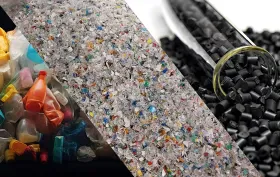
The world is facing a raw materials crisis: more than 100 billion tonnes of raw materials are consumed every year, yet more than 90 % of them are not recycled. The European Investment Bank (EIB) highlights this alarming ratio. Rising CO₂ costs, volatile raw material prices and geopolitical uncertainties are putting further pressure on companies to manage resources more efficiently.
The circular economy is considered a key tool for achieving a sustainable future. An analysis by consultancy Material Economics shows that Europe could save 450 million tonnes of CO₂ equivalent by 2030 through closed material loops – representing 8 % of current emissions. In the long term, the Ellen MacArthur Foundation estimates that a closed-loop circular economy could prevent up to 45 % of emissions.
This transformation also offers enormous economic potential: according to estimates by consulting group EY, using secondary raw materials reduces energy consumption by 20 % to 90 %, saves large quantities of water and could save European companies up to 465 billion EUR in material costs annually. The International Labour Organization (ILO) expects the transition to a circular economy to create 7 to 8 million new jobs worldwide by 2030. An increasing number of case studies show that circularity is beneficial not only environmentally but also economically. For example, the German group Cabka produces pallets and crates from approximately 150 000 tonnes of recycled plastics annually, demonstrating how waste can be turned into valuable products.
For the plastics industry, the circular economy is both an obligation and an opportunity. A strictly regulated approach prevails in Europe, government measures are combined with technological initiatives in Asia, and in the Americas we encounter a wide range of approaches – from ambitious requirements to fragmented measures or faith in the invisible hand of the market.
However, each of these models has its pitfalls. Although regulations set clear rules, they can lead to excessive bureaucracy and hold back investment – something that is becoming increasingly apparent in Europe in particular. “To prevent the transformation from slowing down, we urgently need measures that make investment in the production of plastics ready for the circular economy more attractive. We must reduce the administrative burden, for example by accelerating lengthy approval processes, and ensure fair conditions in international competition,” warns Virginia Janssens, Managing Director of Plastics Europe.
Although market mechanisms foster innovation, they do not guarantee the widespread implementation of solutions. Centrally managed strategies deliver rapid progress, but can be inefficient. One thing is certain – without higher recycling rates and wider use of recyclates, the circular economy will remain just a fragmented mosaic. If individual regions learn from one another, they can combine their strengths and compensate for their weaknesses.
Shaping the circular economy at K 2025
At the K 2025 trade fair, companies from various areas of industry – from raw material producers and machinery manufacturers to processors – will present both the progress made so far and future solutions for the circular economy. The main theme will be “Shaping the Circular Economy”. This topic will also be addressed as part of the trade fair's special events, with the VDMA Dome being one of the programme highlights.
VDMA (German Mechanical Engineering Industry Association) will once again organise an extensive forum entitled “The Power of Plastics”, which will take place in the trade fair's outdoor area. Together with 12 member companies on site – between Halls 10 and 16 – it will demonstrate the key role technology plays in implementing the circular economy in the plastics industry.
Another important highlight will be the official special event “Plastics Shape the Future” in Hall 6, organised by Plastics Europe Germany. On Thursday, 9 October, a discussion forum will take place here under the theme “Circular Thursday: Industrial transformation and resilience – which technologies will enable the circular economy to work?”
For more information on the circular economy, visit: Circular Economy: Future of the Plastics Industry | K Trade Fair
The K 2025 trade fair will be open daily from 10:00 to 18:30 from Wednesday, 8 October to Wednesday, 15 October.
Tickets are available online from 15 April:
- 1-day ticket: 60 EUR
- 3-day ticket: 125 EUR
- School pupils and students: 1-day ticket for 20 EUR
Suppliers on this topic
-

Slovensko-nemecká obchodná a priemyselná komora
Support of trade and economic relations between Germany and Slovakia, consultancy for plastic and rubber production… -

IPA Slovakia, s.r.o.
Consulting for plastic and rubber production, accredited education in the field of plastics, training of operation and… -
Plastikářský klastr
Services for the plastics industry, seminars, workshops, conferences, education, training, plastics production… -

Öko-Pack s.r.o.
Specialising in trading used plastic packaging, logistics and storage products. Buying and selling surplus plastic…ul. 1. mája 6
Hurbanovo
-

Active Communication s.r.o.
Exhibitions, seminars, workshops, conferences, education, training, fair of composite materials. -

SUVko s.r.o.
A training and consulting company connected to business results. Tailor-made solutions that deliver the change…


MOL Group Expands Its Green Energy Portfolio with Bi methane Production
29.10.2026 The MOL Group has officially opened its first biomethane production plant in Szarvas, in Békés County, southeastern Hungary. The facility, representing an investment of more than €7.4 million, can produce biomethane from biogas at a purity level...

Most read in the last 7 days
-
Polymer prices - october price increases partly successful, with minor corrections expected in the week ahead
-
Long-lasting solution: Radiation-crosslinked PE-Xc pipes for drinking water supply
-
Polymer prices – the increase in olefin monomer contract prices in October was in line with expectations
-
Polymer prices - Year-End Polymer Price Scenarios
-
Plastica-expo 26





Most read in the last 7 days
-
Polymer prices - october price increases partly successful, with minor corrections expected in the week ahead
-
Long-lasting solution: Radiation-crosslinked PE-Xc pipes for drinking water supply
-
Polymer prices – the increase in olefin monomer contract prices in October was in line with expectations
-
Polymer prices - Year-End Polymer Price Scenarios
-
Plastica-expo 26