





Job cuts continue: The number of employees in Germany’s mechanical engineering sector fell slightly in the first half of the year, reports the VDMA
“Our industry is under considerable pressure. In particular, the high level of global uncertainty and the associated reluctance to invest, as well as structural changes and global competitive pressure, are presenting companies with growing challenges. The fact that many of them are retaining their core workforce despite everything reflects their long-term planning and responsibility,” explains Dr. Johannes Gernandt, Chief Economist at VDMA.
The Shortage of Skilled Workers Remains a Key Issue
Despite the strained labour market situation, the shortage of skilled workers remains a structural challenge. According to the ifo Institute, almost one in four companies (23 percent) in the machinery and equipment manufacturing sector still reports production bottlenecks due to staff shortages.
More than a quarter of employees in this sector will reach retirement age within the next ten years. The shortage of skilled workers will therefore remain a long-term problem. “Policymakers must finally respond to this: incentives for early retirement must be removed and the retirement age must be gradually increased,” demands Fabian Seus, Head of VDMA's Competence Centre for the Labour Market. “We must not forget the issue of skilled worker immigration either. Above all, we need faster qualification recognition processes, and the ban on temporary agency employment must be lifted,” adds Seus.
Tackling Structural Change with Courage
Companies must make even greater use of the opportunities offered by digitalisation and artificial intelligence. New opportunities are also opening up in new sales markets, such as the ASEAN countries, Africa and Latin America. This is precisely where greater entrepreneurial courage is needed to develop new business models. “To achieve this, we need a policy shift that creates planning certainty and enables economic dynamism. Anyone who wants to secure Germany's position as an industrial location must put an end to stagnation,” demands Dr. Gernandt.
Labour Market Reforms Are Essential
Labour market conditions also play a key role in the future development of employment. Lower labour costs are essential if small and medium-sized industrial enterprises are to remain competitive. “The most pressing policy task is to reduce social security contributions. We need a competitive level, no more than 40 percent, to support employment. Every percentage point above this threshold makes the location less attractive and puts jobs at risk,” warns Seus. “We can only achieve this through reforms across all social security systems. Digitalisation can certainly help us here, but the benefits provided also need to be fundamentally reassessed,” emphasises VDMA's labour market expert.
Suppliers on this topic
-

TG – Toman Group spol s r.o.
Komplexné technologické riešenia na mieru, adiabatické chladenie, poradenská, montážna, inštalačná a servisná činnosť… -

Better industry s.r.o.
A technology company that delivers software products and solutions aimed at improving the efficiency of manufacturing… -

SOVA Digital a.s.
Complex solutions for digitization and optimization of production processes, Industry 4.0, industrial automation… -

CZ TOOLBOX
A Czech-made tool storage and dispensing system that is integrated directly into the company's production processes.… -
DOLIS GOEN, s.r.o.
The company owns a basic profile.





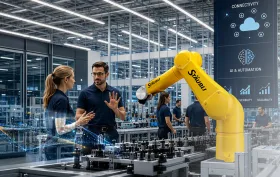
AI in maintenance: How to turn data and human expertise into practical support for manufacturing
2.11.2026 Predictive maintenance, access to know-how, and faster troubleshooting. The panel discussion showed that the real value of artificial intelligence in industrial maintenance lies not only in predicting failures, but also in how companies work with...



Most read in the last 7 days
-
Polymer prices - october price increases partly successful, with minor corrections expected in the week ahead
-
Long-lasting solution: Radiation-crosslinked PE-Xc pipes for drinking water supply
-
Polymer prices – the increase in olefin monomer contract prices in October was in line with expectations
-
Polymer prices - Year-End Polymer Price Scenarios
-
Plastica-expo 26





Most read in the last 7 days
-
Polymer prices - october price increases partly successful, with minor corrections expected in the week ahead
-
Long-lasting solution: Radiation-crosslinked PE-Xc pipes for drinking water supply
-
Polymer prices – the increase in olefin monomer contract prices in October was in line with expectations
-
Polymer prices - Year-End Polymer Price Scenarios
-
Plastica-expo 26