

Delegation of EU Ministers visits the largest green hydrogen plant in Central and Eastern Europe
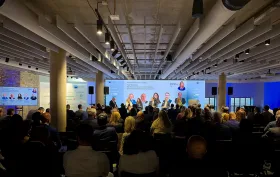
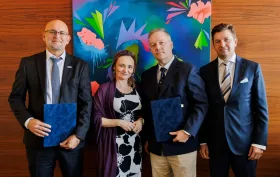
On 28–29 October 2024, a ministerial meeting of the High-Level Group on Central and South-Eastern Europe Energy Connectivity (CESEC) took place in Budapest. The event was organised by the European Commission in cooperation with the Hungarian Presidency of the Council of the European Union. During the meeting, participants adopt conclusions and action plans concerning electricity, renewable energy sources and natural gas. Before the official programme, the delegations visited MOL Group's green hydrogen production plant to gain first-hand experience of the facility with the largest capacity in Central and Eastern Europe.
“We are pleased to share with other CESEC countries the experience and knowledge we have gained so far in green hydrogen production. We believe that green hydrogen can play an important role in making industrial activities and mobility greener. MOL Group's plant in Százhalombatta, together with our similar facilities planned in the region, is one of the first steps. We are committed to advancing the transition to green energy through our investments. However, meeting the European Union's ambitious climate targets while maintaining Europe's competitiveness requires incentives for industrial players and an EU regulatory environment that takes economic challenges and regional characteristics into account. I hope that European decision-makers will also be partners to industry in this respect,” said György Bacsa, CEO of MOL Maďarsko.
 |
|
MOL Group's green hydrogen production plant, with a capacity of 10 megawatts, was officially inaugurated in April and has been fully operational since the end of the summer. The facility uses electricity from renewable sources to split water into hydrogen and oxygen and produces 1 600 tonnes of clean, carbon-neutral green hydrogen annually, which is used to produce motor fuels. According to MOL Group's plans, it may soon also be used directly in transport. No polluting by-products are generated during the production process, and the plant produces 8 to 9 tonnes of pure oxygen per tonne of hydrogen. As a result, the facility will reduce the Duna refinery's carbon footprint by more than 25 000 tonnes of carbon dioxide annually, equivalent to the annual carbon dioxide emissions of approximately 5 400 conventional cars.
The CESEC High-Level Group, established in 2015, coordinates the facilitation of energy infrastructure projects in Central and South-Eastern Europe and works to accelerate market integration, the deployment of renewable energy sources and the integration of hydrogen and biomethane into networks in the region. In addition to the EU Member States in the region, eight other Energy Community countries also participate in the cooperation.
-

SLOVNAFT, a.s.
Production and sale of petroleum products and it´s chemical processing - production and distribution of polyethylene (LDPE) and polypropylene (PP)…
Suppliers on this topic
-

TG – Toman Group spol s r.o.
Komplexné technologické riešenia na mieru, adiabatické chladenie, poradenská, montážna, inštalačná a servisná činnosť… -

Öko-Pack s.r.o.
Specialising in trading used plastic packaging, logistics and storage products. Buying and selling surplus plastic…ul. 1. mája 6
Hurbanovo
-

Flumasys s.r.o.
Authorized distributor of Nordson, manufacturer of dosing systems, technologies for regeneration of industrial… -

Dopak sp. Z o. o.
Dopak is one of the leading suppliers for the plastics processing and recycling industry in Central Europe.


MOL Group Expands Its Green Energy Portfolio with Bi methane Production
29.10.2026 The MOL Group has officially opened its first biomethane production plant in Szarvas, in Békés County, southeastern Hungary. The facility, representing an investment of more than €7.4 million, can produce biomethane from biogas at a purity level...

Most read in the last 7 days
-
Polymer prices - october price increases partly successful, with minor corrections expected in the week ahead
-
Long-lasting solution: Radiation-crosslinked PE-Xc pipes for drinking water supply
-
Polymer prices – the increase in olefin monomer contract prices in October was in line with expectations
-
Polymer prices - Year-End Polymer Price Scenarios
-
Plastica-expo 26





Most read in the last 7 days
-
Polymer prices - october price increases partly successful, with minor corrections expected in the week ahead
-
Long-lasting solution: Radiation-crosslinked PE-Xc pipes for drinking water supply
-
Polymer prices – the increase in olefin monomer contract prices in October was in line with expectations
-
Polymer prices - Year-End Polymer Price Scenarios
-
Plastica-expo 26