


When Data Drives Production: The Benefits of MES Systems Beyond Plastics Manufacturing
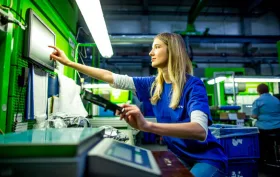
Data Are the Foundation
Even our great-grandfathers knew that. Every day, we ask ourselves why so many production operations still record everything on paper, transcribe it manually and analyse it with who knows what error rate. Why production is still managed the old-fashioned way even at workplaces with modern, state-of-the-art equipment. When it is so easy to collect data automatically from all machines and workstations. It is not about automated = cheaper; it is about the fact that this is the only way to obtain large amounts of hard data online and, thanks to that data, accurate online overviews. It is not MES yet, but it is a good start. Quality data for good decisions. The actual reality.
So What Is MES?
It is far more than just data collection, production reporting, KPI calculations and plotting a few charts. It is real-time production management. With a good MES as a tool, it is easy to build automated production management on top of online data. It takes work and a determination to do things differently, but it pays off many times over. What better way to minimise downtime than, for example, calling a setter before an operation ends so that they can get ready at the machine in question (for example, 10 min. in advance, by SMS)? MES is therefore not a means of achieving paperless production (though of course it is that too), it is a tool for increasing efficiency. Nothing less. Nothing more? Yes, more: MES provides data for downstream applications, including AI.
Performance Under Control
MES makes it possible to assess not only overall KPIs (OEE, SMED etc. ), but also the performance of individual workstations and operators. This makes it very easy to identify production bottlenecks. It is easy to motivate employees, for example by rewarding them for exceeding the set OEE value on a particular shift. Simply visualising the current production status on the shop floor has demonstrable benefits in itself.
Quality and Audits
Quality first. Less scrap, more money. MES records all product data, including unique identification of individual items where applicable, integrates training plans and inspection plans, generates inspection requests and records measurement results directly against the production batch. It is not just about substantial time savings when preparing for customer audits. It is about being able to use MES to configure the production management workflow already mentioned with quality in mind, for example using poka-yoke principles. Transparent production documentation increases a company's credibility and strengthens its position in the market. In many cases, it helps secure more attractive and lucrative orders.
Production Planning and Scheduling
Yes, production can be scheduled “manually”. Or at ERP system level. But always with a certain limit on efficiency, because the human brain cannot handle everything, and ERP does not have as much production data as MES. When we combine enormous computing capabilities, sophisticated algorithms and data from MES, we can calculate significantly more efficient production plans. And we do not depend on our production planner's health. We can respond immediately to changes in production. We can schedule production with maximum machine utilisation, on-time deliveries or something else as the priority. We can take into account the availability of machines and tools, materials and semi-finished products, operator qualifications and predictive maintenance, optimise transitions between operations and incorporate many other requirements. The result is less chaos, savings in capacity and energy, earlier deliveries and better machine utilisation – money again.
People and Their Skills
To put it cautiously, the quality of operators is not improving. There is simply a shortage of good ones, and it is not going to get any better. And, surprisingly, MES suddenly has a role to play here too. If we make things easier for operators, for example by providing video instructions on terminals for the operations they register for, and build an easier, more “foolproof” workflow for them, this can be a solution. And if the operator terminal is also available in Filipino, for example, it will open up further possibilities for production.
Continuous Improvement
Implementing MES is not a one-off project, but the start of systematic, continuous improvement. Of course, most manufacturing companies strive to improve, and many perhaps even do so systematically. But suddenly, the company gains tools to identify untapped potential easily and continuously, eliminate waste and increase efficiency. To respond quickly to changes and new requirements. To gradually deploy additional user scenarios that take efficiency a step further. Production thus becomes more flexible, more resilient and better prepared for future challenges.
Paperless Production and Rapid Responses
The pace of life keeps accelerating, and fast, accurate communication is essential. MES replaces paper job travellers with digital instructions – operators always have the latest work procedures, drawings and other documentation on their panels, can be automatically notified of the latest changes and must acknowledge them. This simplifies and speeds up the entire team's work and minimises errors.
Conclusion
When I see how MES helps our customers every day, how they continue to improve thanks to MES even after years, and how some can quantify the individual benefits, I do not really even want to imagine production without MES. In my opinion, it is the best investment. And viewed from a quarter of the way through the 21st century, it is clearly a necessity, not a visionary step. Many have been caught napping, but they can still catch up. I wish everyone the willingness to change; it is worth it.
Suppliers on this topic
-

SOVA Digital a.s.
Complex solutions for digitization and optimization of production processes, Industry 4.0, industrial automation… -

OSMOS s.r.o.
ERP software, 3D design of plastic products, simulation of plastic injection, plastic press, plastic injection… -

TG – Toman Group spol s r.o.
Komplexné technologické riešenia na mieru, adiabatické chladenie, poradenská, montážna, inštalačná a servisná činnosť… -

UNIS, a.s.
The company owns a basic profile. -

Bonafa projekt s.r.o.
Protection of interiors against overheating and glare, external shading of rooflights with screen fabrics, rooflight… -

NebelX, s.r.o.
High-pressure air humidification, adiabatic cooling and water treatment tailored to industrial and commercial…


AI in maintenance: How to turn data and human expertise into practical support for manufacturing
2.11.2026 Predictive maintenance, access to know-how, and faster troubleshooting. The panel discussion showed that the real value of artificial intelligence in industrial maintenance lies not only in predicting failures, but also in how companies work with...




Most read in the last 7 days
-
Polymer prices - october price increases partly successful, with minor corrections expected in the week ahead
-
Long-lasting solution: Radiation-crosslinked PE-Xc pipes for drinking water supply
-
Polymer prices – the increase in olefin monomer contract prices in October was in line with expectations
-
Polymer prices - Year-End Polymer Price Scenarios
-
Plastica-expo 26





Most read in the last 7 days
-
Polymer prices - october price increases partly successful, with minor corrections expected in the week ahead
-
Long-lasting solution: Radiation-crosslinked PE-Xc pipes for drinking water supply
-
Polymer prices – the increase in olefin monomer contract prices in October was in line with expectations
-
Polymer prices - Year-End Polymer Price Scenarios
-
Plastica-expo 26