

Turning waste into new products – BASF introduces two new methods for recycling polyamides from end-of-life vehicles
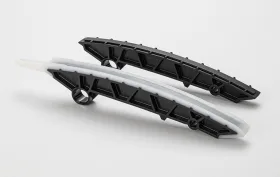
Depolymerisation of Dismantled End-of-Life Polyamide Components
BASF has developed an innovative chemical recycling process that sets new standards for recycling engineering plastics and demonstrated its capabilities in a pilot project. This process enables even heavily used and contaminated plastic parts to be recycled efficiently and sustainably at the end of their life cycle – in this case, for example, used oil pans from ZF Group taken from end-of-life vehicles. At the heart of the process is depolymerisation, in which long polyamide chains are broken down at their natural cleavage sites into their original building blocks – monomers. In the next step, the caprolactam monomer obtained by depolymerising PA6 is purified. This makes it possible to completely remove potentially disruptive contaminants resulting from the material's previous use. These contaminants would remain in the material during mechanical recycling and could potentially reduce the quality and safety of the recycled material. The material is then polymerised again into high-quality polyamide, which is further processed into a polyamide compound in line with the requirements of the specific application. This meets the highest quality standards and is suitable for manufacturing demanding automotive components – closing the loop from car to car.
“What was previously considered non-recyclable now forms the basis of new high-quality products,” explains Martin Scheuble, Team Leader for Engineering Plastics Circularity at BASF.
The success of project partner ZF Group in processing the recycled material into complex, technically sophisticated chassis components, known as stabiliser links, for Mercedes-Benz clearly demonstrates the sustainability of this material in practical applications. Tests carried out on test specimens and the manufactured components themselves show that depolymerisation enables polyamide compounds to be used without compromising performance or other chemical or physical properties.
“This project highlights the potential of recycled plastics – even in technically demanding applications – and underlines ZF's innovative capabilities in establishing sustainable material cycles,” said Dr. Michael Lohrmann, Director of Materials Technology at ZF, explaining its importance for the automotive parts supplier.
Dissolution Recycling of Polyamides from Automotive Shredder Residue
The second pilot project focuses on recycling automotive shredder residue (ASR) – a complex mixture of different materials that remain after the removal of primarily metals and glass. Thanks to close cooperation with a recycling company, polyamides have now been successfully extracted from this mixture in largely pure form using newly available sorting and processing technology.
Some of the polyamides recovered in this way were used in the pilot project as feedstock for a new solvent-based recycling process. In this process, the polymer chain is not broken down but is selectively dissolved using a suitable solvent, then purified and finally reprocessed into PA6 compounds.
This technology was validated using a chain guide rail in Mercedes-Benz series production. As a project partner, Pöppelmann manufactured the components in the pilot project and successfully tested them under near-series-production conditions.
“This project demonstrates remarkably well that solvent-based recycling is a practical alternative for plastics that are difficult to recycle mechanically. It makes an important contribution to the overall circular economy – from vehicle back to vehicle,” emphasises Steffen Meyer, Team Leader for Production Technology at Pöppelmann.
Life Cycle Assessment (LCA) Confirms Significant CO2 Reduction
Alongside the pilot projects, life cycle assessments (LCA) were also carried out by an external partner. The results clearly demonstrated the advantages of the new recycling processes: both solvent-based technology and depolymerisation recycling show a substantial reduction in CO₂ emissions – not only in comparison with the production of conventional polyamide compounds based on fossil raw materials, but also compared with traditional plastics recycling methods such as energy recovery. Each of the processes could therefore make a significant contribution to the circular economy and the sustainable transformation of the plastics industry in the future.
Maintaining a Broad Range of Technologies
BASF summarises the three stages of the product life cycle, i. e. production, use and recycling, in its #OurPlasticsJourney campaign. BASF offers a broad range of recycling solutions for the final stage of the cycle, as recycling targets can only be achieved if these solutions complement one another. The most suitable technologies are determined primarily by the type and availability of waste and the degree of sorting.
As Jana Krägenbring-Noor, Head of Sustainability and Environmental Protection at Mercedes-Benz, explains: “Mercedes-Benz is committed to using secondary raw materials in its current and future vehicles as part of resource conservation and circularity. To ensure that the availability of these sought-after secondary raw materials continues to increase, it is essential to expand existing recycling technologies and introduce new ones. Pilot projects across the value chain are crucial to continuously expanding the range of recycling processes used and gaining well-founded insights. This technological diversity represents another important step through which we can contribute to resource conservation.”
“We are continuously improving the efficiency of physical methods such as mechanical recycling and solvent-based recycling. Furthermore, we are convinced that complementary technologies, such as chemical recycling involving depolymerisation, pyrolysis and gasification, are needed to further support the circular economy and reduce the amount of plastic waste that still ends up in landfills or incinerators today. They are also a potential source of high-quality recycled plastics. The right regulatory framework is a fundamental prerequisite for making optimal use of the various options for plastics recycling and simultaneously developing all technologies,” explains Dr. Martin Jung, President of BASF Performance Materials.
For more information on polyamide recycling and other BASF solutions, you can contact your local BASF representative:
Petr Maňas
Key Account Manager
+420 737 240 506
petr.manas@basf.com
-

BASF spol. s r.o.
Supplier of chemical solutions, engineering and high-performance plastics, and rubber materials designed for demanding industrial applications.

Suppliers on this topic
-

geba Kunststoffcompounds GmbH
Masterbatches for plastics, plastic regranulate, ABS regranulate, ABS plastic regranulate, PC, PC/ABS, PA6, PA66, TPU… -

Remarkplast compounding a.s.
Plastic compounds, plastic compounding, regranulate, plastic regranulation, construction plastics - production and… -

Hort Plast s.r.o.
Production of high quality plastic materials PSH, PSPE, PP and ABS, for industry, construction, automotive and food… -

JMK Recycling, s.r.o.
JMK Recycling, s.r.o. - plastic sorting, plastic recycling, crushing, plastic regranulation, waste management… -

BRIKLIS, spol. s r.o.
Czech manufacturer of machines, briquetting presses, crushers, conveyors and waste processing lines. -

TECHLER INDUSTRY spol. s r.o.
Supplier of products for industry, manufacturing and service, such as oil separators (skimmers), lubrication…




MOL Group Expands Its Green Energy Portfolio with Bi methane Production
29.10.2026 The MOL Group has officially opened its first biomethane production plant in Szarvas, in Békés County, southeastern Hungary. The facility, representing an investment of more than €7.4 million, can produce biomethane from biogas at a purity level...

Most read in the last 7 days
-
Polymer prices - october price increases partly successful, with minor corrections expected in the week ahead
-
Polymer prices - Year-End Polymer Price Scenarios
-
Long-lasting solution: Radiation-crosslinked PE-Xc pipes for drinking water supply
-
Polymer prices – the increase in olefin monomer contract prices in October was in line with expectations
-
Plastica-expo 26




Most read in the last 7 days
-
Polymer prices - october price increases partly successful, with minor corrections expected in the week ahead
-
Polymer prices - Year-End Polymer Price Scenarios
-
Long-lasting solution: Radiation-crosslinked PE-Xc pipes for drinking water supply
-
Polymer prices – the increase in olefin monomer contract prices in October was in line with expectations
-
Plastica-expo 26