





Hot runner system from HRSflow for Class A vehicle windows made of polycarbonate

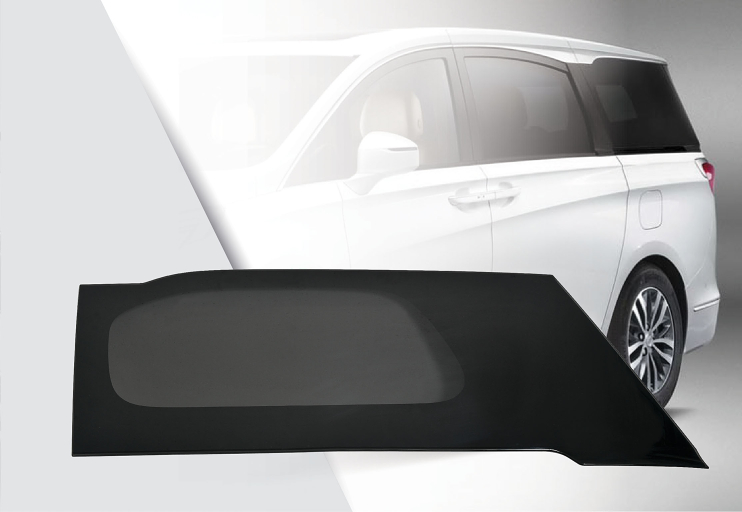
One is for producing the transparent first component and the other for the partial, seamless overmolding with a dark-colored PC around the edges. Both systems integrate the programmable FLEXflow valve gate technology, which enables the manufacturer to achieve the outstanding surface quality specified by the OEM for these parts. With dimensions of 1,200 mm x 460 mm, it is currently the world's largest molding of its kind. Furthermore, FLEXflow helps to ensure that the windows – which are around 40 % (3 kg) lighter than comparable parts made of glass – have very high fitting precision for unproblematical assembly with minimum warpage and very tight tolerances. During the course of the project development, HRSflow supported the converter with extensive Moldflow simulations during optimization of the production parameters for these large, asymmetrical parts.
The two hot runner systems developed by HRSflow each have a hot runner manifold with ten servo-electrical drives for the nozzles with conical valve gate, integrated into the clamp platen. The FLEXflow technology from HRSflow used to control the sequential injection process makes it possible to coordinate every single individually driven needle precisely to the process and to open and close it with selectable speeds. This allows absolute precision control both of the melt flow in the individual hot runner nozzles and of the volume flow in the overall cavity so that it is filled evenly and homogeneously.
 |
|
fig.: The rear-quarter window of a large MPV is a two-component injection molding part, produced with a Class A surface using the precisely controllable FLEXflow valve gate system from HRSflow. © HRSflow |
Thanks to the gentle opening and closing of the needles, there is none of that undesired pressure drop or changes in temperature and flow velocity as can occur with conventional cascade injection molding during the sequentially abrupt switching on of the hot runner nozzles. This thus also eliminates unsightly flowmarks on the molded part. The overall result is Class A molding surface with no optically relevant defects. The main applications of the FLEXflow technology are the injection molding of high-quality complex automotive parts including large-area exterior and interior components such as spoilers, front ends, instrument panel supports, door trim and headlights as well as wide trunk taillights, plus the rear-quarter windows described here made of transparent polycarbonate (PC).
-

Oerlikon HRSflow
Design and manufacture of hot runner systems, SLM inserts, selective laser dissolution, temperature control devices, temperature controllers, hot…

Suppliers on this topic
-

3M TRADE - PLASTIC PARTS s. r. o
Plastic molding, plastic injection, injection molds, molds, industrial robots, manipulators, grippers, EOAT components. -

Anton Clemens s.r.o.
Plastic injection molding, production of injection molds, plastic products for automotive, two-component injection… -

FORM s.r.o.
Glass-reinforced plastics, fiberglass, thermoplastic products, painting of plastic products, metal production and… -

PLP Czech Republic (MICOS) / MICOS TELCOM s.r.o.
Specialist in plastic injection molding, serial production, custom solutions and turnkey projects for automotive… -

WMW – Production, s.r.o.
Plastic moulding and mould making, production of plastic products requiring precision processing. -

LPH GROUP
Technical and aesthetic moldings made of thermoplastics, production of injection molds for thermoplastics, surface…



Stäubli Robotics Hosts the First North East European Robotics & Automation Summit
12.10.2026 On November 19 and 20, 2026, the Stäubli Welcome Center in Bayreuth, Germany will become the meeting point for the automation industry of Northern, Central and Eastern Europe. The North East European Robotics & Automation Summit also marks the...



Most read in the last 7 days
-
BASF expands the Ultradur® portfolio with new grades based on post-consumer recycled PET
-
OPEX Industry Summit 2026: Meeting of Slovak Industry Leaders
-
Polymer prices – the increase in olefin monomer contract prices in October was in line with expectations
-
Fully automated production cell for manufacturing rubber-to-metal bonded parts by ROMI Automation
-
Polymer prices - narrowing availability, rising prices without panic buying


Most read in the last 7 days
-
BASF expands the Ultradur® portfolio with new grades based on post-consumer recycled PET
-
OPEX Industry Summit 2026: Meeting of Slovak Industry Leaders
-
Polymer prices – the increase in olefin monomer contract prices in October was in line with expectations
-
Fully automated production cell for manufacturing rubber-to-metal bonded parts by ROMI Automation
-
Polymer prices - narrowing availability, rising prices without panic buying