


FORMY A PLASTY 2026: A conference showing that stable production begins long before the first moulded part
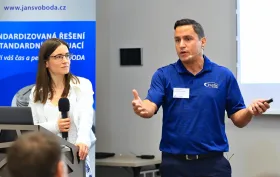
It was precisely this continuity that was one of the greatest strengths of the entire conference. The programme was not seen as a series of separate company presentations, but as the journey of a plastic part from granules to audit. In their feedback, participants repeatedly praised the practical focus, the continuity of the topics, the speakers' high level of expertise and, above all, the fact that the individual presentations were based on real manufacturing practice.
The conference's entire narrative was structured around presentations that together formed coherent sessions. The sessions followed one another logically and gradually guided the audience through the entire narrative, with its logical and technical connections.
The conference began where every plastic part begins – with the material. The presentation by Prestar showed that granule handling is not a peripheral topic, but the first point at which losses, inefficiencies and unnecessary operating costs can arise. It was naturally followed by the topic of a stable production environment, presented by Colt International / CoolStream. Participants appreciated that the discussion covered not only comfort on the factory floor, but also the influence of the environment on process stability, production quality and the day-to-day work of production staff. Adiabatic cooling was a much-discussed topic.
| Dušan Příbrský, Colt International, s.r.o. |
The session devoted to moulds in operation proved particularly effective. Invotec Solutions provided a practical perspective on quick mould changes and the NFP principle (NoFlyingProdutcs) – controlling the movement of parts after ejection from the mould to prevent contamination, rejects and unnecessary operator intervention. Linde followed with the topic of mould maintenance using cryogenic technologies, demonstrating the importance of gentle, fast and effective tool care. The same thread also included the presentation by Petr Hyvnar, which offered a thoroughly practical look at mould repairs by weld build-up and grinding. These practical experiences from real operations were among the aspects that technicians received particularly well.
| Lenka Tycová, JAN SVOBODA s.r.o. |
The next part of the programme showed that mould manufacturing is also changing rapidly. 3Dees Industries introduced the topic of additive manufacturing and the digitalisation of mould manufacturing. This was not a futuristic demonstration of a distant technology, but a very practical look at how a mould can be designed and manufactured differently – more efficiently, faster and with future process stability in mind. Lintech followed with laser technologies, demonstrating further possibilities for working with parts, moulds and subsequent operations. Participants rated this technology session very positively precisely because it demonstrated specific applications of modern technologies, rather than just general trends.
An important transition was the session devoted to process prediction and working with data. Ing. Petr Sůva / PLASTSIM showed that many problems subsequently addressed at the machine arise much earlier – in the design of the part, mould or process. Participants viewed injection moulding simulation as a practical tool that helps prevent problems, rather than a theoretical analysis for a presentation. Pharis then provided a perspective on production data and MES systems. This clearly showed that modern manufacturing can no longer rely solely on intuition, experience and manual record-keeping. To control a process, a company must first be able to see it.
One of the highlights of the entire conference was the session devoted to communication and warning signs of problems. The presentation by Business Success showed that many production problems do not begin in the machine or the technology. Problems very often start when people fail to understand one another. Process engineers, setters, maintenance, quality and management often look at the same problem, but each from a different angle. Participants responded very positively to the fact that communication was presented not as general training, but as a practical production necessity. It became clear that poorly conveyed information can have consequences just as severe as an incorrectly set injection moulding parameter.
The communication thread was followed particularly effectively by the Voice Of Mould – SmartyCounter presentation (JAN SVOBODA s.r.o.). This became one of the most-discussed topics of the entire conference. Its strength lay in a simple but precise idea: the mould speaks. It does not produce sentences, but signals. A change in behaviour, rhythm or cycle, a recurring problem, a slight deviation. Participants appreciated that this topic accurately described the reality that experienced technicians know from practice. A mould usually does not wait until a breakdown to give a warning. It warns earlier – its signals simply need to be detected, understood and not lost.
| Ing. Lubomír Zeman, prominent author and expert in plastics injection moulding |
It was here that the main idea of the entire conference began to come together particularly strongly. Fixing a problem is not enough. Assessing it correctly once is not enough. If the information is lost between shifts, in a paper record or in one person's head, the company has not actually learned from the problem. This was therefore naturally followed by the presentation by MachineLOG IT, which demonstrated the importance of an audit trail, mould histories and a systematic approach to tracking problem statuses. If a mould gives signals and a technician detects them, there must be a system that preserves this experience and allows it to be used next time.
The concluding audit perspective presented by Známe řešení then rounded off the entire topic from the other side. An audit is not a problem in itself. A problem arises when a company cannot document what actually happened to the mould, process or production. This section served as a reminder that production history is not merely an administrative obligation, but an important part of quality management, accountability and long-term production stability.
Feedback from the audience made it absolutely clear that participants most appreciated the practical focus, the speakers' expertise and the direct connection to real operations. The speakers were seen as industry professionals – people who know what they are talking about. What worked particularly well was that the discussions covered not only an ideal world, but also errors, downtime, losses, repairs, communication and the problems that manufacturing companies actually deal with.
MOULDS AND PLASTICS 2026 thus showed that the future of plastics injection moulding lies not only in new machines or more advanced moulds. It lies in the ability to bring together people's experience, technical knowledge, production data, mould histories and communication into a single functioning system.
And that was the greatest contribution of this year's event.
The conference showed that stable production does not happen by chance. It arises where a company understands the entire process – from granules to audit.
Photo Gallery


-

JAN SVOBODA s.r.o.
Complex deliveries of semi-finished products for molds for plastics, tools for molding plastics and light metals, machine tools, tempering…

Suppliers on this topic
-

KOH-I-NOOR MACHINERY a.s.
Development and production of tools, injection molds, blow molds, plastic injection, blow molding machines for… -

3M TRADE - PLASTIC PARTS s. r. o
Plastic molding, plastic injection, injection molds, molds, industrial robots, manipulators, grippers, EOAT components. -

Anton Clemens s.r.o.
Plastic injection molding, production of injection molds, plastic products for automotive, two-component injection… -

ZÁLESÍ a.s.
Production of plastic parts, plastic injection, construction, development and production of injection molds… -

PLP Czech Republic (MICOS) / MICOS TELCOM s.r.o.
Specialist in plastic injection molding, serial production, custom solutions and turnkey projects for automotive… -

WMW – Production, s.r.o.
Plastic moulding and mould making, production of plastic products requiring precision processing.


DESMA Open House 2026: Innovation, Practical Application, and International Exchange
28.10.2026 Under the motto “Built right. Runs right.”, DESMA opened the doors of its main plant in Fridingen on October 1, 2026, and welcomed over 280 visitors from around the world to a thoroughly successful Open House.
Most read in the last 7 days
-
Polymer prices - october price increases partly successful, with minor corrections expected in the week ahead
-
Long-lasting solution: Radiation-crosslinked PE-Xc pipes for drinking water supply
-
Polymer prices – the increase in olefin monomer contract prices in October was in line with expectations
-
Polymer prices - Year-End Polymer Price Scenarios
-
Plastica-expo 26




Most read in the last 7 days
-
Polymer prices - october price increases partly successful, with minor corrections expected in the week ahead
-
Long-lasting solution: Radiation-crosslinked PE-Xc pipes for drinking water supply
-
Polymer prices – the increase in olefin monomer contract prices in October was in line with expectations
-
Polymer prices - Year-End Polymer Price Scenarios
-
Plastica-expo 26