

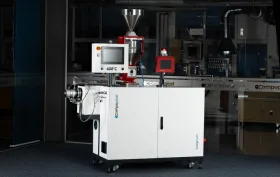
Complete extrusion line for 3D printer filaments from COMPUPLAST s.r.o.
How Did We Develop an Extruder for 3D Printer Filaments?
Probably our biggest design challenge was the extruder. So 3 years ago, we got to work and began developing an extruder specifically designed to extrude filaments for 3D printers. We chose a screw diameter of 25 mm because this size is ideal for extrusion speeds of around 40-60 m/min and also allows new materials to be tested, for example at speeds of around 20 m/min, which most of our customers appreciate. The motor with a gearbox and frequency inverter is designed to deliver its rated torque even at maximum speed (2,500 rpm = 87 Hz). Control is via a PLC and a 12“ touchscreen, which provides a clear graphical representation of the entire extrusion process, including the option to save recipes, the selected screw type, and a graphical indication of whether a breaker plate or just a ring is fitted at the extruder outlet. The barrel has 4 heating and cooling zones, temperature measurement beneath the hopper with measurement of cooling water flow and temperature, and 2 zones for the extrusion die and connecting flange. The measurement system also includes a sensor for measuring melt pressure and temperature.
In terms of material feeding, our machine is equipped with gravimetric dosing for both the main component and the secondary component (e.g. masterbatches). We can also control the haul-off from the extruder control panel, allowing the belts to be closed pneumatically and the machine to be started at the specified speed, which is very practical for the operator, particularly when threading the filament at the start of production. On request, we can supply the extruder with temperature settings up to 400°C.
The cooling bath is equipped with water temperature control up to 90°C, and a pump rated for these temperatures ensures constant, uniform circulation. At the bath inlet, there is a multi-chamber section that provides flexibility, for example for extrusion and specific cooling of demanding engineering materials such as PEEK, PEI, PEAK, etc. Control is again via a PLC and a touchscreen, which provides bath control, including display of the required parameters, as well as the option to display the filament diameter in two axes (three on request) using downstream laser diameter measurement. At the bath outlet, a drying unit removes surface water from the filaments. The machine can be adjusted in three axes. For speeds above 60 m/min, we recommend an additional cooling bath at least 2 m long with cold water to ensure proper cooling of the filament.
The haul-off unit has two belts with durable PU belts. The machine is designed for speeds up to 100 m/min, with a servomotor as the main drive. The upper belt is moved by a pneumatic cylinder with adjustable lifting force, which is advantageous, for example, for filaments made from plasticised materials. The haul-off is also controlled by a PLC, whose settings allow activation of a function that synchronises the haul-off speed with data from the filament diameter measuring device, helping to keep filament diameter tolerances within the required limits.
Controlled Filament Accumulation Saves Operator Time and Production Costs
The next unit in the extrusion line is the accumulator. This is a device that allows the filament being produced to be accumulated in its storage section for a given period of time. Our unit has an accumulation capacity of almost 100 m, meaning that at an extrusion speed of 100 m/min, the operator would have approximately 60s to change the spool in the winding unit. The unit is based on a fixed shaft with independently rotating pulleys and a movable shaft with the same number of pulleys. The movement involved in filament accumulation is provided by rodless pneumatic cylinders operated by a proportional valve controlled by the PLC.
Thanks to this intelligent control and continuous measurement of the movable shaft position, we can precisely set the pressure in the relevant circuit and thereby control the speed of movement and, above all, the tension in the filaments. Thanks to the option to save recipes, we can set individual accumulation parameters for each material. Our machine is equipped with an emergency servo haul-off at the outlet, ensuring automatic emptying of the accumulator if, for example, the operator does not manage to change the spool and start winding in time. Without this option, the filaments become slack in the accumulator when it reaches its maximum position, and in most cases the operator must reduce the extrusion speed, rethread the filament into the accumulator, restore the required extrusion speed and restart winding after adjusting the diameter tolerances to meet the requirements. This function saves the operator a great deal of time and also significantly reduces filament production costs.
The winding unit is designed as a single-station unit. The empty spool must be loaded manually, but the subsequent process is automatic. The unit is equipped with pneumatic scissors that automatically cut off the end of the filament. A separate servo drive guides the filament into a triangular opening on the winding diameter of the spool, while the spool simultaneously begins to rotate. After a defined rotation of the spool, the filament is secured in the spool and winding can gradually accelerate to the required speed. Everything is controlled via a PLC and a 12“ touchscreen with the option to save recipes.
Winding is performed using a servo drive with tension control via a dancer at the machine inlet. Traversing is also implemented using a servo drive and a ball screw. Completion of the filament winding on the spool is also automatic. The end of the winding is secured with an auxiliary shrink tape, which is automatically cut off together with the end of the filament after a defined number of revolutions. The spool change itself is manual, but we are already working on fully automating the entire process, with the expectation that the process will run completely automatically. On request, we can also equip the winders with a marking device that will mark each spool with a unique code and the required data relating to the production of the filament on that spool.
From Line Configuration to Testing in the Showroom
We can supply the line according to the customer's requirements including a cooling unit, material drying and conveying to the extruder hopper. We can also equip the line with a co-extruder and a co-extrusion die, so that the extruded filament can have, for example, two crescent shapes in cross-section, or an inner core made from one material and an outer layer made from another material. For special materials and applications, we can also design a gear pump that will be the “heart” of the extrusion assembly and control the extruder speed based on the pressure measured upstream of the gear pump.
A huge advantage for both us and the customer is the fact that we have a complete line in our showroom, so by arrangement it is possible to test this line and find out how everything works, what the capabilities of this equipment are, and what further options can be offered and added to the line to ensure complete satisfaction.
-

COMPUPLAST s.r.o.
Extrusion lines including tools, extruders, extrusion lines for plastics, cooling gauges, cooling baths, extrusion lines, blow molding machines for…

Suppliers on this topic
-

CHODOS CHODOV s.r.o.
Manufactures of machines and equipment for processing of rubber and plastic for the rubber and plastics industry… -

1.PLASTCOMPANY, spol. s r.o.
Horizontal and vertical injection molding machines, extruders and extrusion lines, extrusion tools, material conveyors… -

LUGER spol. s.r.o.
Peripheral equipment for the plastics industry, tempering equipment, plastic crushers, plastic conveyors, metal part… -

Wittmann Battenfeld SK spol. s r.o.
Wittmann peripherals, plastics processing machines, spare parts for WITTMANN BATTENFELD peripherals, injection molding… -

Wittmann Battenfeld CZ spol. s r.o.
Injection molding machines, linear robots and manipulators, tempering devices, systems for drying and conveying… -

ARBURG spol. s.r.o.
Injection molding machines, injection molding machines, two-component injection moulding, accessories for plastics…


DESMA Open House 2026: Innovation, Practical Application, and International Exchange
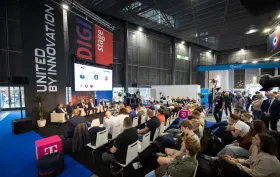
28.10.2026 Under the motto “Built right. Runs right.”, DESMA opened the doors of its main plant in Fridingen on October 1, 2026, and welcomed over 280 visitors from around the world to a thoroughly successful Open House.
Most read in the last 7 days
-
Polymer prices - october price increases partly successful, with minor corrections expected in the week ahead
-
Polymer prices - Year-End Polymer Price Scenarios
-
Long-lasting solution: Radiation-crosslinked PE-Xc pipes for drinking water supply
-
Polymer prices – the increase in olefin monomer contract prices in October was in line with expectations
-
Plastica-expo 26






Most read in the last 7 days
-
Polymer prices - october price increases partly successful, with minor corrections expected in the week ahead
-
Polymer prices - Year-End Polymer Price Scenarios
-
Long-lasting solution: Radiation-crosslinked PE-Xc pipes for drinking water supply
-
Polymer prices – the increase in olefin monomer contract prices in October was in line with expectations
-
Plastica-expo 26