


CEE Automotive Supply Chain 2025: Transformation without certainties. How to keep Europe in the global game?
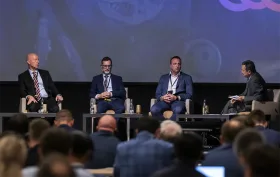
The eighth edition of the CEE Automotive Supply Chain conference, the largest gathering of automotive industry suppliers in Czechia and Slovakia, took place in Olomouc on 4–5 November 2025. The event attracted more than 350 participants from companies, industry associations and European institutions, who jointly discussed current challenges and new opportunities at a time of geopolitical change and growing regulatory demands, particularly in the field of electromobility.
Where the Obstacles Lie
The opening panel dedicated to the economic and geopolitical situation delivered a clear assessment: Europe is running out of steam. Martin Jahn, a member of the Board of Management of Škoda Auto and President of Sdružení automobilového průmyslu, warned in the opening session that rising energy prices, complex regulation and a shortage of skilled labour are becoming key obstacles to development. In addition to addressing these problems, the Czech Republic should focus more on technical education and support for applied research.
Jahn's Slovak counterpart Alexander Matušek, President of the Automotive Industry Association of the Slovak Republic, said that the situation is similar in Slovakia, where businesses are troubled not only by high energy costs but also by the exodus of technically educated young people abroad.
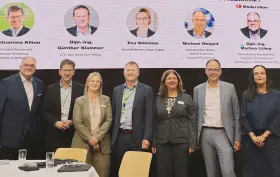
| Jahn, Matušek, Vondra and Tůma on European competitiveness, expensive energy and the need for greater flexibility and cooperation in Central Europe. |
Both agreed on the need for more flexible labour legislation, support for innovation and more effective use of European funds. Broader cooperation between the two countries and, by extension, within the V4 would also be beneficial.
Zdeněk Tůma, Chairman of the Supervisory Board of ČSOB and former Governor of the Czech National Bank, highlighted the need to rethink industrial policy. In his view, Europe has a structural problem linked to demographics and also to excessive dependence on the German economy. Nevertheless, he believes that the Central European region remains a “stable pillar” that has always managed to adapt despite crises.
European Policy Under Pressure
MEP Alexandr Vondra brought a political dimension to the debate, criticising the European Commission for its “arrogance”. He emphasised that Europe cannot assume it could dictate the pace of the green transition to the world. It should act more realistically and put an end to the overregulation that is weakening business on the old continent.
Martin Jahn recalled the “Draghi report”, which addresses the weakening of the European economy relative to the USA and China and proposes a range of measures to support innovation, strategic investment and a more coordinated industrial policy in the EU, enabling Europe to cope with new global challenges. He also called for a review of measures that make doing business more difficult.
Alexandr Vondra also mentioned the urgent need to secure rare earths, one of the basic commodities required for production, for European businesses in the automotive sector. Rather than relying on China, sources need to be sought in Africa or Latin America. This, however, is primarily a political issue.
Martin Jahn added that Europe also needs to secure its own production of battery cells for electric vehicles. The problem, however, is that such production in Europe cannot be profitable at current energy prices. According to the speakers, one of the first tasks for the new government will therefore be to respond swiftly in the energy sector – particularly because our closest neighbour, Germany, plans to subsidise energy on a massive scale.
China as a Challenge and an Opportunity
The next part of the conference focused on the future development of the automotive industry in connection with the need to revise CO2 emissions targets from the perspective of vehicle manufacturers in the automotive sector.
Robert Kiml, President of Toyota Motor Manufacturing Czech Republic and Vice-President of Sdružení automobilového průmyslu ČR, emphasised the importance of technological neutrality – in his view, Europe should support different paths to decarbonisation rather than impose a single solution. Alongside batteries, hydrogen combustion engines should also be given a chance. Every customer must be able to choose the powertrain that suits them.
| Robert Kiml from Toyota Motor Manufacturing ČR emphasises the need for technological neutrality – Europe should support different paths to decarbonisation, also make room for hydrogen combustion engines and leave customers free to choose their powertrain. |
David Kříž, CEO of Iveco Czech Republic, shares a similar view. He pointed out that uniform regulation cannot apply equally to all segments – while the electrification of urban buses makes sense, it has yet to gain a foothold economically or technically in touring coaches and trucks. Iveco is not pursuing a single direction; its range includes all types of powertrains.
Robert Kiml and David Kříž also agreed that the subsidies some countries use to support electric vehicle sales work, but neither speaker supports their introduction in Czechia. In their view, every subsidy distorts the market, with adverse effects elsewhere.
Changes in the Global Supply Chain
Current uncertainty is affecting automotive suppliers even more than final manufacturers. According to Petr Novák of JTEKT Central Europe, Vice-President and Chairman of AutoSAP's Suppliers and Special-Purpose Organisations Division, suppliers are caught “in a pincer grip” between pressure from OEMs and rising costs. Long-term contracts limit their room for manoeuvre, while Chinese companies are pushing for extreme price reductions and introducing new, often unacceptable terms.
Lukáš Rosůlek, head of Schaeffler's Czech operations and a board member of the Automotive Industry Association, and Martin Keresteši, Plant Manager at Yanfeng Automotive Interiors in Námestovo, agreed that price pressure is currently enormous, but quality and reliability must not be sacrificed.
According to Rosůlek and Keresteši, European businesses are forced to seek new approaches, new materials and new production processes if they want to remain competitive. However, solutions are not quick. Until replacements for some Chinese suppliers can be found, it is necessary to find common ground with existing suppliers and establish some form of cooperation.
Although supplier companies face the same problems, they are choosing different strategies. While Yanfeng is currently holding off on investments, Schaeffler, by contrast, is making major investments – most recently, for example, in Hrušov in Ostrava. According to Petr Novák, JTEKT has not stopped investing either, but is directing its investments outside Europe.
Jan Vlasák of Digiteq Automotive, which designs, develops and tests innovative functions for modern cars, spoke at the conference about the impact of software-defined vehicles (SDVs) on the supply chain.
Vlasák emphasised the transformative power of SDVs, which are fundamentally reshaping the supply chain by shifting the emphasis from hardware to software. Traditional Tier 1 suppliers, which previously focused on mechanical and electronic components, are being forced to adapt. And as software becomes a key driver of innovation and development, these suppliers are transforming into strategic software partners – instead of physical parts, they now offer platforms, middleware and cloud services.”
Opportunities for Automotive in the Defence Industry
A dedicated session on links between the automotive and defence sectors brought an interesting dimension to the conference. It was led by Kristýna Helm, Vice-President and Deputy Executive Director of the Defence and Security Industry Association of the Czech Republic. In her opening remarks, the association's representative stated that the Czech defence industry is exceptionally strong in terms of exports – more than 90 percent of production goes abroad, while demand for both land and aviation systems continues to grow.
She emphasised that although the defence sector offers promising prospects, it is difficult to enter – contracts are awarded by governments, and processes are lengthy and heavily regulated. Success depends on the specific product and the partner's credibility, not on declarations of interest in cooperation. Only a few companies succeed and become suppliers meeting military needs. Sometimes the best bid does not win, because decisions in the defence sector also depend on considerations other than economics.
| Kristýna Helm of the Defence and Security Industry Association of the Czech Republic outlined the growing potential of links between the automotive and defence sectors. She highlighted both the strength of Czech exports and the challenges involved in achieving success in defence contracts. |
Pavel Hortlík, Chief Operating Officer of Excalibur Army Přelouč, stated that automotive companies have something to offer – their experience in efficient production, logistics and quality can also be valuable for military projects. According to Martin Kele, former CEO of STV GROUP and Matador Holding, however, the path to success in defence takes years and requires not only perseverance but also the ability to adapt to a different culture of contracting and decision-making.
The Way Forward
The conference concluded with Miroslav Kroupa of Škoda Auto, who summarised all the changes in the global automotive industry and supply chains and put them into context with their expected impacts on the European automotive industry.
In any case, it is clear that the automotive sector will have to deal with many challenges in the coming years, and not everyone will be able to get through this process without losses.
One way to counter adverse trends is to seek new partnerships. The second day of the conference in Olomouc catered to this need, with a programme devoted to B2B meetings. As in previous editions, there was strong interest in these meetings.
The next edition of the CEE Automotive Supply Chain conference will take place in autumn 2026 in Žilina.
| A total of 507 organised B2B meetings took place at CEE Automotive Supply Chain 2025. |
Photo Gallery


Suppliers on this topic
-

Slovensko-nemecká obchodná a priemyselná komora
Support of trade and economic relations between Germany and Slovakia, consultancy for plastic and rubber production… -

IPA Slovakia, s.r.o.
Consulting for plastic and rubber production, accredited education in the field of plastics, training of operation and… -

3D Tlač - Stepanek3D
3D scanning, 3D printing, editing of 3D models, plastic atypes, custom production, small series production, production… -

Bonafa projekt s.r.o.
Protection of interiors against overheating and glare, external shading of rooflights with screen fabrics, rooflight… -

SLOVNAFT, a.s.
Production and sale of petroleum products and it´s chemical processing - production and distribution of polyethylene… -

Archeo CZ s.r.o.
Distributor of leading brands of technical granules, including PA and POM, expert advice on selecting the right…


MOL Group Expands Its Green Energy Portfolio with Bi methane Production
29.10.2026 The MOL Group has officially opened its first biomethane production plant in Szarvas, in Békés County, southeastern Hungary. The facility, representing an investment of more than €7.4 million, can produce biomethane from biogas at a purity level...

Most read in the last 7 days
-
Polymer prices - october price increases partly successful, with minor corrections expected in the week ahead
-
Long-lasting solution: Radiation-crosslinked PE-Xc pipes for drinking water supply
-
Polymer prices – the increase in olefin monomer contract prices in October was in line with expectations
-
Polymer prices - Year-End Polymer Price Scenarios
-
Plastica-expo 26





Most read in the last 7 days
-
Polymer prices - october price increases partly successful, with minor corrections expected in the week ahead
-
Long-lasting solution: Radiation-crosslinked PE-Xc pipes for drinking water supply
-
Polymer prices – the increase in olefin monomer contract prices in October was in line with expectations
-
Polymer prices - Year-End Polymer Price Scenarios
-
Plastica-expo 26