


The MOL Group informs that INA has completed the refinery modernization project in Rijeka
The construction of a delayed coking unit (Delayed Coking Unit, DCU) and associated facilities will increase the installed processing capacity of the Rijeka refinery to up to four million tonnes of crude oil per year. The refinery will also be able to process a wider range of crude oils, including heavier grades. The key change is the optimisation of production – the new unit enables a significantly higher yield of high-value products from the same volume of crude oil. The share of diesel in total production is expected to increase by approximately 30 percent, which is of strategic importance for the market – particularly during the peak tourist season in Croatia.
Production at the refinery will no longer require imports of vacuum gas oil (VGO), which on the European market is predominantly of Russian origin. This further increases Croatia's energy security and reduces dependence on imported feedstocks.
The ceremony marking the completion of the refinery modernisation was attended by representatives of the government of the Republic of Croatia, the government of Hungary, ambassadors from several countries, representatives of regional and local communities and the management of INA and MOL Group. Before the completion ceremony, a grant agreement for the construction of a green hydrogen production plant at the Rijeka refinery was signed with Croatia's Ministry of Economy under the National Recovery and Resilience Plan, signalling further investment in sustainable development.
Zsuzsanna Ortutay, President of the Management Board of INA, emphasised that the refinery modernisation project represents a strategic milestone: “From now on, we will be able to use every barrel of crude oil more efficiently and maintain our long-term competitiveness. The benefits of the project extend beyond the refinery. For Croatia and the region, this means greater energy security, for our customers more stable supplies and for INA a stronger position as a regional supplier. The project is also a powerful driver of economic growth and the development of local communities. The modern production facility will support our transition to a low-carbon economy. INA is already implementing renewable energy projects, and a green hydrogen production plant, the first of its kind in Croatia, will be built here by the end of the year.”
Ante Šušnjar, Croatia's Minister of Economy, spoke about the project's importance for the energy security of Croatia and the region: “The commissioning of the delayed coking unit at the Rijeka refinery represents a significant step in strengthening the energy security of Croatia and the entire region. In a period of geopolitical instability, it is crucial to have robust and reliable energy infrastructure that ensures more secure supplies, a more stable market and a more resilient economy. We expect the Rijeka refinery to operate steadily, sustainably and at full capacity, bringing benefits to the Croatian economy, the energy system and our partners in the region. Croatia will continue to strengthen its energy infrastructure and capacities, because a strong energy system means a stronger economy, greater national resilience and greater security for our citizens and the economy.”
Levente Magyar, State Secretary at Hungary's Ministry of Foreign Affairs and Trade emphasised that this is about shared energy security: “This is a great day for Croatia. A great day for Hungary. And a great day for the energy security of our region, because we firmly believe that energy security in this region is indivisible. Croatia cannot have energy security without Hungary having it – and Hungary cannot have it without Croatia. This major investment of historic proportions embodies this indivisibility and will be a guarantor of our shared energy security, especially in these challenging times. It represents a historic step in the right direction towards strengthening both our shared energy sovereignty and energy security.”
The modernisation of the Rijeka refinery is part of a long-term investment cycle in which INA and MOL Group have invested more than 1.3 billion euros in modernising refining and logistics infrastructure over the past twelve years.
József Molnár, CEO of MOL Group, emphasised: “Today marks the beginning of a new chapter in INA's refining activities. We have completed the construction phase of the largest industrial investment in the history of both INA and Croatia. However, our work is only just beginning. The global energy market remains fragile, so we must do everything possible to achieve high productivity and ensure that Rijeka ranks among the most efficient refineries in Europe. Our interests are clear: we want a strong INA. And a strong INA means a stronger Croatia, a more reliable energy supply for the region and a stronger MOL Group.”
The scale of the engineering and construction achievement is best illustrated by the figures. More than 10 000 tonnes of steel were used to build the new facilities, equivalent to almost one and a half Eiffel Towers. The project consumed 60 000 cubic metres of concrete, enough to build a medium-sized football stadium. More than half of the work, worth almost 700 million euros, was carried out by domestic contractors. By completing the project, INA has secured the long-term sustainable operation of the Rijeka refinery and continues to make a significant contribution to economic growth, development and employment stability in the wider Rijeka region.
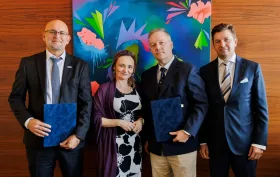
| From left: Damir Mikuljan, Ante Susnjar, Zsuzsanna Ortutay, Levente Magyar, Jozsef Molnar |
About the Green Hydrogen Project
To diversify its traditional portfolio by adding renewable energy sources, INA is investing more than 60 million euros in the Rijeka refinery site to build a green hydrogen production and distribution plant. Alongside a 10 MW electrolysis unit, an accompanying 11 MW solar power plant will also be built. The green hydrogen produced will be intended for the market, primarily for transport, and will also be usable in the refinery's own production processes. Completion of the work is scheduled for the end of 2026, with the first molecules of green hydrogen expected to be produced in 2027. The grant agreement under the National Recovery and Resilience Plan, worth up to 15 million euros, was signed on behalf of INA by President of the Management Board Zsuzsanna Ortutay and Management Board member Hrvoje Šimović, together with Croatian Minister of Economy Ante Šušnjar and the Director of the Environmental Protection and Energy Efficiency Fund, Luka Balen.
-

SLOVNAFT, a.s.
Production and sale of petroleum products and it´s chemical processing - production and distribution of polyethylene (LDPE) and polypropylene (PP)…

Suppliers on this topic
-

VACULA s.r.o.
Engineering, technical plastics - sales, construction plastics - production and sales, plastic granulate… -

SRNOPLAST K96 s.r.o.
Purchase and crushing of plastic materials, custom crushing of plastics, regranulate, regranulation, recycling of… -

Archeo CZ s.r.o.
Distributor of leading brands of technical granules, including PA and POM, expert advice on selecting the right… -

geba Kunststoffcompounds GmbH
Masterbatches for plastics, plastic regranulate, ABS regranulate, ABS plastic regranulate, PC, PC/ABS, PA6, PA66, TPU… -

Szeplast Zrt.
Development and production of soft and hard PVC granulates, testing of plastic granulates, laboratory tests. -

Röchling Industrial Tábor s. r. o.
Plastic semi-finished products, extruded and molded sheets, rods, profiles and welding wires for 3 divisions…


MOL Group Expands Its Green Energy Portfolio with Bi methane Production
29.10.2026 The MOL Group has officially opened its first biomethane production plant in Szarvas, in Békés County, southeastern Hungary. The facility, representing an investment of more than €7.4 million, can produce biomethane from biogas at a purity level...


Most read in the last 7 days
-
Polymer prices - october price increases partly successful, with minor corrections expected in the week ahead
-
Long-lasting solution: Radiation-crosslinked PE-Xc pipes for drinking water supply
-
Polymer prices – the increase in olefin monomer contract prices in October was in line with expectations
-
Polymer prices - Year-End Polymer Price Scenarios
-
Plastica-expo 26





Most read in the last 7 days
-
Polymer prices - october price increases partly successful, with minor corrections expected in the week ahead
-
Long-lasting solution: Radiation-crosslinked PE-Xc pipes for drinking water supply
-
Polymer prices – the increase in olefin monomer contract prices in October was in line with expectations
-
Polymer prices - Year-End Polymer Price Scenarios
-
Plastica-expo 26