


IPA Slovakia: What Does the Future Hold for Manufacturing Plants?
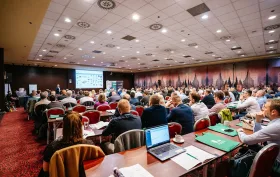
The Perspective of Jozef Krišťak – Moderator of the Production Management Conference
On paper, it seems that with every major crisis, Brussels officials call for the rescue of battered supply chains. However, the reality within companies is different, and the gap between utopian visions on paper and everyday practice keeps widening. Rising input and labour costs are compounded by geopolitical risks and the aftermath of the unfulfilled vision of a purely post-industrial European economy. Keeping production in the EU today thus often seems a truly heroic feat.
The Illusion of Certainty in a World of Uncertainty
The EU institutions' response to global uncertainty is, paradoxically, massive bureaucratisation. The idea that prosperity, security and stability can be achieved by continually piling on new regulations has clearly prevailed. The result is an environment in which enormous amounts of energy and time are burned up fighting the system (applications for EU grants, directives such as ESG, GDPR, CBAM, CSRD or..,.). Instead of eliminating actual waste and focusing on work that creates real value for the customer, companies devote resources to officials' priorities.
Speed as the Main Problem
Bureaucracy relentlessly kills flexibility. Any change, innovation or attempt at a rapid, agile solution to a problem runs up against complex paperwork and the need to certify and approve everything in advance down to the smallest detail. Our greatest opponent is not Asian competition, but bureaucracy.
The key problem facing European industry today is therefore not the Green Deal or energy prices, but speed. Everything takes us many times longer (improvement, smart factories, AI, ...) – from decision-making through planning to implementation itself – than it does countries that are overtaking us thanks to their flexibility.
Topics for Improving Your Production
How can we reverse this trend, shift the focus back to creating added value for customers and increase competitiveness in an environment where costs are rising, administrative burdens are growing and the market is reporting a critical shortage of skilled people?
Cheaper energy will not enable us to survive and prosper as a manufacturing business in the EU. We must win in the areas of absolute process efficiency, innovation and speed. This means moving from "keeping things running" to a radical focus on genuine value creation. I see four key pillars underpinning manufacturing companies' ability not only to survive, but also to continue growing.
A Strategic Shift Towards Higher Value-Added Production
Competing on price is a road to hell. Manufacturing companies must deliberately focus on products and processes that require close cooperation with customers, where technological know-how needs to be used for maximum flexibility.
The future of manufacturing will therefore not depend on producing more cheaply than Asia.
Success will be built on world-class engineering know-how, absolute process stability and close, agile cooperation with the customer's development teams.
Strengthening Improvement Activities. More Added Value, Less Waste.
The greatest internal obstacle in our companies is overlooked waste. It is essential to radically separate work that genuinely adds value for the customer from activities that merely generate unnecessary data and reports with no visible impact on results.
|
|

The principle is simple: reduce everything that consumes company resources but creates no value for the customer. Closely related to this is moving decision-making closer to the places where value is actually created. Every unnecessary management level lengthens response times, complicates communication and increases the risk that a company will maintain an inefficient process simply because it has become part of the existing structure.
An Agile Approach to Smart Technologies and Artificial Intelligence
Human labour is becoming increasingly expensive and also remains prone to error and often slow. People should only be given tasks that new technologies cannot handle.
Meaningful integration of automation, robotics and logistics systems supported by rapid collection, evaluation and optimisation of information flow will enable a radical increase in production efficiency.
Smart factories with AI components are no longer being implemented in the old way, like ERP/MES systems. Instead, small prototypes with minimal budgets are repeatedly emerging. The result is practical digitalisation and automation.
AI is another layer on top of this system, enabling more efficient data analysis, prediction and support for planning, quality, maintenance and decision-making.
People, Responsibility and Engagement at the Centre
Technology changes the factory, but people determine whether the change succeeds.
The technical design of a change often accounts for perhaps 30–40 % of success. The rest is:
- Leadership, communication, ownership, competencies and implementation discipline.
- For production managers, this means a shift from managing through orders and KPIs to the ability to lead transformation.
- The decisive factor will be how to get people to accept, use and further develop new ways of working.
Are You Looking for Solutions to Increase the Competitiveness of Your Production?
If your company wants to maintain its position, doing things slightly better than in the past will not be enough. You will have to fundamentally rethink what you produce, how you produce it, what technologies you use and how you can mobilise your people.
You will survive only if you are faster and more capable as leaders than ever before.
Which solution do you see as the best for you?
Come to the Production Management Conference and discuss with experts.
The conference takes place on 13. - 14. 10. 2026 in Žilina, where you can also look forward to site visits to selected companies, such as Volkswagen Slovakia, Martin, Franke Slovakia, Strečno, Kia Slovakia, Teplička nad Váhom and Scheidt & Bachmann, Bytča.
-

IPA Slovakia, s.r.o.
Consulting for plastic and rubber production, accredited education in the field of plastics, training of operation and maintenance of machines…

Suppliers on this topic
-

Slovensko-nemecká obchodná a priemyselná komora
Support of trade and economic relations between Germany and Slovakia, consultancy for plastic and rubber production… -

3M TRADE - PLASTIC PARTS s. r. o
Plastic molding, plastic injection, injection molds, molds, industrial robots, manipulators, grippers, EOAT components. -

ATU Slovakia, spol. s.r.o.
Ultrasonic Welding Machine, Hot Plate Welding Machine, Spin Welding Machine, Vibration Welding Machine, Hot Air… -

PM AUTOMATION CZ s.r.o.
Complete solutions for industrial automation, robotics and machine vision. We support you every step of the way, from… -

TG – Toman Group spol s r.o.
Komplexné technologické riešenia na mieru, adiabatické chladenie, poradenská, montážna, inštalačná a servisná činnosť… -

SOVA Digital a.s.
Complex solutions for digitization and optimization of production processes, Industry 4.0, industrial automation…


AI in maintenance: How to turn data and human expertise into practical support for manufacturing
2.11.2026 Predictive maintenance, access to know-how, and faster troubleshooting. The panel discussion showed that the real value of artificial intelligence in industrial maintenance lies not only in predicting failures, but also in how companies work with...
Most read in the last 7 days
-
Polymer prices - october price increases partly successful, with minor corrections expected in the week ahead
-
Plastica-expo 26
-
Polymer prices – the increase in olefin monomer contract prices in October was in line with expectations
-
Report from Ruma, Serbia: How MAPRO opened the doors to Haitian’s European megafactory
-
Long-lasting solution: Radiation-crosslinked PE-Xc pipes for drinking water supply




Most read in the last 7 days
-
Polymer prices - october price increases partly successful, with minor corrections expected in the week ahead
-
Plastica-expo 26
-
Polymer prices – the increase in olefin monomer contract prices in October was in line with expectations
-
Report from Ruma, Serbia: How MAPRO opened the doors to Haitian’s European megafactory
-
Long-lasting solution: Radiation-crosslinked PE-Xc pipes for drinking water supply