


European automotive industry at a crossroads: time to act, avoid fines and reduce regulation
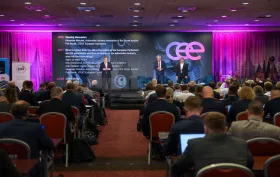
More than 300 Participants from 12 Countries
The event, organised by the Automotive Industry Association of the Slovak Republic and the Automotive Industry Association AutoSAP, welcomed more than 300 participants from 12 countries. The discussions were moderated by the experienced Ivan Hodáč, former Secretary General of the European Automobile Manufacturers’ Association (ACEA). Alexander Matušek, President of ZAP SR, and Petr Novák, a member of the AutoSAP Board of Directors, welcomed guests on behalf of the organisers.
Crisis and Opportunities in the Automotive Industry
In his address, Alexander Matušek emphasised that the decline in car production and sales in Europe by approximately 2 million vehicles compared with pre-COVID levels, together with geopolitical challenges and Chinese competition, poses a serious challenge for European carmakers.
 |
|
| (From left) President of the Automotive Industry Association of the Slovak Republic Alexander Matušek, member of the AutoSAP Board of Directors Petr Novák and moderator Ivan Hodáč |
In Slovakia, the situation is stable – carmakers have production secured for the next three years, but need new products to remain competitive. The Automotive Industry Association is therefore advocating three key priorities:
- reducing production costs,
- ensuring a sufficient supply of skilled workers,
- supporting the environmental sustainability of production.
Petr Novák from the Czech AutoSAP warned of the threat of fines for failing to meet CO2 emission targets, which could reach as much as 15 billion euros. He also highlighted geopolitical risks and legislative challenges, while emphasising the record growth in Czech production, which is expected to reach 1.4 million vehicles in 2024. “These figures make the Czech Republic „a European exception“, he said.
Geopolitics and the Action Plan for the Automotive Industry
The discussion of geopolitical and European issues emphasised the need to support Europe’s competitiveness. Dita Charanzová and Ivan Štefanec, former Members of the European Parliament, welcomed the approach of the European Commission and Parliament, which opened a discussion on the sustainability of European industry. Secretary General of ACEA, Sigrid de Vries, said that the automotive industry is ready for a zero-emission future, but insufficient demand, a lack of infrastructure and complex regulation are hindering the mass adoption of electromobility. She pointed to the low share of electric vehicles in Europe, which currently stands at only 10 %, while the original estimate was 20 – 25 % by 2025. She sees the solution in a realistic assessment of the current situation and adjustments to regulatory frameworks, together with effective implementation of the Action Plan for the Automotive Industry.
Challenges for Suppliers
The panel discussion entitled „Challenges and Opportunities for Suppliers Tier 1“ focused on the transformation of the supply chain in the context of electromobility and environmental requirements.
Company representatives Dušan Valient from ADIENT, Vladimír Toman from MIBA SINTER Slovakia, Petr Novák from JTEKT and Lukáš Rosůlek from Schaeffler Czech Republic agreed that competition, particularly from China, brings challenges, but also opportunities for innovation. Flexibility and a pragmatic approach will be key to success, and they do not rule out cooperation with Chinese partners.
 |
|
| (From left) Company representatives Dušan Valient from ADIENT, Vladimír Toman from MIBA SINTER Slovakia, Petr Novák from JTEKT, Lukáš Rosůlek from Schaeffler Czech Republic and moderator Ivan Hodáč |
Slovak Carmakers: Plans and Visions
Roman Kraľovanský from KIA Slovakia presented a plan to reduce CO2 emissions to 93 g/km by 2025 and also revealed that the plant will introduce its first affordable battery electric car in 2026.
The representative of Jaguar Land Rover Martin Štefanovič spoke about a strategy to improve quality standards and localise supply chains in Central Europe.
Veronika Fečová from VOLVO presented the high sustainability standards of the new plant being established in Košice, which focuses not only on climate neutrality and the circular economy, but also aims for women to make up 50% of its workforce.
 |
|
| Veronika Fečová from VOLVO |
B2B Meetings
The second day of the event was dedicated to 435 B2B meetings, which confirmed the importance of CEE Automotive Supply Chain as a platform for building business relationships and cooperation in the automotive industry. The CEE Automotive Supply Chain event, held on 13 – 14 November 2024, once again demonstrated that it brings professionals together and shapes the future of the automotive industry in the region.
 |
|
| The CEE Automotive Supply Chain 2024 event also included B2B meetings |
Photo Gallery


Suppliers on this topic
-

TG – Toman Group spol s r.o.
Komplexné technologické riešenia na mieru, adiabatické chladenie, poradenská, montážna, inštalačná a servisná činnosť…


MOL Group Expands Its Green Energy Portfolio with Bi methane Production
29.10.2026 The MOL Group has officially opened its first biomethane production plant in Szarvas, in Békés County, southeastern Hungary. The facility, representing an investment of more than €7.4 million, can produce biomethane from biogas at a purity level...


Most read in the last 7 days
-
Polymer prices - october price increases partly successful, with minor corrections expected in the week ahead
-
Long-lasting solution: Radiation-crosslinked PE-Xc pipes for drinking water supply
-
Polymer prices – the increase in olefin monomer contract prices in October was in line with expectations
-
Polymer prices - Year-End Polymer Price Scenarios
-
Plastica-expo 26




Most read in the last 7 days
-
Polymer prices - october price increases partly successful, with minor corrections expected in the week ahead
-
Long-lasting solution: Radiation-crosslinked PE-Xc pipes for drinking water supply
-
Polymer prices – the increase in olefin monomer contract prices in October was in line with expectations
-
Polymer prices - Year-End Polymer Price Scenarios
-
Plastica-expo 26