


Sentien: Development of functional prototypes of open-ear headphones by cotu s.r.o.
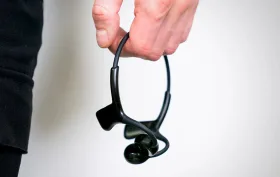
Sentien is behind the development of sleek headphones with bone conduction, voice control and customisation options.
When developing a new generation of devices, Sentien sought a partner capable of producing prototype parts with high precision, functionality and an emphasis on design. Together with cotu®, they created a set of high-quality prototypes ready for testing and presentation of the final product. They focused on combining rigid and flexible components, precise fit and aesthetic finish with future series production in mind.
Based on the customer's initial 3D data, cotu® took over the entire production process. First, they optimised the models and prepared master patterns using stereolithography. These were used for multi-stage vacuum casting of plastics in silicone moulds. The final stage involved surface finishing of the castings according to the required visual and functional parameters. The project also included the production of custom fixtures and several iterations of the manufacturing procedures to achieve maximum precision and repeatability.
How cotu Decided to Tackle This Challenge
Technology used: ASIGA MAX 3D printer, vacuum casting
Materials used: Asiga PlasGray V2 and Asiga Denta Model
Production of Master Patterns
The customer provided 3D data, which cotu® modified before printing to meet the technological requirements of SLA 3D printing and vacuum casting. In particular, the geometry and design details were optimised so that the parts could be printed accurately, cast and fitted together perfectly.
The final adjustments to the data were followed by the production of master patterns using SLA 3D printing on an ASIGA MAX 3D printer. All parts were printed at a resolution of 25 μm using Asiga PlasGray V2 and Asiga Denta Model materials to ensure maximum precision and detail.
To ensure dimensional stability during polymerisation, the models were cured in glycerine. This achieved consistent results without deformation and allowed them to proceed with subsequent finishing operations.
Each part underwent careful surface finishing, including smoothing, making the surface uniform and final painting in matt or gloss black, depending on the desired visual effect. They paid particular attention to parts joined into a single unit (e.g. transducers or parts of the battery case), which had to be finished without separating them to avoid damaging the edges and precisely mating surfaces.
Production of Silicone Moulds
After completing the master patterns, cotu® moved on to producing silicone moulds for vacuum casting. Depending on the type of part and the required arrangement, they used two types of silicone:
- Stiffer silicone – for the first series of moulds with a simple parting arrangement and multiple cavities (e.g. transducers in a four-cavity arrangement),
- More flexible silicone – for the second series of moulds, where we needed greater elasticity and more precise definition of the parting planes.
The moulds were designed as multicavity (multiple-cavity) moulds to enable efficient production of several parts at once. The parting planes were defined according to the geometry of the parts, either directly in the master pattern or mechanically using tape or a scalpel during mould production.
In some cases, the moulds were supplemented with vent channels (air vents), sprues and custom fixtures that enabled cable harnesses or wires to be held securely in place before encapsulation.
Casting Functional Parts
When manufacturing functional parts such as transducers, ear frame and back frame, they combined rigid polyurethane for the rigid sections and flexible rubber for the flexible zones. The process was adapted to the specific mechanical property requirements of each part.
For the transducers, they initially used a two-component casting process – casting the rigid shell and the soft inner section separately. In the second version, they cast the entire body from a single material in a vacuum chamber. All castings were then cured in an oven to achieve the required strength.
For the ear frame and back frame parts, they encapsulated wire reinforcements and cables in rigid polyurethane, followed by flexible rubber. They used 3D-printed fixtures to position the components precisely. The connectors were protected using soluble filament, which is simply removed with water after casting.
Every manufactured part underwent a detailed visual and functional inspection.
Final Finishing and Assembly
After the parts were removed from the moulds, mechanical finishing followed, which included:
- removal of sprues, air vents and flash around the parting planes,
- precise fitting of mating surfaces, particularly on the transducers, which consisted of two parts,
- inspection of geometry, edges and surface quality – ensuring there were no scratches, deformations or visual defects.
In areas intended for the installation of electronics and connectors, it was necessary to maintain clean, precise mating surfaces so that the transducers could be fitted with electronics and then closed. For the second version of the transducers (rigid PU on both sides), cotu® also carried out localised polishing of the contact surfaces using a fine cloth and mechanical polishing to a high gloss. To prevent damage to the surrounding area, they prepared a special fixture to precisely define the area to be polished.
Optimisation Using 3D Printing
During production, the cotu® team modified both the part designs and the manufacturing processes themselves. This enabled them to gradually improve precision and repeatability and reduce the reject rate.
For the ear frame and back frame, they switched to a more efficient casting process using 3D-printed fixtures, which helped them secure cables and reinforcements precisely in place. They improved adhesion between the materials by modifying the moulds and positioning the wires more accurately. To encapsulate the connectors safely, they used soluble filament, which is easily removed after curing. The mould parting planes were designed to make inserting components as easy as possible and to prevent deformations in the castings.
The result was more stable production with less need for additional finishing.
Outcome of the Collaboration and Benefits for the Client
cotu® supplied Sentien with a set of functional prototypes ready for testing the construction, ergonomics and appearance of the final product. By combining SLA 3D printing, vacuum casting and custom fixtures, demanding requirements for mechanical strength, precise fitting, a combination of rigid and soft materials, and a high standard of aesthetics were met. The result was a validated manufacturing concept suitable for the next step – series production.
Thanks to the capabilities of SLA 3D printing, technical know-how and the ability to work with various materials, cotu® can now carry out similar projects entirely through additive manufacturing, without the need for vacuum casting.
The prototypes you have just read about are now an actual product. You can find the final version of the Sentien headphones and the option to order them here.
cotu® provides clients with comprehensive manufacturing support, from technical advice and modification of 3D data to the delivery of precise, visually high-quality parts ready for use. It approaches each project individually, with an emphasis on functionality, efficiency and long-term reliability. Thanks to state-of-the-art SLA printing and extensive experience in manufacturing optimisation, it offers solutions that meet your specific needs.
Are you looking for a partner for the development of functional prototypes or small-batch production? Get in touch with cotu®, who will be happy to discuss the options with you and propose a tailored solution.
Suppliers on this topic
-

FilamentyBrno.cz
Custom 3D printing, filaments and 3D printer servicing. Prototypes, jigs and small series for companies in Brno. -

ADATEX, s.r.o.
3D printing, 3D printers, 3D scanners, 3D scanning and inspection, 3D digitization, 3D measurement, 3D model, 3D… -

Anton Clemens s.r.o.
Plastic injection molding, production of injection molds, plastic products for automotive, two-component injection… -

LPH GROUP
Technical and aesthetic moldings made of thermoplastics, production of injection molds for thermoplastics, surface… -

Veeser Plastic Slovakia k.s.
Plastic production for the automotive industry; plastic injection molding, plastic molding, plastic molding shop… -

3D Tlač - Stepanek3D
3D scanning, 3D printing, editing of 3D models, plastic atypes, custom production, small series production, production…


LIFOCOLOR presents trends in the design of plastic products and packaging
7.9.2026 What determines whether a plastic product or packaging appeals to us at first sight and touch? Colour helps brands communicate, evokes emotions and influences our decisions. However, the material’s surface and the way a product feels are also...

Most read in the last 7 days
-
Polymer prices - october price increases partly successful, with minor corrections expected in the week ahead
-
Polymer prices – the increase in olefin monomer contract prices in October was in line with expectations
-
Plastica-expo 26
-
Long-lasting solution: Radiation-crosslinked PE-Xc pipes for drinking water supply
-
Polymer prices - Year-End Polymer Price Scenarios




Most read in the last 7 days
-
Polymer prices - october price increases partly successful, with minor corrections expected in the week ahead
-
Polymer prices – the increase in olefin monomer contract prices in October was in line with expectations
-
Plastica-expo 26
-
Long-lasting solution: Radiation-crosslinked PE-Xc pipes for drinking water supply
-
Polymer prices - Year-End Polymer Price Scenarios