

ENGEL manufactures the largest injection moulding machine in the world
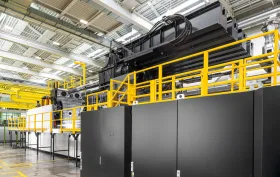
With the duo 12000 US, ENGEL opens up new dimensions in cost-effective parts production
The two-platen machine with a clamping force of 110 000 kN was developed specifically for parts with a projected area of more than 2.5 m² and was recently commissioned at a customer's site. It enables the cost-effective production of large-format components in an integrated manufacturing process. Functional integration, a reduced number of parts and lower assembly requirements open up new possibilities in engineering, lightweight construction and product design.
New products require new manufacturing concepts. With injection moulding solutions on this scale, manufacturers can produce large-format structures in a single production step. This reduces material consumption, simplifies production logistics and thus saves time and costs. It also improves the carbon footprint throughout the product's entire life cycle. ENGEL thus supports its customers in opening up new dimensions of cost-effective production and introducing innovative, sustainable product solutions.
To achieve high moulded part weights for components with large surface areas, the system is equipped with two injection units operating in parallel. With screw diameters of up to 210 mm, they enable shot volumes of up to 65 000 cm³ and uniform filling of large areas.
The eight-tie-bar design was selected together with the customer as the most suitable solution for its specific requirements. Machines of this size are also possible with four tie bars.
The large mould space enables flexible automation and efficient production of complex, large-area components in integrated manufacturing processes. |
The system's dimensions illustrate the technical challenge: at around 24 metres long and approximately 8.4 metres high, it ranks among the world's largest industrial production systems for injection moulding. Its total weight is 551 tonnes, with a maximum mould weight of 170 tonnes. Approximately 30 kilometres of cables were installed in total. The total installed power is approximately 2.4 MW, with a total current of 2 900 A. Despite these dimensions, the machine remains compact thanks to the modular design principle of the duo series, saving valuable floor space.
High vertical integration and comprehensive process know-how
Injection moulding solutions on this scale are developed exclusively on the basis of specific customer requirements. To implement them quickly and efficiently, ENGEL has an extensive modular system and an exceptionally high level of in-house manufacturing.
Its own technical centre for large machines enables customers to carry out extensive testing for technology and part development. Shrinkage behaviour plays a decisive role, particularly for large-volume components. At this technical centre, ENGEL has the facilities to carry out iterations and optimisation to ensure the required part quality.
Many years of experience in large machine engineering
ENGEL has decades of experience in developing and implementing large machines. In addition to the standard sizes of the duo series, several systems with a clamping force of 74 400 kN have already been successfully installed on the market.
The specially developed machine concept enables efficient engineering and production of systems on this scale. Thanks to global production structures, these machines can, if required, be manufactured not only at the large machine production plant in Austria but also regionally in Asia.
Despite their dimensions, the large machines offer exceptional precision. With options such as injection-compression moulding, component dimensions can be defined to within a few hundredths of a millimetre, a level of precision comparable to the thickness of a sheet of paper. This sensitivity, combined with enormous force, opens up new possibilities in precision lightweight construction and the functional integration of large-format components.
Gigamoulding enables new vehicle architectures
In the automotive sector, demand is growing for such gigamoulding solutions for large structural components. This development is driven by megatrends such as electromobility, autonomous driving, platform consolidation and CO₂ emissions reduction targets. New production capabilities make it possible to rethink applications such as battery housings, underbody panels or hybrid inner door structures. The aim is to reduce component costs. These enable functional integration, weight reduction and simplified assembly. At the same time, they can contribute to the rigid and safe vehicle architectures required by autonomous mobility concepts.
New possibilities in technical injection moulding
Large machines also open up new application potential in technical injection moulding. ENGEL has already successfully introduced machines with a clamping force of around 11 000 tonnes to the market, including for logistics and infrastructure products.
These include transport containers for the disposal of electric vehicle batteries, large-volume infiltration tanks for rainwater management, as well as water tanks with a moulding area of almost six square metres and moulded part weights of up to 109 kg. Particularly for large water tanks, plastics offer clear advantages over concrete: the components are easier to transport and install, require less infrastructure and respond more flexibly to ground movements, whereas concrete structures can crack when the ground moves. At the same time, these systems help municipalities and companies adapt to more frequent heavy rainfall and legal requirements for water storage. With the help of ENGEL large machines, these products can also be manufactured economically and in new dimensions.
A technological driver for sustainable large-scale structures
With the duo 12000 US, ENGEL strengthens its position as a technology leader in injection moulding. This system is not only a record-holder in terms of size, but also serves as a platform for new technologies, material substitution and highly integrated component concepts. It enables more sustainable product solutions in mobility, infrastructure and industry and demonstrates the potential of gigamoulding for the industrial production of large-format structures. At the same time, however, this machine does not represent the technical limit of what is possible. Based on its experience in development and manufacturing, ENGEL is capable of implementing even larger systems if corresponding customer requirements arise. The company thus opens up further opportunities for plastics processors to produce components in new dimensions cost-effectively and further enhance their competitiveness.
-

MASTEX, spol. s r.o. (ENGEL SK)
ENGEL injection molding machines, industrial robots, production automation, peripherals, conveyor systems, manipulators. -

ENGEL CZ s.r.o.
Development and production of injection molding machines, ENGEL injection molding machines, injection molding machines, industrial automation…


Suppliers on this topic
-

Dopak sp. Z o. o.
Dopak is one of the leading suppliers for the plastics processing and recycling industry in Central Europe. -

ARBURG spol. s.r.o.
Injection molding machines, injection molding machines, two-component injection moulding, accessories for plastics… -

Wittmann Battenfeld SK spol. s r.o.
Wittmann peripherals, plastics processing machines, spare parts for WITTMANN BATTENFELD peripherals, injection molding… -

ARBURG SK s.r.o.
Injection molding machines, Arburg injection molding machines - sales and service, peripherals, automation and… -

BOLE Europe Technology Co.LTD.sp.zo.o.
Bole injection molding machines: hydraulic, fully electric, double plate, two-component injection molding machines (2K). -
TG – Toman Group spol s r.o.
Komplexné technologické riešenia na mieru, adiabatické chladenie, poradenská, montážna, inštalačná a servisná činnosť…


AI in maintenance: How to turn data and human expertise into practical support for manufacturing
2.11.2026 Predictive maintenance, access to know-how, and faster troubleshooting. The panel discussion showed that the real value of artificial intelligence in industrial maintenance lies not only in predicting failures, but also in how companies work with...

Most read in the last 7 days
-
Polymer prices - october price increases partly successful, with minor corrections expected in the week ahead
-
Polymer prices – the increase in olefin monomer contract prices in October was in line with expectations
-
Plastica-expo 26
-
Long-lasting solution: Radiation-crosslinked PE-Xc pipes for drinking water supply
-
Polymer prices - Year-End Polymer Price Scenarios




Most read in the last 7 days
-
Polymer prices - october price increases partly successful, with minor corrections expected in the week ahead
-
Polymer prices – the increase in olefin monomer contract prices in October was in line with expectations
-
Plastica-expo 26
-
Long-lasting solution: Radiation-crosslinked PE-Xc pipes for drinking water supply
-
Polymer prices - Year-End Polymer Price Scenarios