


Ekochem Sp. z o.o.: How SMART technologies increased efficiency and reduced production costs in a modern recycling line
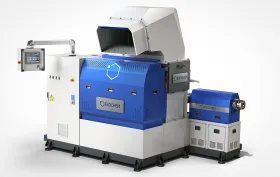
Client Challenge
A plastics processing plant faced a set of critical challenges: rising energy costs, inconsistent input material quality, and downtime caused by manual operation and lack of adaptive process control. Additionally, the company needed an effective way to process difficult materials such as films, fibers, and irregular waste streams – without material losses.
The client required a solution that would simultaneously:
- increase production efficiency,
- reduce operating costs,
- ensure consistent granulate quality,
- automate processes and reduce operator dependency.
Solution: Implementation of a SMART Line
The proposed solution was based on an integrated SMART technology system combining intelligent control, automation, and energy optimization.
Key components of the implementation included:
- intelligent material feeding (SmartFeed),
- automatic filtration and cleaning (SmartScreen™),
- advanced material transport system (SmartLiftFeed),
- real-time process monitoring (SmartDetect™),
- energy optimization (SmartSave),
- fast and automated start-up (SmartStart).
Implementation Results – Hard Data
Following the deployment of SMART technologies, the client achieved immediate and measurable results:
Energy Efficiency
- energy consumption reduced to 0.25 kWh/kg,
- energy cost reduction of up to 40%,
- significant decrease in heat losses through optimized system performance.
Operational Efficiency
- 40% reduction in line start-up time,
- 50% reduction in operator involvement,
- stable operation in both continuous and batch modes.
Product Quality & Consistency
- high and repeatable granulate quality regardless of input material,
- elimination of contamination issues thanks to automatic filtration,
- stable process parameters even with irregular materials.
Material Management
- full material utilization in a zero waste model,
- capability to process a wide range of materials: LDPE, HDPE, PP, ABS, PS, PVC,
- efficient handling of demanding waste streams such as films, fibers, and bulky materials.
Key Benefits for the Client
1. Immediate Cost Reduction
Lower energy consumption and process automation significantly reduced the cost per kilogram of production – without increasing workforce requirements.
2. Maximum Line Availability
Automatic parameter adjustment minimizes downtime and eliminates operator errors, ensuring stable and predictable production.
3. Full Control and Transparency
Real-time monitoring enables continuous analysis of energy usage and process efficiency, supporting faster and better decision-making.
4. Production Flexibility
A single line can process multiple material types – from heavy fractions to light production waste – without reconfiguration.
5. Sustainability
The closed-loop, zero-waste model supports ESG goals while reducing disposal costs.
Conclusion
The implementation of SMART technologies demonstrates that a modern recycling line is no longer just a production tool – it is a strategic basset that builds competitive advantage.
The combination of automation, intelligent control, and energy optimization directly translates into business performance:
- lower costs,
- higher efficiency,
- consistent quality,
- greater operational independence.
For the client, this means one thing: more output with fewer resources – and a fast return on investment.
-
Ekochem Sp. z o.o.
Plastic granules, thermoplastic elastomers, plastic additives, masterbatches, machines, extruders, plastic crushers, recycling and regranulation...



IPA Slovakia: What Does the Future Hold for Manufacturing Plants?
18.9.2026 New technologies, more efficient processes and strong leadership are shaping the future of manufacturing companies. How can you turn these opportunities to your advantage? Join us at the Manufacturing Management Conference, taking place on 13–14...