


Dronetag – 3D printing of cases for remote identification of drones from cotu s.r.o.
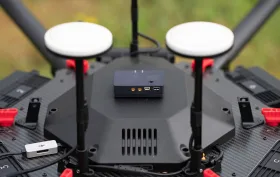
3D Printing of Durable Plastic Parts
Dronetag is an innovative Czech company focused on ensuring the safe and regulated operation of drones in airspace. It offers a modern solution for drone identification using advanced IoT devices and applications that comply with the latest regulations in both the USA and the EU. These new regulations require existing drones to be equipped with what is known as remote ID, a form of remote identification that transmits identification data during flight. This increases airspace safety and ensures compliance with local regulations governing drone use in the area.
Given that these remote ID devices are mounted directly on the drone, it was crucial for the enclosures to be made from a technologically advanced material that withstands outdoor conditions and temperature fluctuations, while also providing fine surface detail. Dronetag opted for additive manufacturing, which allows flexible design modifications and optimisation of the remote identification model. To address this challenge, the company turned to cotu®, which specialises in stereolithography 3D printing and, among other things, DLP technology.
How cotu® Decided to Address This Challenge
Technology used: Asiga PRO 4K
Material used: Ultracur3D® ST 45 B
After a thorough review of the project's requirements, cotu® identified BASF Ultracur3D® ST 45 as the ideal material. This was thanks to its low cost and excellent mechanical properties, including high impact strength and elastic modulus. This tough reactive urethane photopolymer offers long-term UV stability and high definition, ensuring the durability and fine detail of printed components. In addition to the resin itself, cotu® also decided to use BASF Cleaner, which, besides improving mechanical resistance, provides a matt surface finish, perfectly complementing the benefits of BASF Ultracur3D® ST 45.
The parts were printed using an Asiga PRO 4K printer, known for its precision and ability to produce parts with exceptional detail. This high-resolution DLP printer ensures consistent results in any production environment. With an intuitive user interface and advanced features such as SPS technology, which enables trouble-free printing without lines, the Asiga PRO 4K achieves an accuracy of 10 microns and produces detailed and durable parts.
| Dronetag – 3D printing of enclosures for remote drone identification by cotu s.r.o. |
Additive Manufacturing for Series 3D Printing
Thanks to additive manufacturing, the design can be flexibly modified, tailored to individual customers and the identification tag model optimised. Using 3D printing and Ultracur3D® ST 45 B material, it was possible to create components with an excellent combination of high strength, long-term durability and impact resistance. This technology makes it possible to produce 30 units in 3 hours (100 units per day), allowing the customer to manufacture batches of thousands of units. Compared with an alternative method such as injection moulding using moulds, which is time-consuming, expensive and difficult to adapt to design changes, this innovative solution not only meets all requirements for air traffic safety and regulation, but also allows easy customisation and mass production of identification tags for various types of drones.
During testing on various 3D printers, cotu® encountered several problems. Cheaper LCD printers had problems with image quality, often leaving streaks on the surface, and defects occurred at points where the focal areas meet. These printers also have lower output and speed, which can lead to random lines during printing. In addition, inexpensive LCD and DLP printers often produce inaccurate prints, meaning that each enclosure has different dimensions. Before series production, print jobs therefore require extensive fine-tuning so that the enclosures fit together properly during assembly and do not need laborious sanding. If the front and rear sections from the same pair are not used in production, the differences are visible. These problems are eliminated on the Asiga printer. The enclosures are identical, with dimensions that match precisely, ensuring repeatability and consistent results over time.
| Remote Drone Identification |
Dronetag's collaboration with cotu® led to the successful development and production of Dronetag Mini, the smallest, lightest and most efficient drone identification device on the market. Thanks to its expertise in stereolithography 3D printing, Cotu® helped Dronetag evaluate all stages of product development and move from conventional manufacturing technologies to more innovative solutions. This collaboration and cotu®'s know-how enabled Dronetag to develop new workflows and gain a better understanding of material fine-tuning and the development process required for the successful production of custom parts.
“We chose 3D printing to manufacture our products because this flexible technology allows us to produce miniature devices without using screws. Our products could not be made using injection moulding because of ongoing research and development, customisation, logos, modifications during development and small dimensions. Thanks to the high flexibility of the custom solution, we are able to manufacture the lightest and smallest devices in the world. Our collaboration with cotu® has been very beneficial for us, and we are already looking forward to further joint projects.” - Lukáš Brchl, CEO of Dronetag
Suppliers on this topic
-

3D Tlač - Stepanek3D
3D scanning, 3D printing, editing of 3D models, plastic atypes, custom production, small series production, production… -

SORTEC EUROPE, s. r. o.
Supply of robotic systems for large-format pellet 3D printing, custom 3D printing of parts up to 3 m, mould… -

Anton Clemens s.r.o.
Plastic injection molding, production of injection molds, plastic products for automotive, two-component injection… -

voestalpine High Performance Metals Slovakia, s.r.o.
Market leader for special steels, tool steels and other value-added services such as heat treatment and PVD coating. -

Veeser Plastic Slovakia k.s.
Plastic production for the automotive industry; plastic injection molding, plastic molding, plastic molding shop… -

LukMatic s.r.o.
LukMatic is a modern Czech company that has been providing professional services in the field of additive…


MSV 2026 brought together industrial innovation, experts and young talent – Photo Gallery, Part 2: Halls A, B and F
23.10.2026 This year’s MSV offered not only industrial technologies but also a rich programme of expert events and networking, featuring around 100 conferences and discussions. Key topics included digitalisation, artificial intelligence, robotics, technical...



Most read in the last 7 days
-
Polymer prices - october price increases partly successful, with minor corrections expected in the week ahead
-
Long-lasting solution: Radiation-crosslinked PE-Xc pipes for drinking water supply
-
Polymer prices – the increase in olefin monomer contract prices in October was in line with expectations
-
Polymer prices - Year-End Polymer Price Scenarios
-
Plastica-expo 26





Most read in the last 7 days
-
Polymer prices - october price increases partly successful, with minor corrections expected in the week ahead
-
Long-lasting solution: Radiation-crosslinked PE-Xc pipes for drinking water supply
-
Polymer prices – the increase in olefin monomer contract prices in October was in line with expectations
-
Polymer prices - Year-End Polymer Price Scenarios
-
Plastica-expo 26