


Modern incineration plant near Bratislava: solutions for waste, emissions and circular economy
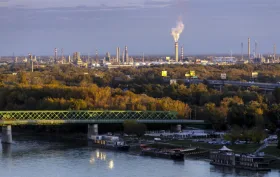
I will attempt the impossible. To explain why an “incinerator” is beneficial for Bratislava. For the city, because it will solve its industrial waste problem, reduce emissions and lessen the burden on the entire area. For the state, because it will reduce landfilling around Bratislava and also solve the industrial waste problem. For residents, because waste will be used to generate energy that will replace the burning of natural gas and reduce the refinery’s carbon footprint. For Slovnaft, because it will help reduce the use of fossil components and enable the launch of a circular economy on an industrial scale. Similar facilities in Linz and Lenzing, Austria, serve as models for us throughout the project. We have chosen the same technological solution.
The Issue of Sufficient Waste
There is enough waste. In western Slovakia, we have 400.000 tonnes of municipal waste from black mixed-waste containers and 200.000 tonnes of industrial waste. People do not really see the latter, because it goes directly from companies to landfills or abroad for recovery. OLO currently has a capacity of 165.000 tonnes, and after an investment of 200 million euros, which Bratislava has to borrow, it will have a capacity of 185.000 tonnes. Cement plants burn only non-recyclable waste with a high calorific value, so they cannot help with comprehensive disposal. They also import suitable waste from abroad. They have authorisation from the Ministry of the Environment of the Slovak Republic. Apart from the project in Skalica currently being discussed, where local residents’ opposition is very strong, no new project in western Slovakia is realistic.
Of our planned capacity of 300.000 tonnes, 100.000 tonnes will be industrial waste and 200.000 tonnes will be non-recyclable municipal waste.
We are therefore offering a solution for waste that ends up in these landfills (see the regions in western Slovakia), which are filling up. Waste Landfills: Where They Are, How Much Space They Have and How Long Their Permits Are Valid (+Map) | ODPADY-PORTAL.SK
The EU will not allow us to build new landfills. Slovakia therefore has no plan for what to do with its waste. Producing less waste is often proposed as an alternative. I agree, but unfortunately, human behaviour goes in the opposite direction. Economic growth goes hand in hand with waste generation, especially non-recyclable waste. If we already had enough capacity, why are landfills filling up? And we do not know how many illegal dumps there are in western Slovakia.
Why Bratislava and Slovnaft Specifically
Because this is where the most waste is generated and will continue to be generated. Moreover, we need to replace our old oil sludge incinerator with a new, more modern incinerator. Neither waste from all over Slovakia, as many claim, nor waste from abroad will be brought to us. It will be brought from the western region and, in the case of industrial waste, also from within Bratislava. We categorically reject the claim that we want to import waste from Hungary. In Hungary, MOL is building two large incinerators with capacities similar to those at Slovnaft, while one already exists near Budapest. These three should be sufficient to meet Hungary’s needs in terms of municipal waste. In countries where the population’s environmental awareness is higher than in Slovakia, these projects are supported and also operate in major cities. Therefore, reassurance that we will not use waste from Hungary will probably have to come at the political level in both countries, since despite our arguments, some politicians continue to keep the issue alive.
Location of a similar facility in Linz, Austria
How Does Fluidised Bed Technology Work?
CEZO will consist of two units – a facility for further sorting selected fractions of municipal waste and the waste-to-energy facility itself.
Sorted fractions of municipal and industrial waste will be collected in a hall designated for further sorting and waste treatment.
The principle of fluidised bed combustion technology is the circulation of sand heated to such a high temperature that it behaves like a liquid. The sand heated in this way burns the waste, producing gases and fly ash that can be used for further processing. The heat generated is used to produce steam and electricity.
The waste reception hall will have four fast-closing doors equipped with air curtains to prevent any escape of odorous substances during the entry and exit of trucks.
The waste treatment hall will be fully enclosed, with its own air extraction and filtration system. Extraction will also be installed above the waste shredders. After filtration, the air extracted from these zones will be used as combustion air in the combustion chamber.
Solid waste from the refinery with an elevated hydrocarbon content will be received in a separate unloading area. The material will be fed into a storage bunker through a discharge hopper with a motorised closure that prevents volatile substances from escaping. Mechanically processed waste will be fed directly into the combustion chamber via an enclosed conveyor belt.
Bulky waste will be tipped directly into a hopper with an odour-tight closure.
Waste handling will be similar to current practice at Lenzing in Austria. Lenzing – Innovative By Nature
Impact on Residents and the Surrounding Area
On the one hand, we are criticised for not taking the environmental burden on the area into account, but on the other hand, participants in the discussion do not consider our refinery decarbonisation plans, which will reduce the overall burden. Projects are already under way – the electrification of production, meaning the replacement of steam drives with highly efficient electric motors, a project to process bio-based and waste oils to produce sustainable fuels such as HVO and SAF, and the conversion of the heating plant to gas, which will reduce emissions from steam production. We are also focusing on increasing the yield of light products, improving the efficiency of furnaces and turbines, and using biogas and green hydrogen. Last but not least, we are also increasing the utilisation of our own waste gases. In terms of emissions alone, all these projects will reduce the burden on the area by at least 20 %. Slovnaft will emit one fifth fewer emissions than it does now. These projects are already being implemented.
Waste Deliveries
Waste will be transported to Slovnaft by rail siding and by road. The existing rail siding connecting Slovnaft to the Central Freight Station will be used, and the possibility of building a new rail connection close to CEZO is also being considered. Rail is crucial because waste management companies can also connect to it and locate their sorting centres accordingly. It is expected that 50 percent of the volume will be transported by rail and the remaining 50 percent by road, which means an additional 20 to 30 vehicles per day on the D4R7. This is an acceptable increase according to the waste collection study as well.
The currently smouldering landfills release enormous volumes of hazardous substances into the atmosphere, which no one monitors and which the president has recently also called for action to address. These already pose a real threat to public health.
What Will Come out of the New Incinerator's Stack?
All modelled scenarios found that CEZO's highest contributions of the pollutants assessed were well below the limit values and did not exceed 0.5 times the limit value. Model calculations demonstrated that the proposed stack height of 60 metres meets the operating parameters with a margin to spare and also meets the requirements for ensuring sufficient dispersion of emissions.
Flue gases from CEZO will be continuously monitored using an automated measuring system (AMS) before entering the stack. In addition to processing and archiving the measured emission concentrations of selected pollutants, it will also record O2 concentration, pressure, temperature and humidity at the point where emission parameters are measured, as well as the flue gas temperature.
All required emission values will be monitored continuously or determined by periodic measurements at intervals prescribed by the relevant public authority, and will be published regularly on Slovnaft's website in accordance with the law.
What about the Ash Generated during Waste Recovery?
Ash – what remains after waste recovery, approximately 25% by volume – is already in a stabilised form that can be processed further. We will transport the ash for further processing, as they do in Austria or the Netherlands. Coarse ash will be stored in silos fitted with a filter on the roof to clean the exhaust air escaping from the silo during filling, unloading and loosening. The ash will be collected by an external customer for recovery, most commonly for the production of construction materials.
Fine ash (fly ash), of which there will be substantially less, will arise mainly from the fabric filter. Its removal follows a procedure similar to that for the coarse ash silo. The fly ash will be sent for material recovery or, alternatively, transported to a waste disposal facility. This is also how other facilities around the world operate.
What Will Bratislava Gain from This?
A comprehensive solution to waste management in line with EU objectives. OLO currently supplies approximately 20 percent of Bratislava's heat demand, with the remainder supplied by the heating plant through the combustion of natural gas. So, in addition to the emissions savings at our refinery, Bratislava could boast further savings in the emissions it currently generates when providing heat to its residents. CEZO could fully cover Ružinov's heat demand for the entire year and could also supply another smaller city district. In other words, everything would be fully in line with the city's climate plan. Bratislava could also effectively dispose of the sludge produced by its wastewater treatment plants. Bratislava will have a solution for managing the waste generated by industry within its territory. And above all, Bratislava and the surrounding area will no longer create landfills as they have done until now.
Because the landfills are here, they are gradually filling up, and time is running out for Slovakia. Over time, they will start to pose an uncontrollable threat to residents. The discussion about the incinerator is also about where we want to belong. Whether in the West, where this problem has already genuinely been solved, or in the East, where waste is taken beyond the village, to landfills or to places where supposedly no one will notice it.
Bratislava can set an example because it currently has no other realistic alternative.
-

SLOVNAFT, a.s.
Production and sale of petroleum products and it´s chemical processing - production and distribution of polyethylene (LDPE) and polypropylene (PP)…

Suppliers on this topic
-

TECHLER INDUSTRY spol. s r.o.
Supplier of products for industry, manufacturing and service, such as oil separators (skimmers), lubrication… -

Klüber Lubrication Slovensko s.r.o.
Production and development of advanced, high-performance and efficient customised lubricants, expert tribological… -

Lubexpert Slovakia s.r.o.
Authorized importer and distributor of ExxonMobil products in Slovakia, greases, hydraulic and synthetic oils… -
KREDUS TECHNIK, s.r.o.
Waste management, waste recovery, plastics, plastic recycling, plastic recycling technologies. -

geba Kunststoffcompounds GmbH
Masterbatches for plastics, plastic regranulate, ABS regranulate, ABS plastic regranulate, PC, PC/ABS, PA6, PA66, TPU… -

Remarkplast compounding a.s.
Plastic compounds, plastic compounding, regranulate, plastic regranulation, construction plastics - production and…


MOL Group Expands Its Green Energy Portfolio with Bi methane Production
29.10.2026 The MOL Group has officially opened its first biomethane production plant in Szarvas, in Békés County, southeastern Hungary. The facility, representing an investment of more than €7.4 million, can produce biomethane from biogas at a purity level...

Most read in the last 7 days
-
Polymer prices - october price increases partly successful, with minor corrections expected in the week ahead
-
Polymer prices - Year-End Polymer Price Scenarios
-
Long-lasting solution: Radiation-crosslinked PE-Xc pipes for drinking water supply
-
Polymer prices – the increase in olefin monomer contract prices in October was in line with expectations
-
Plastica-expo 26





Most read in the last 7 days
-
Polymer prices - october price increases partly successful, with minor corrections expected in the week ahead
-
Polymer prices - Year-End Polymer Price Scenarios
-
Long-lasting solution: Radiation-crosslinked PE-Xc pipes for drinking water supply
-
Polymer prices – the increase in olefin monomer contract prices in October was in line with expectations
-
Plastica-expo 26